Charlie Kirk vs. Richard Reeves:  Messages To Young Men

Charlie Kirk vs. Richard Reeves: Messages To Young Men

As we process the tragic death of Charlie Kirk, let’s not debate the content of his character; instead, let’s acknowledge and understand the content and legacy of his ideas. ~ S.F.

Charlie Kirk was a powerful voice that spoke to young men in America. As author of over 10 blog posts on Richard Reeves’ book, Of Boys and Men, (introductory post on website below),

https://www.matingstraighttalk.com/visitation-of-a-crisis-in-six-parts/

I feel compelled to consider what Charlie Kirk said to men and boys and compare and contrast that with the diagnosis and solutions offered by Richard Reeves.

In this long post, I address:

  • Kirk’s message to young men
  • Kirk vs. Reeves — diagnosis and solutions: shared concerns and disagreements
  • Kirk’s blind spots related to social and economic policies
  • Criticism of Reeves diagnosis and solutions
  • Summary of agreement and disagreement between Kirk and Reeves
  • Concluding reflections: Kirk’s biblical model of marriage and the mating marketplace
  • Addendum: making matters worse — failures of the Left and the Right

What Messages Did Charlie Kirk Have for Young Men in America?

 “The biblical model for women is to have a partner who is a protector and a leader … and deep down, a vast majority of you agree.” ~ Charlie Kirk

Charlie Kirk built a substantial following among young men by addressing their feelings of alienation and insecurity with messages centered on traditional masculinity, Christian conservatism, and American exceptionalism.

Kirk’s approach combined conservative rhetoric with social media savvy, providing a sense of community for those who felt disenfranchised by mainstream culture and academia.

Embrace Traditional Masculinity and Family Values

A significant aspect of Kirk’s message was his call for young men to embrace traditional gender roles and family structures. He suggested that many of their anxieties stemmed from modern society’s erosion of masculinity and promoted a return to a “mythical past… where men were really men.” This included:

  • Prioritizing marriage and family: He promoted the traditional path of marriage and starting a family.
  • Standing up for beliefs: He encouraged young men to be bold in their convictions, offering a model of audacity that appealed to those who feared expressing conservative views on college campuses and elsewhere.

Overcome Financial Hardship and Embrace Opportunity

Kirk also presented a message of economic empowerment that resonated with young men struggling with financial concerns.

  • Rejecting poverty: He told his audience they did not have to “stay poor” or accept being “worse off than your parents”.
  • Criticizing government spending: He argued that Democrat policies and spending on foreign nations and undocumented immigrants worsened the financial prospects for young Americans.
  • Entrepreneurship over college: In some instances, he advocated for entrepreneurship as an alternative to college, suggesting that one could always return to school later.

Find Strength in Christian Faith

For many young men, Kirk’s open and unapologetic defense of his Christian faith was a significant source of inspiration.

  • His Christian conservative values resonated with followers who felt looked down upon for their religious beliefs in a mainstream, liberal-leaning culture.
  • This defense made his followers feel less lonely and affirmed their values within a supportive community.

Defend Freedom and Engage in Debate

Kirk consistently encouraged young men to engage in what he saw as a battle of ideas, particularly on college campuses.

  • He highlighted what he called the “rigidity of progressive culture.” He promoted and framed campus debates in a way that made young men feel powerful and superior.
  • He founded Turning Point USA to bring young people into the political process and spread his message of “common sense”.
  • He presented himself as a patriot who fought for “liberty, democracy, justice, and the American people” — championing American values.

Leverage a Sense of Shared Grievance

At the heart of Kirk’s message was an understanding of young men’s feelings of social isolation and anxiety.

  • Giving a voice to the voiceless: By offering seemingly simple, traditional narratives, he presented solutions to young men grappling with uncertainty in their lives.
  • Building an online and campus community: He used his platform and organization to create a community for disaffected young men, especially white men, who felt out of step with what he described as overly “woke” culture.

Charlie Kirk vs. Richard Reeves: Diagnosis and Solutions for Boys and Men

“What is needed is a positive vison of masculinity that is compatible with gender equality. We need a prosocial masculinity for a post-feminist world.” ~Richard Reeves

Charlie Kirk and Richard Reeves both acknowledge the existence of significant problems facing boys and men in modern America, including struggles in education, work, and family life.

However, their fundamental diagnoses of the root causes and their proposed solutions differ sharply, stemming from divergent ideological perspectives. Kirk would likely agree with Reeves’s diagnosis on some statistical observations but would reject his solutions as insufficient and ideologically flawed.

Shared Areas of Concern

  • Underperformance in education: Reeves highlights the gender gap in education, noting that boys are now significantly less likely than girls to earn a bachelor’s degree. This would likely resonate with Kirk, who attributes male educational struggles to an “institutionalized attack on manhood” and education policies that disadvantage boys.
  • Decline in the labor market: Both would acknowledge the economic challenges facing many men, including the decline of traditionally male jobs and the stagnation of wages for less-educated men. Kirk would attribute this to broader systemic failures by a liberal establishment, while Reeves views it as a structural challenge requiring new policy interventions.
  • Breakdown of family and social structures: Reeves identifies high rates of fathers not living with their children and the “friendship recession” among men as significant problems. Kirk would wholeheartedly agree with this diagnosis, blaming it on the erosion of traditional marriage and family values, and the rise of a “hook-up culture” driven by what he calls “radical feminism”.

Fundamental Points of Disagreement

Kirk’s “Blind Spots:” Solutions for Men and Boys in the Context of Republican Social, Economic, and Tax Policies

Charlie Kirk’s messaging to young men on economic issues often focused on personal responsibility and criticizing liberal economic policies, without addressing how Republican social, economic, and tax policies might contribute to the very problems he identified. This is a key blind spot in his analysis.

Kirk’s rhetoric framed the struggle of young men in terms of cultural decay and political opposition, but it largely sidestepped the effects of the policies his own movement championed.

Kirk Focused on Cultural Issues Over Economic Structures

Kirk’s primary focus remained on cultural issues, and he often attributed the economic struggles of young men to the “woke” political establishment rather than to structural economic factors.

  • Emphasis on individualism: He emphasized individual empowerment and entrepreneurship as a solution for young men, without a critical examination of how broader economic shifts affect earning potential, especially for those without higher education.
  • Overlooking the wealth gap: While Kirk acknowledged the financial plight of young Americans, he frequently failed to connect this to the growing income and wealth gap exacerbated by tax cuts that disproportionately benefit the wealthy.

Uncritical Support for Republican Tax Policies

Kirk was a staunch supporter of Republican tax cuts, such as the 2017 Tax Cuts and Jobs Act, which lowered the corporate tax rate and primarily benefited the wealthiest Americans.

  • Impact on young families: These policies had little to no effect on addressing the struggles of working-class men trying to achieve traditional milestones, such as buying a home or starting a family. Instead, they added trillions to the national debt, which some economists argue could lead to cuts in social services that aid lower- and middle-income families in the long run.
  • Regressive tax proposals: In August 2025, Kirk floated a flat income tax proposal, which critics quickly pointed out would place a higher tax burden on lower- and middle-income earners while benefiting the wealthy, thereby increasing income inequality.

Inadequate Solutions for Working-class Men

Kirk’s solutions often centered on a revival of traditional masculinity and rejection of perceived liberal excess, which did not adequately address the economic realities faced by many working-class men.

  • Ignoring stagnant wages: He did not provide a coherent explanation for the long-term trend of stagnant wages and reduced bargaining power for blue-collar workers. This trend accelerated during decades of Republican and Democratic deregulation and trade policies.
  • Lack of policy substance: His message lacked concrete policy proposals to address the declining manufacturing sector or the rising cost of living, which are significant economic hurdles for the demographic he targeted. Instead, he blamed political opponents and cultural forces.

Blind Spots Regarding Social Policy

While Kirk preached the importance of traditional family roles and male leadership, the specific Republican social policies he supported could undermine the stability of working-class families.

  • Undermining the social safety net: Some Republican welfare reform proposals, including work requirements for welfare recipients, have been criticized for disproportionately harming low-income families and making it more difficult for men with fluctuating employment to access benefits.
  • The cost of basic needs: Republican tax cuts and deregulation have been criticized for increasing the cost of necessities, such as healthcare, potentially putting more strain on families and undercutting the very stability they were intended to promote.

Disconnecting Economic and Social Issues

Kirk’s rhetoric tended to compartmentalize economic and social problems, treating them as separate issues rather than interconnected ones.

  • The cost of traditional life: The high cost of housing, healthcare, and education—aggravated by many Republican economic policies—directly contradicts Kirk’s idealized vision of young men achieving traditional life milestones, such as home ownership and starting a family. By not acknowledging these connections, Kirk’s solutions appear disconnected from the real economic pain experienced by his target audience.
  • Ignoring data on marginalized groups: His focus on cultural grievances often obscured the disproportionate economic impact of specific policies on marginalized communities. For example, some analysts suggest Republican economic policies negatively affect Black households more significantly, a blind spot given Kirk’s focus on a predominantly white male audience.

Criticism of Reeves’ Diagnosis and Solutions

Many reviewers concede that Reeves brings together a substantial amount of data and that the phenomenon of male underperformance (on specific metrics) is indeed real. The question is not “is something wrong,” but “how much, why, and what to do.” So, criticisms are less about denying the basic facts and more about challenges in interpretation and in solution design.

  • Some critics argue that Reeves’s proposals may have unintended consequences or overlook trade-offs. For example, starting boys’ school a year later raises questions about the size of the potential advantage to boys. And there are concerns about its feasibility, cost, and the impact on girls, and how it interacts with existing policies. While it is clear that starting school later makes some sense for the cognitive maturation of boys, Katha Pollitt in The Nation (as Left as you can get) says it is a terrible idea because that means boys in middle and high school would be bigger, more sexually developed, and therefore a threat to girls.
  • Also, critics note that Reeves is relatively mute on promoting marriage or more traditional family structures compared to what some believe the data suggests would help. But as noted below (see Conclusion), Reeves was afraid of criticism from the feminist Left on that issue, the male sexual deficit, and inequality in the mating market.
  • Critics also question the political feasibility of some of the solutions and their long-term implications. For example, reforming custody systems, changing the school start age, training more male teachers, etc., are costly, difficult, and may be politically controversial.

Summary of Agreement and Disagreement

In short, Kirk and Reeves would find a superficial agreement on the symptoms of the problems facing men—that men are struggling in school, work, and family life. However, this is where the alignment ends.

  • Agreement:
    Men are struggling, and this struggle is observable in educational and economic data.
  • Disagreement:
    They hold opposing views on the fundamental reasons for the struggle and completely different philosophies for addressing it. Kirk views the problem as a cultural and spiritual battle against progressive ideology, while Reeves sees a need for pragmatic, evidence-based policy adjustments to outdated institutions. Kirk would likely dismiss Reeves’s solutions as “woke” or incremental, while Reeves would likely find Kirk’s cultural war rhetoric unhelpful and divisive.

Conclusion: Reflections on Mating Marketplace and “Biblical Model”

Neither Reeves nor Kirk directly addresses (like Scott Galloway) the problem of many young men finding partners for sex or marriage, especially as it relates to female preferences and behavior within a mating marketplace. That topic was, admittedly, too “hot” for Reeves, who was already in trouble with progressives.

Biblical Model Resonates with Evolutionary Adaptation

But the Kirk sentiment (quote above) about the biblical model* for men as “protector and leader” is congruent (in part) with aggregate studies in evolutionary psychology, mate selection science, human reproduction, and recent on-the-ground surveys of female mating preferences. While the need for male protection might be debated and resisted, male “leadership” and confidence are critical traits for a successful heterosexual partnership even in a “post-feminist” world.

I am a liberal, social progressive. Yet, Kirk’s assertion (in various videos and podcasts) that men’s well-being may be tied to a marriage (or a committed romantic relationship) that includes children and the experience of being a successful provider resonates as true.

This does not need to be an endorsement of traditional male-female roles. Or imply that the women involved are not also providing and being empowered. We do not need to couch it in a biblical context. This is just the evolutionary and intrapsychic wiring of heterosexual men.

Deep Down

When Kirk says, “deep down you agree” (see quote above), this call for male leadership (and the capacity to “protect-provide”) shows up as largely true among heterosexual women of child-bearing age in my experience and studies. “Deep down” means an “ultimate cause.”** Resisting this truth is mostly “undiscussable” on the political Left.

Traditional Marriage – “Nice Work If You Can Get It”

Kirk’s traditional (biblical model) marriage may be a great aspiration, but first, a man must be seen by women as marriageable – he must be chosen. Not being chosen is an epidemic among men. Sexual deprivation and lack of romance and intimacy are, for many men, a part of their alienation and sense of hopelessness. Neither Kirk nor Reeves would dispute that. We all suffer the repercussions of male alienation (especially from alienated men who own and are familiar with guns). Perhaps Kirk lost his life (in part) because of it.

*Obviously, and problematically, this model leaves gay, lesbian, and other queer folks in the wilderness to fend for themselves.

**Ultimate causes of human behavior and psychological processes are causes that were adaptive for survival (natural selection) or sexual selection for our ancestors, most of which occurred during the Pleistocene Epoch.

Addendum: Politicians Making Matters Worse: Failures of the Left and the Right

There is a political stalemate on issues of sex and gender in America. Both sides have entrenched themselves in an ideological position that hinders genuine change. Views on what it means to be a man in the twenty-first century have hardened along partisan lines. But as Richard Reeves writes in Of Boys and Men:

“We can hold two thoughts in our heads at once. We can be passionate about women’s rights and compassionate toward vulnerable boys and men.”

Politicians Are Making Matters Worse

Progressives refuse to accept that important gender inequalities can run in both directions. They dismiss legitimate concerns about boys and men and pathologize masculinity.

Conservatives appear more sensitive to the struggles of men and boys, but only as a justification for turning back the clock and restoring traditional gender roles. The populist Right weaponizes male dislocation and offers false promises.

Failure of the Left and the Right

“The failure of both Left and Right to respond to the growing problems of boys and men has created a dangerous vacuum in our political life. In the dynamics of culture-war politics, the more the Right moves to the extreme, the more the Left must move to the other side, and vice versa. The Left dismisses biology; the Right [perhaps] leans too heavily on it. The Left sees a war on girls and women; the Right [less ardently or clearly] sees a war on boys and men. The Left pathologizes masculinity; the Right pathologizes feminism.”

~ Richard Reeves

Please Note: Your comment may take up to 12 seconds to register and the confirmation message will appear above the “Submit a Comment” text. 
The Price of Love? The Movie ‘Materialists’ Keeps It Real

The Price of Love? The Movie ‘Materialists’ Keeps It Real

I’m looking for a man in finance – trust fund, 6’5”, blue eyes.”
~ Man in Finance* – music by Billen Ted

 Sometimes a movie or TV show comes around that I must acknowledge and comment on.  Poor Things got my attention. And Barbie got everybody’s attention and two posts from me.

Now comes the Materialists by writer and director Celine Song — a follow-up to her Oscar-nominated Past Lives.

Materialists is an innovative, sophisticated exploration of modern romance and indispensable fodder for ruminating about the tensions and ambivalence in choosing a mate, roughly posed as a practical polarity: to marry for love or money? The story is modern, but the opening scene begins with a prehistoric “couple.” Song shows her cards early: courtship rituals and love are ancient; connection can be spiritual and nonmaterial.

Mating Preferences and Psychological Undertow

Song dips her toes into the waters of class and beauty privilege but not as deeply as the subject ultimately deserves. She does, however, take a daring plunge into the murky and muddy psychological undertow of male and female mating preferences.  In New York City (if not everywhere), some of these preferences are crystal clear. They elucidate economic and biological mandates — the components of assessed mate value in a fickle mate-selection marketplace.

Unvarnished Truth About Matchmaking and Mate Selection

Dakota Johnson as Lucy is a successful matchmaker in present-day New York City. That dating market is notoriously cruel and competitive. Lucy works with entitled upper-class folks.  The men want beautiful women; the women want successful men.  These are bedrock evolutionary directives. Lucy’s clients are picky, but Song’s script courageously (and correctly) displays the longer list of female requirements. The dialogue in this movie is some of the best writing ever.  Many uncomfortable truths (what I call “undiscussables”) are told about the exchange or “contract” between men and women in the mating marketplace.

Checking the Boxes in the “Contract”

Materialists tells the truth about the erotic-economic bargain and “checking the boxes” for the promise of this exchange.  Song shows the exhaustive list of boxes required by women, especially in the context of their self-referential beauty and expected economic entitlement.  It is about, as Lucy says, the “math” of relationships. This story is perennial in the canons of literature and history: marriage has often been an economic contract and business relationship between families of wealth.  (Currently illustrated with aplomb in the HBO show The Gilded Age.)

 Harry is a “Unicorn” and John Is Poor

Harry (Pedro Pascal) is a tall, wealthy, handsome financier– a “unicorn” in the lexicon of matchmaking. Lucy wants to find him a match.  Harry thinks Lucy IS his match. Lucy broke up with John (Chris Evans) because he was poor. Well, Harry isn’t poor. He puts on smooth full-court press for Lucy.

Courtship Math: Houses, Trips, and Food

Harry has a 11-million-dollar loft in Tribeca. Lucy loves the satin sheets.  John has a small, messy apartment with chaotic roommates. Harry offers Lucy a predictable early courtship gift – a trip to Iceland.  (This gives guys like Harry a longer “interview.”)  At the end of the movie, John gives Lucy a car trip upstate with the new money from his play.  John loves food trucks (who doesn’t) but Lucy loves the way Harry deftly and graciously picks up the bill at expensive restaurants. That confident “dance move” of providing turns her on.

Harry’s Speech at Dinner

Song’s message about love and money resonates with pivotal scenes and dialogue.

Harry’s speech at dinner with Lucy is a critical piece of messaging from Song.  Harry makes it clear; he could not care less about Lucy’s status in the job world or the money she makes; he does not need money from her.  Nor, is it solely because of her beauty that he is interested in Lucy. (Even though it was evident that her beauty was the only reason that Harry wanted to get to know her.  Lucy’s beauty absolutely opened that door).

 “Intangibles”

Harry recognizes Lucy’s wisdom, her insights, and her clarity about how the world works.  She is street smart like he is.  It is her “intangibles” that make her special, Harry asserts. Harry’s perceptions are on target and raise his stature as a sensitive and mature person.  He is not a vapid, boring rich guy. He delivers this communication to Lucy with confident power.   Song wants us to appreciate the nuance in attraction and mate selection. Listen up, she says: not all rich guys are superficial, and there are “intangibles” in this biochemical soup.

“You Make Me Feel Valuable”

Then the conversation at dinner gets even better.  “What do you like about me?” Harry asks. “You make me feel valuable,” Lucy replies — another key insight about relationships from Song. Women want to be seen and feel valued for who they are on the inside.

“You Are Not a Fish”

Lucy is cynical about her job. She detests her clients as “children” in one breath but cares about them the next.  When one of her female clients gives Lucy a long list of requirements she wants in a man, the client adds, “I am a real catch.”  This is a pregnant moment for Lucy and the movie audience. Will Lucy tell this woman the truth about her overblown mate value?  Lucy says, “No, you are not a catch, because you are not a fish.

Fudging the Truth of “Hot or Not?”

The fish line (excuse the pun) is Lucy’s first and best lie in the movie. She retains her professional composure. She cannot tell this woman the truth about her diminished mate value and misplaced entitlement. This client is not a catch because she is overbearing; her beauty is average at best. I wanted Lucy to say that, but Song is aware of how tricky the truth is in matters of personal perception of mate value. Who among us wants to look into a mirror and grapple with the question: “Am I hot, or not?”

“Love Must Be Present”

Lucy is cynical and romantic about relationships and marriage. This duality can’t be helped; in Materialists, that’s the point.

Lucy tells Harry, in a matter-of-fact tone (no hesitancy or bullshit), that she is not in love with him and asserts that he does not love her (which he does not refute).  Harry is not sure he knows how to love. Lucy says, “Love must be present.”  This is another pivotal piece of dialogue about the tradeoff dilemma we are trying to resolve.  Lucy is, at that moment, a romantic.

The Privilege and Problem of Height Bias

Most of Lucy’s female clients want a man who is at least six feet tall.  The percentage of men in the U.S. who are six feet or taller is 14.5%.  Here, Song is really in alignment with the hard facts of female preference for a mate. Harry gives Lucy a profound lesson on height privilege for men and what it is like for a man to be short.  He freely discloses about his leg lengthening surgeries (apparently, a real thing). Harry knows he would not have had the confidence to approach Lucy at 5’6”.  He would not have made as much money or been treated with as much respect if he were short.  Lucy softens and probably cares most about Harry in that moment.  They feel closer.  When they part, she tells him he is “perfect.”  But is she being truthful?  Or just compassionate?

Love or Money?

Materialists confronts the enduring question: “Should one marry for love or money?” Song deftly and correctly illustrates that both preferences are inside of a woman, or at least inside of Lucy, even when she at times denies it.  But in the “war on the ground” of mate selection, a man’s status, resources, and stature will usually win the “first battle” of courtship.  Initially, character is often secondary.   Feelings of sexual chemistry and love are frequently fused together and even rationalized after the fact. Yet, the tradeoff dilemmas of love versus money and money versus character simmer underneath for many women, always nagging.

“I Want Someone Who Cannot Help But Love Me”

When Lucy and John go to save Sophie (a client who suffered date assault) near the end of the movie, Sophie gives the transformational final statement of the movie.  She says, “I want someone who cannot help but love me.”   (That line resonated with me.) This is a lightbulb moment for Lucy. A few minutes later, John essentially tells Lucy that he does love her exactly that way. No matter what, he cannot help but love her.

John Will Strive Harder to Be Good Enough

John says he will strive harder to be good enough for her. He emphasizes his ambition for his career and the desire for increased financial stability. Lucy leans into her romantic side and the chemistry she feels for him.

The Tradeoff Question is Left Unresolved – That is Real

Ultimately, Lucy seemingly chooses love over cynicism and her need for a secure, upper-class lifestyle. But she never really disavows the need for financial security. Will her love for John sustain her?

Polarity to Manage, Not Resolve

Song wants us to know that the central tradeoff preference for women —intimacy, risk, and passion vs. financial security —is a polarity to manage, not resolve; she keeps it real. (Is this trade-off often necessary?  Topic for another day.)

Meaning In Non-Material Things

Materialists clearly embraces the struggle to seek meaning in non-material things.  As John and Lucy embark on their next chapter, John presents Lucy with a flower ring, just like the caveman did in the opening scene.

The Postscript: “A Good Match”

The movie ends with the message that love can win the day … for now. But as a final follow-up to the Sophie plot line, we learn that she finds a match.  Is it someone who cannot help but love her?  Perhaps, but Lucy does the math: Sophie’s new beau is a dentist who clears $ 200,000 a year after taxes.  “A good match,” Lucy says.

*Looking for a man in finance
https://www.youtube.com/watch?v=RUzgVapnc3U


Addendum – AI-Chat GPT Offers Insights

Prompt:

“Give an analysis of the movie Materialists in addressing the conflict between financial security and love in choosing a mate.  Does Celine Song give us answers and direction?”

Chat GPT had a lot to say, but most importantly:

“Song’s brilliance lies in reframing the love vs. money dilemma not as a question of “right or wrong,” but of what one is willing to trade off:”

  • Choosing love may mean choosing risk, instability, and dependence on emotional reciprocity.
  • Choosing money may mean sacrificing mystery, passion, or the freedom of not being beholden.

Celine Song’s Materialists is less a guidepost and more a meditation on the paradoxes of modern love. She does not give answers, but she sharpens the question. Her signature touch is a blend of moral ambiguity and emotional realism.

Song dignifies the dilemma of modern love, offering a rare empathy to those navigating love in the shadow of economics. Rather than condemning or romanticizing, she portrays the modern mate market with clear eyes and a full heart.

Chat GPT offered a bar chart of tradeoffs comparing the perceived benefit of love vs. money across the following six dimensions:

1. emotional fulfillment  – love wins by a large margin

2. sexual chemistry – love wins by a significant margin

3. stability and security – money wins by the second-largest margin on the chart

4. autonomy and growth – love wins by a small margin

5. social status – money wins by a large margin

6. future risk, a negative – love brings greater risk by the largest margin on the chart

Please Note: Your comment may take up to 12 seconds to register and the confirmation message will appear above the “Submit a Comment” text. 
Why Do Some Feminists Oppose Evolutionary Psychology?

Why Do Some Feminists Oppose Evolutionary Psychology?

Seven Reasons Fueled by Denial of Sex Differences — Let’s Talk About Them

There exists overwhelming evidence for evolved sex differences in human psychology. Rejection based on the misperception that they interfere with the goal of achieving gender equality degrades science and delays scientific progress.
~ David Buss and William von Hippel, Archives of Scientific Psychology (2018)


Evolutionary psychology (EP) is the study of human nature—meaning, the study of evolved psychological mechanisms or psychological adaptations. Adaptations are a product of evolution by natural and sexual selection that allow the human species to solve particular problems, most importantly, the problems of survival and reproduction.

So, why do some feminists oppose evolutionary psychology?

Evolved behavioral sex differences are seen as a barrier to progress for gender equality.   I will expound on this and cite six additional reasons that explain the psychological denial and political rationale for this opposition, addressing sex drive, “erotic capital,” objectification, and cues for fertility.

I suspect this post will trigger discomfort for “some” women.

Support of Feminist Political Objectives

I do not dislike “feminists.” I feel alignment with defenders of women’s rights and freedom of expression in all social and business arenas.

For this post, I will identify those defenders as feminists and speak specifically to female feminists. I am not making assertions about all feminists and certainly not all women.

I realize feminism can mean many things.

To be clear, I support women’s empowerment and nearly all “progressive” political positions women take. (The cause of the wage gap is an important exception.)

Aggregate Differences Between Men and Women

I believe in the aggregate biological and psychological differences between men and women, as revealed by thousands of years of adaptation for sexual selection, reproduction, and survival. These are essential tenets of evolutionary psychology.

In aggregate, men and women differ in physical morphology, emotions, behavior, cognition, hormones, brain structures, and many mechanisms for mate selection and sexual psychology.

Inequities Will Not Be Rectified by Denying Difference

While I agree with feminists politically, I am unwilling to ignore the evolutionary science of mate selection and capitulate to all versions of modern “wokeness.”

I will not rethink the interdependency of “nature-nurture” by elevating nurture over nature.

In matters of human reproduction, nature does trump nurture by more than a little bit, and that reality may not serve feminist political ends.

Furthermore, we will not rectify historical power inequities endured by women by blurring the distinction between biological males and females.

Seven Reasons Why Feminists Oppose Evolutionary Psychology

1. Feminist theory and activism consider the proposition of evolved behavioral sex differences as a barrier to progress for gender equality.

Evolutionary psychology has long been entangled in the philosophical debate of nature versus nurture. EP does not align with the “cultural determinist” or “blank slate” perspective that has dominated the social sciences for 50 years.

However, sociocultural and evolutionary explanations are not necessarily at odds with one another.

Evolutionary psychology explicitly identifies how nature and nurture work together.

“Nature” is not an excuse for bad behavior or the oppression of women. Feminists need not fear the terrain of evolved behavioral sex differences.

The following reasons for opposition to EP follow from this first one.

2. Feminists do not want to accept that men (in aggregate) are more sexual than women.

The fact that men are more sexual than women is supported by evolutionary psychology, evolutionary biology, and every relevant measure of cognition and behavior.

Such research does contradict a singular belief in a sociopolitical and environmental causation of female sexual behavior but need not conflict with a feminist narrative of female sexual empowerment.

There is no need for judgment about male or female sexuality. Female sexuality is more fluid and complex than male sexuality, but that, too, is not to be revered in comparison to men.

3. Feminists do not want to acknowledge that women use sexual power for economic ends — both consciously and unconsciously.

Sex work by women is historically ubiquitous.

But studies also reveal the utility of female sexuality and physical beauty for mate choice hypergamy*, career trajectory, courtship gifts, and receipt of helping behavior in most social interactions and domains of commerce.

Social psychologists and evolutionary psychologists have observed this dynamic. Daniel Hamermesh wrote the book on it: Beauty Pays.

Author Catherine Hakim (Honey Money) calls this “the power of erotic capital.”

Feminists commonly deny the operation of erotic capital.

4. Feminists do not want to admit that women already control men through sex.

Women cannot as easily scream about patriarchy if women control individual men so thoroughly through sex. The Lysistrata phenomenon (“stop fighting or no sex”) is not just a Greek comedy.

Women’s control of men as a gatekeeper to sexual access stems from a simple supply and demand imbalance in mate selection and the differences in sexual initiation by men versus women.

Women are in great demand; interested men are in great supply. Sperm is cheap; eggs are expensive. EP reveals this adaptive feature of human sexual reproduction.

5. Feminists do not want to admit they want to be “objectified” sometimes.

“Objectified” in this context means being “desired with abandon” — a sexual lust that plays consciously with the polarity of subject and object. (Mutual consent is an obvious precondition.)

Preeminent researcher in women’s sexuality, Marta Meana, says, for women, “being desired (being an “object”) is the orgasm.” Evolutionary psychologists, relationship experts, and sexologists understand this.

Women’s sexual desires may include submission — using “role-play” to release control and temporarily suspend responsibility. Submission can be a turn-on and a form of freedom.

Transgression can be erotic, according to international relationship expert Esther Perel.

Feminists may not want to acknowledge their participation in sex play that incorporates a dominance hierarchy.

6. Feminists do not want to admit they want a man who has the capacity to protect and provide.

Heterosexual feminists, like most women, prefer to mate with men who have status, resources, prestige, physical stature, and dominance. (Character and intelligence are always in the mix. Feminists may set a higher bar for men in those realms than the “average” woman.)

The preference for a relatively “high status” man is a “politically incorrect” yet hard-wired female mating strategy predicted by evolutionary psychology.

Here, we see a potential double bind imposed on men: a woman wants a man willing and able to provide and protect while presenting herself (correctly) as independent and self-sufficient.

7. Feminists often deny the truth about cues for fertility that come from the science of body shape, symmetry, facial metrics, skin, and hair.

It is critical for female empowerment (it would seem) to pretend that male attraction to the .7 waist-to-hip ratio is not scientifically proven.

Or that it is some kind of cultural/media artifact — that obese women are as beautiful and sexy to men as fit, youthful women or should be.

Some women need to deny that men are naturally attracted to youth.

Yet, there is broad agreement across all cultures about most signifiers of female beauty associated with youth and fertility.

Women in general, and especially women in their 50s and older, may convince themselves that mate selection science is bogus because the alternative is too psychologically painful.

Women secretly (or not too secretly) are glad for the tremendous erotic power rendered by their youth and beauty in their 20s but want to deny that power exists when they no longer have it themselves.

Embracing Differences Empowers Both Women and Men

This post attempts to surface controversial (and largely “undiscussable”) topics addressed by evolutionary psychology and the science of sexuality and mate selection.

If told through the lens of personal experience and handled with grace and patience, these conversations can deepen empathy and connection between heterosexual men and women and empower both sexes.

Here’s the takeaway — talk to each other and listen with curiosity.

Epilogue: The Political Moment

We are entering a moment in American politics when gender tension will be severe.  According to Derek Thompson of the Atlantic (“What Is America’s Gender War Actually About”), the GOP is selling itself as the “testosterone party” with a version of “alpha-victim masculinity.”

As strongly as feminists may oppose evolutionary psychology, I equally oppose that version of masculinity.

In March 2024, the Views of the Electorate Research Survey found 39 percent of men identified as Republicans versus 33 percent of women—a six-point gap. However, when the survey asked participants how society treats, or ought to treat, men and women, the gender gap exploded. The gender-attitude gap was six times larger than the commonly discussed gender gap.

I do not want to exacerbate tension with this post. Discussing the reasons for opposing evolutionary psychology and the differences between men and women is challenging. But, to borrow from Robert Frost, maybe “the only way out is through.”

*Hypergamy is a social science term that describes the act of marrying or dating someone who is considered to be of higher social status, wealth, or sexual capital than oneself. It can also refer to the practice of continuously trying to replace a current partner with someone who is seen as superior.


Please Note: Your comment may take up to 12 seconds to register and the confirmation message will appear above the “Submit a Comment” text. 
Sperm Are Cheap – Eggs Are Expensive

Sperm Are Cheap – Eggs Are Expensive

“Men tend to want many more sex partners than women do.”
~ Susan Hughes, Archives of Sexual Behavior (2021)


Most of my writing these days is in response to authors on Medium who write about relationships, gender, and sexuality. This community is 80% female. Their “voice” leans feminist and culturally progressive. Carlyn Beccia has been a favorite in this space. She covers many subjects, deeply considered with humor and aplomb — writing that sparkles underneath her own unique illustrations. Occasionally we butt heads; she dismisses and sometimes denigrates evolutionary psychology (EP) and my understanding of mate selection science.

Her latest piece was “Nature Makes Men More Promiscuous is an Evolutionary Biology Myth.” This piece is mainly about the number of sex partners reported by men and women. Beccia asserts that men and women are equally promiscuous, as revealed by research from evolutionary biology. I could not let this go unchallenged. Below is my response to her. My post would make more sense if you read her piece, but I think my statements of fact and opinion stand alone in their retort and rebuke.

Promiscuity Assertions Hurt Women More Than Men.

Becca’s first point. I agree. “Slut-shaming” is unfair and uninformed.

Darwin Revisited

Charles Darwin was not right about everything related to non-human species. Still, in the human population, he was right in his speculations about male desire and interest in multiple partners for sexual reproduction.

“Just So Stories” — An Old Criticism of EP Methodology

“Just so stories” is a “bullshit” (using Beccia’s aggressive word choice) and snarky framing of evolutionary science methodology – a worn-out trope. What Beccia describes as a “just so story” (women’s biological investment in children, etc.) is the way it is. Yes, as Beccia notes sarcastically, “sperm are cheap, and eggs are expensive.”

Women Are More Choosey – Full Stop

Women are more “choosey” than men for sexual partners. This comports directly with the evolutionary science of sexual selection and pretty much every single study of modern sexual selection dynamics, including the latest studies of dating apps. To think otherwise is indeed “bullshit.” (Speaking to Beccia) “hell, use yourself and your girlfriends as anecdotal evidence.” Men find the majority of women attractive. Women find the majority of men unattractive.

Women Are Just Not as Promiscuous as Men

Women are just not as promiscuous as men; that would make no sense for children’s survival and the need for paternal certainty. (I will not itemize here the numerous studies that show the difference between men’s and women’s sex “drive” as evidenced by thoughts, fantasies, spontaneous arousal, masturbation, and willingness to engage in sex.) Interestingly, Beccia and other female authors want to take on the badge of promiscuity. To prove what point? A sign of female empowerment? A way to assert that there are no sexual or biological differences between men and women?

Women Do Have More Opportunity

Women have enormously more choices, sexual access, and sexual opportunity than men, but they generally do not act on it. Sexual opportunity is different from a sexual mating strategy. Men and women are typically on opposite sides of that coin.

Rates of Infidelity and Number of Affairs

Rates of infidelity are indeed narrowing between men and women. Recent studies show that men cheat with a more significant number of partners, and women are choosier even in this domain, typically having a single affair.

Numbers on the Bed Post

EP researcher David Schmitt studied 16,288 individuals residing in 52 nations and found that men said they wanted 1.87 sex partners over the next month; women wanted only .78. (He also found agreement of findings across all nations and cultures.)

Ten Partners or One Partner Ten times?

Susan Hughes’ research (2021) in the Archives of Sexual Behavior found (in a very clever design of choosing, in a continuum, between sex with one partner ten times vs. sex with ten partners one time) “in most cases, the women allotted all ten dates to only one or two men.” Concluding, “The results of this study seem to confirm the observation that men tend to want many more sex partners than women do.”

Male Overestimation and Over-perception Bias

Yes, men overestimate the number of their partners, and women underestimate their number because of the bias against female promiscuity. Men’s inflation is somewhat related to the psychological phenomenon of over-perception bias – a belief that women may possibly (aka the movie Dumb and Dumber) be interested in them romantically and sexually. This sexual section phenomenon is related to error management theory; a man cannot afford a false negative result: NOT pursuing a woman (egg) who might otherwise be interested if a pursuit had taken place.

The Difference in Reporting Numbers of Sex Partners Has Four Causes

1. Promiscuity bias (above), also cited by Beccia in the Alexander and Fisher “bogus pipeline” study. That study had an unimpressive subject sample of 293 General Psychology students.

Most Importantly!

2. Women are having sex with the same lucky small subset of men.

Studies from dating apps reveal that the top 78% of women are fighting over the top 20% of men.

Essentially, multiple women are having sex with the same man: one man has sex with five women. He accurately reports five partners. Each of the five women accurately reports one partner.

Reproductive Variance

Reporting of the number of sex partners is not only influenced by the overreporting by men and underreporting by women but, more importantly, by the operation of a “micro” version of the macro reproductive variance phenomenon, i.e., more women are having sex than the number of men having sex, by perhaps a large margin. Researchers call this the modern male sexual deficit. The number of women who have sex is more than the number of men who have sex.

More Mothers Than Fathers Throughout History

The macro reproductive variance refers to the variability of reproductive success for human females and males throughout human history. The difference between men who do not reproduce (the have-nots) and those who reproduce prolifically (the haves) is vast. DNA studies by Jason Wilder and colleagues revealed that approximately 80% of women in human history have reproduced (have children), compared to 40% of men. More women are mothers than men are fathers. The human population is descended from twice as many women as men. A few men are siring many children (the Genghis Khan effect).

College Dating Environment – Slightly Better Deal for the Average Guy

One unique dating environment (mating pool) is on modern college campuses, where the sex ratio is approximately 60% women to 40% men. On college campuses, women lower their standards a little bit. They are slightly less choosey. With that ratio, more men of lower mate value/attractiveness get to have sex than in the average population. But even there, the most attractive guys get most of the action.

On the Other Hand – More Women Are Having Sex With Each Other!

3. The mathematical asymmetry of the number of reported partners by men and women (in some reports) is also because more women are having sex with women and not men!

4. Finally, according to Kristen Mitchell (Journal of Sex Research), men might include non-penetrative sexual encounters in their tally of sex partners. Women did not. Hey women, cunnilingus and fellatio are not sex?

Male Promiscuity Can Negatively Affect Genetic Legacy

It is true (as Beccia implies) that there is a point at which male promiscuity negatively affects the survival of his children. Children need the support of both parents to secure a genetic legacy.

Will Not Debate Bateman’s Principle Here*

I will spare the reader an attempt to unpack Beccia’s assertion that geneticist Angus Bateman cherry-picked his data or the integrity of Patricia Gowaty’s biology lab at U.C.L.A. But I don’t believe the studies of fruit flies or even other primates are decisively instructive or preclude the vast evidence related to human sexual selection and reproduction. Yes, the research on the mating habits of non-monogamous female birds is notable, but birds are not homo sapiens. Humans have a 9-month gestation and prolonged infant dependency.

The Coolidge Effect** Is Real

But if you want to use primates, the Coolidge Effect holds up. And it is operative for human males. Novelty works for both sexes, but it is compelling for human males. Beccia’s post does not really dispute the truth of the Coolidge Effect. It is worth noting that women need more novelty inside a pair bond than that required by a man because male sexuality is less complicated.

The Honeymoon Effect

The “honeymoon effect” – bonds caused by the “love hormone,” oxytocin, is also real. But oxytocin is more instrumental to women’s sexuality and sexual functioning than to men’s. (This leads to the conversation about the female orgasm as a male mate selection strategy –- female orgasm increases the chance of being chosen and being retained as a mate.)

Honeymoon Effect Coexists with Coolidge

Bottomline: the honeymoon effect does not preclude the male need for partner novelty; it does not contradict the operation of the Coolidge Effect.

What is Beccia’s Beef – Really?

Finally, I do not understand Beccia’s psychological schema around these issues. Why does she refuse to accept the evolutionary and biological science of human sexual selection and human sexuality? Why does she misrepresent the claim and evidence of evolutionary psychology? EP is not “bullshit.” “Boys will be boys” is never uttered by reputable researchers in this field. Beccia is an empowered woman. She is probably sexier and more sexual than average. Good for her. Many men desire her, no doubt (she is quite attractive), but I bet she chooses very few. Beccia probably exists on the robust side of the bell curve from the average woman in terms of sex drive/desire, access, and socio-sexuality.

Rectify Inequities – But Don’t Blur Biological Distinctions Between Male and Female

I have studied the hard biological science of aggregate populations throughout human history. I study researchers who do not, as a rule, have an agenda or bias to shape the nature-nurture debate in favor of women to rectify historical power inequities. The Beccia post is representative of this bias. Let’s rectify power inequities without blurring the biological distinctions between males and females. 

*Bateman’s principle (in evolutionary biology): since males produce millions of sperm cells with little effort and females invest much higher energy levels to nurture a relatively small number of eggs, the female plays a more significant role in their offspring’s reproductive success. Bateman’s paradigm views females as the limiting factor of parental investment, over which males will compete to mate successfully.

**The Coolidge effect is a biological phenomenon seen in animals whereby males exhibit renewed sexual interest whenever a new female is introduced, even after sex with prior but still available sexual partners.


Please Note: Your comment may take up to 12 seconds to register and the confirmation message will appear above the “Submit a Comment” text. 
Gamma Bias: Cognitive Distortions About Sex and Gender

Gamma Bias: Cognitive Distortions About Sex and Gender

“Although we live in times where we rightly talk about the conscious and unconscious bias against women, we are not yet conscious of our biases against men.” ~ Martin Seager and John Barry

A bias is a prejudice in favor of or against a thing, person, or group usually considered unfair, misleading, or a direct distortion of the truth.

“Gamma” bias is a form of cognitive distortion that builds on the existing concepts of alpha bias and beta bias. Alpha bias is the magnification of gender differences. Beta bias* is the minimization of gender differences. Gamma bias illustrates how these opposing distortions can operate simultaneously.

Gamma Bias and Gender
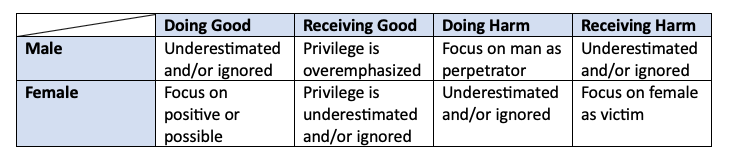
Gamma bias is a form of cognitive distortion that operates within a matrix of four possible judgments about gender**: 
  1. Doing good (celebration/valuing)
  2. Doing harm (perpetration)
  3. Receiving good (privilege)
  4. Receiving harm (victimhood)
Gamma Bias has an Ugly, Unfriendly Face

As described recently by British psychologists Martin Seager and John Barry in “Gamma Bias: A New Theory” (The Psychologist), the theory predicts:

  • Within mainstream Western cultures, masculinity is highlighted only in the domains of privilege (receiving good) and perpetration (doing harm).
  • Masculinity is hidden in the domains of celebration (doing good, heroism, etc.) and victimhood. Heroism may be gender neutralized (“firefighters”), and male victimization by women domestically is excluded in gender narratives.

Effects of Gamma Bias on Men and Women 

  • Men receive less credit for doing good and less support for being victimized.
  • Women receive more significant support for being victimized and are held less accountable for being perpetrators.
Summary of Four Judgments Related to Gender
revised gender distortion matrix
Female Privilege is Ignored in Gamma Bias

Though not explicitly addressed by Seager and Barry, female privilege (female receipt of “good” benefits) is almost entirely unaddressed because of gamma bias. This is a critical oversight for understanding the preeminence of female choice in mate selection as a gender-specific privilege.

This privilege is demonstrated by the exchange of sexual access (fertility) for resources and security inherent in the unconscious sexual psychologies for reproduction and childrearing — the supply and demand dynamics of millions of sperm (and hundreds of men) chasing one, quite privileged egg. Physically attractive, fertile-aged women (in the West) have significant privilege in securing mates and advantages in other domains of life.

The Four Judgments Operate Independently

All four judgments can operate concurrently; the opposing distortions are not zero-sum.

  • Women can be victims and perpetrators.
  • Women can be privileged and be victims.
  • Men can be heroes and perpetrators.
  • Men can be privileged and victims.

The four cognitive distortions function as independent “dials” of influence.  Each dial operates on a continuum or gradient of strength; they are not on-off switches.

Gamma Bias is Pernicious – Let’s Do Better

Gamma bias has an ugly, unfriendly face. It has never been more pernicious in American culture than it is now. Let’s be aware of our judgments, pay attention to our narratives, and be fair to all.


Notes:

*Beta bias is more characteristic of today’s narrative about gender and sex. It often includes minimization of biological differences between males and females.

**“Gender,” used here, means biological females (presenting as women) and biological males (presenting as men).

Please Note: Your comment may take up to 12 seconds to register and the confirmation message will appear above the “Submit a Comment” text. 
Why Bella’s Sexuality in Poor Things Disturbs Men

Why Bella’s Sexuality in Poor Things Disturbs Men

“You mean I actually get paid for that?”
~ Bella Baxter

Bella is a female Frankenstein “monster” in the movie Poor Things. For most of the film, she is an unbridled child with primal sexual urges detonating within her adult female body – a kind of “erotomania.” Bella scares the sh…t out of men.

Bella does some “whoring” in a Paris brothel to find herself. She discovers that her sexuality is easily exchanged for money. Bella acknowledges and accepts the utility of her sexual passion, saying, “I am my own means of production.” But that is not what scares men. She most disturbs men when she inquires with amazement: “You mean, I actually get paid for that?” Let me explain.

Bella’s Sexuality is Outside the Norm

Evolutionary psychology, mate selection science, and studies of female sexuality describe long-term and short-term mating strategies of women, both ancient and modern in their relevance. Bella’s sexuality is outside the understood norms of mate selection science. (See Long-term and Short-term Mating Strategies: Domain #2 of Male-Female Differences.)

 
Women’s Long-term Mating Strategy

A woman’s long-term heterosexual mating strategy seeks a sexual relationship with a man who has the resources and character traits that ensure stability, protection, and loyalty to her and her children over the long term.

Women’s Short-term Mating Strategy

A woman’s short-term mating strategy seeks, first and foremost, genetic fitness in male sexual partners – traits of muscularity, strength, masculinity, and features associated with symmetry. Short-term mates need only minimal generosity and kindness – but may require a modest amount of resources (less than required in the long-term strategy) in case of pregnancy or the desire to switch mates. (See Mate Switching Hypothesis).

A woman’s short-term strategy is not dominant in female mate selection; it is secondary and selective. But rarely is the sex act itself the only reason.

Why Women Have Sex

In research for their book Why Women Have Sex, Cindy Meston and David Buss surveyed 1006 women in seven countries about their reasons for having sex (defined as sexual intercourse.) Two-hundred and thirty-seven (237) reasons were identified. The number one reason given was related to “biochemical attraction” – what Buss and Meston said conferred unconscious signals for genetic and resource benefits. The #2 reason was “because it feels good” – to experience pleasure. But this was never the only reason. Of paramount importance was the need to experience love and enhance an emotional bond.

Buss and Meston concluded: “What motivates a woman to have sex is often multifaceted, containing various combinations of motivation. It is a fungible asset that provides great utility to secure many tangible and intangible benefits.” For more on the topic, see the Mating Straight Talk page Why Women Have Sex.

But Bella Wants Sex Only for the Sensory Feedback

A woman’s short-term, potentially non-monogamous mating strategy is concerned with a man’s genetic material, resources, and sometimes the goal of securing a long-term mate. It is not about sex as an end in and of itself.

That is why Bella in Poor Things is so disturbing. In her sexual awakening, Bella seeks a singular experience of titillation and release. Her pleasure is entirely a personal event of her nervous system; it is not interpersonal.

Male-oriented porn depicts sex as an end in and of itself. No form of women’s erotica (or modern female sexuality in practice) depicts sex that way.

Sex For Money

Bella eventually discovers the “fungibility” of her sexuality in the Parisian bordello. Sex for money becomes her motivation. Her sexuality is a business. But sex for resources is not where she starts. Initially, she can’t believe she will be paid for something so inherently pleasurable. Bella’s lesbian encounters with her female bordello friend are not in the context of her sexual fluidity or bisexuality. No, Bella, at that point, is more of a pansexual – up for anything that turns her on

Females Sexuality with No Moral Compass

Bella scares heterosexual men because, in the early exploration of her sexuality, she acts like a man with a strong sex drive and no moral compass. She acts like some gay men who have unrestrained access to express their sex drive with like-minded men. (No judgment here — just the statistical facts about the ease and frequency/quantity of lovers for gay men.) Ultimately, Bella’s early sexuality is an existential threat to men and their evolutionary need to be chosen in competition with other men. There would be no loyalty to a man who had “competed” successfully for her because she cannot be “won.” There would be no paternal certainty or genetic legacy with Bella, which is a preeminent directive of sexual selection.

Bella As Feminist Crusader

By the conclusion of this science fiction story, Bella’s primitive self “evolves” into a wise philosophical narrator (even a philanthropic “do-gooder”). Along her journey of adult self-discovery, Bella articulates a clear, feminist, anti-misogynist message, adding a dose of sweet revenge. Good for her. “Evolved” Bella does seem to have some allegiance to the doctor scientist who wants to marry her.

The Book Behind It All

Poor Things, the movie, is based on Alasdair Gray’s novel (of the same name) about a young woman who frees herself from the confines of the suffocating Victorian society she was created to serve. Poor Things (the book) is a hilarious political allegory and a thought-provoking duel between men’s desires and women’s independence.

Who Are the “Poor Things?”

Bella develops an awareness of the poor and oppressed while in Alexandria. However, some reviewers have said that it is the men of that time (including her sadistic former husband) who are the “poor things.” But modern male moviegoers may also be troubled by Bella’s sexual liberation and independence from the rules of romantic partnership.

Bella is a Heroine

For all its explicit sex and foul-mouthed dialogue, Poor Things (the movie) is a romance about a woman learning to fall in love with herself, no matter what others think she should be. For that reason alone, Bella is a cinematic heroine, and Poor Things is a unique piece of artistry.


Please Note: Your comment may take up to 12 seconds to register and the confirmation message will appear above the “Submit a Comment” text.