
Mate Value of High-Income Men: Seeking Arrangements and the Erotic-Economic Bargain

Mate Value of High-Income Men: Seeking Arrangements and the Erotic-Economic Bargain

“You can lose a lot of money chasing women, but you will never loose women by chasing money.”
                    ~ Chris Rock — I Think I Love My Wife

Evolution and Behavior published (September 2021) a recent study by Rosemary Hopcroft 1 that confirms that high-income men have a higher value as long-term mates in the U.S.   The study’s conclusions are almost too obvious to report given years of data and research that have confirmed this fact of mate selection in America (and around the world), but like climate change, the benefits of Covid vaccines, and the integrity of the 2020 election result, some things bear repeating over and over until the impact is understood.

I will take this occasion to share the conclusions of this study and revisit related posts and pages on Mating Straight Talk (also see concluding Appendix.)  My intent (a return to basics) is similar to that of First Principle: Acknowledge Male-Female Differences, where I reviewed fundamental sex differences as a prologue to understanding the sexual fluidity of women.  In a couple of weeks, I will get back to that topic:  beginning a deep dive into the conditions, context, and politics (all proximate causes) of contemporary female sexuality.

Hopcroft Study

“High-income men have high value as long-term-mates in the U.S.: personal income and the probability of marriage, divorce, and childbearing in the U.S.”  Rosemary Hopcroft in Evolution and Human Behavior, 42 (2021) 409-417.

Study Abstract (abridged)

“Using data that includes complete measures of male biological fertility for a large-scale probability sample of the U.S. population (N=55,281), this study shows that high-income men2are more likely to marry, are less likely to divorce, if divorced are more likely to remarry, and are less likely to be childless than low-income men.

Study Conclusions

• Women Prioritize Earning Capability

Income is not associated with the probability of marriage for a woman and is positively related to divorce.  High-income women are less likely to remarry after divorce and more likely to be childless than low-income women.

These results are behavioral evidence that women are more likely than men to prioritize earning capabilities in a long-term mate and suggest that high-income men have high value as long-term mates in the U.S.”

Higher-income Men in the U.S. and Scandinavia

Prior research in the U.S., Norway, Sweden, and Finland has shown that higher-income men have more biological children than lower-income men and higher-income women have fewer biological children compared to lower-income women.

Men with Status in Pre-industrial Societies

Hopcroft says research findings in the U.S. and Scandinavia are relevant to studies in behavioral ecology and evolutionary demography that detail the relationship between status and reproductive success for men in pre-industrial societies.   “Status is positively related to reproductive success for men in pre-industrial societies, whether status is measured as land ownership, hunting ability, prestige, or wealth.”

Evolutionary Psychology and Mate Preferences

According to Hopcroft, these research findings are also supported by the literature in evolutionary psychology regarding sex differences in mate preferences. The positive relationship between income and fertility is predicted by sexual strategies theory. “Financial prospects and status in a long-term mate are a higher priority for women than for men, according to mate preferences research.”  (Buss, 1989, 2016; Buss & Schmitt, 2019; Fales et al., 2016; Walter et al., 2020; Wang et al. 2018; Williams & Sulikowski, 2020.)

Income and Wealth are Most Important in the U.S.

In most modern societies, status is measured by education, occupation, or household income.  Hopcroft reports that in the U.S., education does not have a robust correlation with income.  Income or wealth is the most crucial ingredient for reproductive decision-making in the U.S., while reproductive success is still associated with overall male status.

Low-Income Men Are More Likely to Be Childless

Men’s income is positively associated with fertility because low-income men are more likely to be childless than high-income men.  “This is further supported,” Hopcroft says, “by evidence that low-income or unemployed men are less likely to be married and more likely to be divorced.”

Watch What She Does — Not What She Says

Hopcroft cites the research of evolutionary psychologists Paul Eastman, Eli Finkel, and Jeffry Simpson (2019) 3 that showed stated preferences for traits in a partner might not be in alignment with a chosen partner’s actual characteristics.  “Female choice influences the occurrence of marriage, divorce, and childbearing.  This suggests a revealed female preference for earning capability in a long-term mate, regardless of stated preferences or ideals.”  In other words, watch who women marry, not who they say they might want to marry.

Females Value Resources, Men Not So Much

“While income for men predicted greater success in long-term mating and reproduction, income for women was either unrelated or negatively related to long-term mating and reproduction.”

It is About Female Choice

“Increased marriageability, lack of divorce, re-marriageability, and increased likelihood of fatherhood by high-income men are evidence that the marriage, divorce, and reproductive behavior of men reflect female choice,” Hopcroft said.

Societal Norms Are Shaped by Evolved Predispositions

Hopcroft asserts (as do most evolutionary psychologists) that evolutionary approaches and sexual strategy theories take into account societal norms, values, and individual preferences that “are themselves shaped by evolved predispositions, so that sociological explanations do not exclude a role for evolved factors.”

High-income Men Beat Low-income Men in Intrasexual Competition

Any reproductive advantage that accrued to high-income men stemmed from their marriageability and re-marriageability alone, Hopcroft’s analysis suggested.  “Competition for mates is always intrasexual,” Hopcroft concluded, “and the evidence presented here suggests that in this competition, high-income men win out over low-income men.”

Higher-income Men More Likely to Have Younger Mates

Hopcroft reminds us that sexual strategies theory predicts male preference for younger women as mates, and men with higher personal income may be more likely to fulfill that preference. 4

Seeking Arrangement

One way for high-income men to fulfill the preference for younger mates is to find motivated and willing women online.  The phenomenon of young women seeking financial and “entrepreneurial” support from rich men has seen a recent uptick.  College is expensive.  The website service Seeking Arrangement matches “sugar daddies” with “sugar babies.”  The site’s mission directly embraces and expresses the perennial exchange between men and women – what sociologist Catherine Hakim calls the use of “erotic capital” to achieve mating objectives.5

Erotic Capital

Hakim defined erotic capital as “an individual’s beauty, sexual attractiveness, enhanced social integration, liveliness, social presentation, sexuality, and fertility that can provide opportunities to advance in life.”  Erotic capital, she says, plays a subconscious role in daily life decisions, such as career offerings, enrichment opportunities, and social networking.    Hakim asserts that current dating apps and subsequent decisions for marriage are driven by a woman’s erotic capital and a man’s economic capital.   I call this the erotic-economic bargain. (See Dynamics in the Mating Economy: Domain #1 of Male-Female Difference.)

Seeking a Wallet in the Form of a Person

Seeking Arrangement implores women to “meet a rich sugar daddy who can provide exotic trips, lavish gifts, financial support, mentoring, and the up-graded lifestyle you desire.”  Every profile comes with a “gift wish list.” One profile I read (for research purposes only) said, “I need a man that gets off by buying me things — seeking a wallet in the form of a person.”

What’s Your Price?

Seeking Arrangement has created several sister sites, including “What’s Your Price?” which allows men to bid against each other for a first date with a beautiful woman.  This bidding process promotes intrasexual economic competition between men that gives the woman a cash reward – a pay-to-play before you even get on the field.

Glorified Escort and Sex Work

Female proponents of the Seeking Arrangement tout it as a vehicle for female empowerment (with some validity).  In reality, the site primarily operates as a glorified escort and sex-worker service, which has existed for thousands of years.  Some of the women may be fantasizing about securing a rich man to marry.  Men, of course,  are fantasizing about having sex with beautiful young women.

Erotic-Economic Bargainthe Unconscious Infrastructure of Heterosexuality

The exchange of physical beauty and fertility (erotic power) for economic power (and/or protection) is the perennial bargain of human mating over eons of time.  This bargain is rooted in the willingness and capacity for parental (economic) investment from the man and the reproductive (sexual) access allowed by the women in response to that investment.  It is the unconscious infrastructure of heterosexuality — the ultimate exchange in the mating economy.

Male Aspiration for Dominance

The ability of a man to protect and provide for children is the crucial ingredient and evolutionary force driving this mate preference by women; it is the trigger for her sexual availability.  Her youth and fertility is her erotic power — a power that controls and influences male aspiration for social dominance, economic power, and competition with other men.   Sexual access to women is the penultimate motivation and prize.

Assortative Paring By Mate Value

The strength of a man’s preference for physically attractive women and a women’s preference for financially successful men works conjointly in relationship to their mate value.   At the upper end of their respective mate value, there is an assortative pairing of the beautiful with the rich.  For the “average” man or woman, the erotic economic bargain is not as stark, but its “hard-ware” (infrastructure) remains an influence along the entire spectrum of class and physical attractiveness. (See Dynamics in the Mating Economy: Domain #1 of Male-Female Difference.)

Renegotiating the Bargain?

In recent decades, the erotic-economic bargain may be undergoing a bit of renegotiation with surface or cosmetic changes that comport with our particular political moment.  Female empowerment and independence from men are progressing and evolving in their influence.   But most evidence “on the ground” of the modern dating scene does not show movement away from our ancient, evolutionary adaptations; there has not been a significant change in the foundational priorities and preferences for a partner by men and women.  Content analysis of dating websites reveals that women explicitly ask for “financially secure” or “professional” partners roughly twenty times more often than men.

Foundational Collusion

Although the exchange of sex for resources is a shared agreement, it is often implicit and “secretly” held – that is what is meant by “collusion.”  Men and women have vastly different parts to play in keeping the agreement in place.  This foundational collusion of exchange influences all other pieces of the heterosexual “puzzle.”  The erotic-economic bargain is often not explicit or conscious; it is largely “undiscussable” (Undiscussables).

“Erotic-Economic Bargain” As  Modern Evolutionary Mismatch

The hard-wired erotic-economic bargain is now destructive to the planet.   Getting off fossil fuel (which is related) may be easier than “getting off” (no pun intended) the desire by women for men with power and resources and the desire by men for women who are physically beautiful (fertile).  The “good news” is that change probably starts (or really must start) with women.

“You’ve Got the Whole World In Your Hands”

When “high mate-value” women TRULY prefer (prioritize) to mate with men of character rather than men of power, status, and money, men will change their behavior, and the planet will be saved.  (Allow me this bit of hyperbole.)  The world may be decidedly less sexy, but women’s capacity for flexibility and fluidity may be part of the roadmap for a more sustainable future.  Sexual access to women by men is a hard-wired co-variant to the desire by men for youthful, fertile, female beauty.  If women changed the criteria for sexual access, there might be a possibility for change.

It’s A Wicked Problem

In addition to hard-wired mating preferences, the intransigence of the erotic-economic bargain presents a “wicked” problem6 with multi-causal systems interacting together – including unregulated capitalism and the myth of unlimited growth.  A social safety net and guaranteed care for children may be needed to change the sexual psychology of men and women in the U.S. .

Sexual Juice Repurposed

Yes, a lot of “sexual juice” between men and women will have to be reconfigured or “repurposed” in a world where alpha-male power can no longer be an energetic-biochemical turn-on.   Women must lead the way.  Female choice is the preeminent dynamic of mate selection.  We could just kill all the men by destroying the Y chromosome – but, if you are watching Last Man Standing on Hulu, that may not be an optimal world for the women (and trans-men) who are left.

Notes

  1. Hopcroft is a Professor of Sociology at the University of North Carolina at Charlotte. She has published widely in evolutionary sociology and comparative and historical sociology in journals that include the American Sociological Review, American Journal of Sociology, Social Forces, Evolution and Human Behavior, and Human Nature.  She is the author of Sociology: A Bio-Social Introduction (2010).
  2. Income is from reported monthly earnings and amounts received from all businesses and investments. High vs. low income was determined by a statistical cut-off within the subject sample distribution.
  3. From the University of California-Davis, Northwestern University, and University of Minnesota, respectively.
  4. See “Age Differences of Male Celebrities and Their Partners,” Appendix, Dynamics in the Mating Economy: Domain #1 of Male-Female Difference.
  5. For discussion of Hakim’s research and related issues, see The Male Sexual Deficit: Social Fact of the 21st Century.
  6. From social planning and systems theory, a wicked problem is difficult or impossible to solve because of incomplete, contradictory, and changing requirements that are difficult to recognize. Most importantly, there are multiple interacting variables and no single solution.
References

Buss, D.M. (1989). Sex differences in human mate preferences:  Evolutionary hypotheses tested in 37 cultures.  The Behavior and Brain Sciences, 12(1), 1-14.

Buss, D.M. (2016). The Evolution of Desire: Strategies of Human Mating.

Buss, D.M., & Schmitt, D. P. (2019).  Mate preferences and their behavioral manifestations.  Annual Review of Psychology, 70, 77-110.

Eastwick, P. W., Finkel, E. J., & Simpson, J. A. (2019). Best practices for testing thy predictive validity of ideal partner preference-matching.  Personality and Social Psychology Bulletin, 45(2) 167-181.

Fales, M. R., et al. (2016). Mating markets and bargaining hands:  Mate preferences for attractiveness and resources in two national U.S. studies. Personality and Individual Differences, 88, 78-87.

Hopcroft, R. L. (2006). Sex, status and reproductive success in the contemporary U.S. Evolution and Human Behavior, 27, 104-120.

Hopcroft, R. L. (2015). Sex differences in the relationship between status and number of offspring in the contemporary U.S. Evolution and Human Behavior, 36(2), 146-151.

Hopcroft, R. L. (2019).  Sex differences in the Association of Family and Personal Income and wealth with fertility in the United States, Human Nature, 30, 477-495

Walter, K. V., et al. (2020) Sex differences in mate preferences across 45 countries:  A large-scale replication. Psychological Science, 31 (4) , 408-423

Wang, G., et al. (2018). Different impacts of resources on opposite sex ratings of physical attractiveness by males and females. Evolution and Human Behavior, 39, 220-225.

Williams, M., & Sulikowski, D. (2020).  Implicit and explicit compromises in long-term partner choice.  Personality and Individual Differences, 166, 110226.

Appendix

From Mate Value and Mating EconomyScience of Attraction and Beauty, and Long-term and Short-term Mating Strategies: Domain # 2 of Male-Female Difference

 Women’s Long-term Strategy

Women’s long-term mating is driven by genetic characteristics and interests of our species: internal fertilization, an extended period of gestation, prolonged infant dependence on mother’s milk, and the need for relatively “high” male parental investment compared to other primates

Women Prioritize Male Status

Women have evolved to prioritize male status before being concerned about other mate characteristics.   It makes sense for women to first verify that a man has sufficient status/resources and then (and only then) seek positive levels of other characteristics. 

Mate Value Budget

Using a budget–allocation and mating screening method, evolutionary psychologist Norman Li found that under constraints of low budget, men spent the highest proportion of their budget on physical attractiveness, and women spent the highest percentage of their budget on status and resource-related characteristics.  As budgets increased, spending on these traits decreased but increased on other traits, such as creativity and intelligence.  But, when choices were highly constrained, men prioritized some minimal level of physical attractiveness, and women prioritized some minimum level of status.  Both sexes also prioritized kindness.
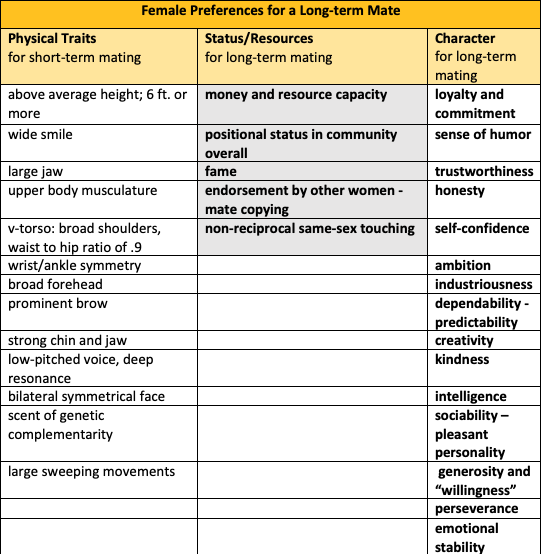
chart: female preferences for a long-term mate
Trade-offs Between Resources and Character

In addition to protection and a provision of resources, a woman’s long-term strategy seeks character traits that ensure stability and loyalty to her and her children over the long term.

What is often more salient in female mate selection and relationship satisfaction is the tension between the two preferences inside the female long-term strategy:  resources and character.   A woman’s long-term mating strategy often involves ambivalence and internal confusion related to her desire for a mate with resources and status and her preference for loyalty, kindness, intelligence, and character traits for parenting. (See “trade-off boundary” on the diagram below.)  In America, resources usually win this game of mate selection preference, often with rationalization and denial about the lack of optimal character.
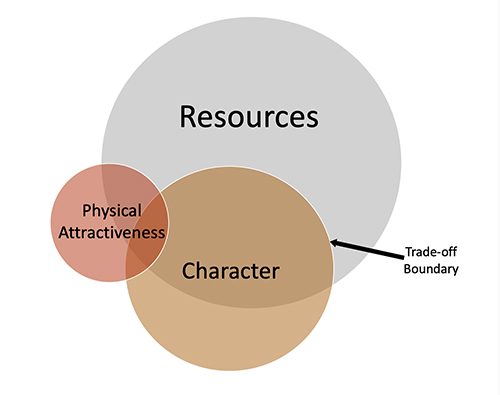

Venn diagram: women's long-term mating strategy
Please Note: Your comment may take up to 12 seconds to register and the confirmation message will appear above the “Submit a Comment” text. 
First Principle: Acknowledge Male-Female Differences

First Principle: Acknowledge Male-Female Differences

As I prepare to address issues of sexual orientation and fluidity (see Sexual Orientation, Gender Identity, Presentation, and Biological Sex), it seems appropriate if not necessary to review “first principles” related to my mission and central message, including:

  • Assumptions of Mating Straight Talk
  • General differences between men and women in sexual psychology and response
  • The twenty-two (22) domains of male-female difference. Domain #13 is related to the influence of context, and domain #15 is about sexual orientation, preference, and response variability.  These domains will receive special attention in coming posts. But nearly all domains have an impact on sexual fluidity.
Denial of Sex Differences is Problematic

Part of the mission of Mating Straight Talk is to affirm the differences between the sexes as revealed by evolutionary science and psychological research.  My motivation?  The denial of relevant sex differences in our culture is nearly as problematic as the denial of similarities related to race, ethnicity, and religion.

We Are Uniquely The Same

As a degreed person from a  humanistic psychology graduate program started by a colleague of Abraham Maslow, I am well aware of Maslow’s hierarchy of needs.  Although at least one evolutionary psychologist (Douglas Kenrick at Arizona State) has offered a revision of Maslow’s hierarchy to include sex, mate acquisition, and mate retention, I embrace Maslow’s original ideas describing the universal features of human beings – similar needs of all human men and women.  But from an evolutionary perspective, a salient question remains: How do men vs. women uniquely meet the needs of esteem, belonging, and intimacy as a function of their biological sex?  Is it the same in aggregate?  I think not.

Universal Emotions — Sex-Specific Causes

I believe in exploring universal emotional needs as a pathway for healing interpersonal relationships, perhaps, especially for couples.  All men and women experience anger, sadness, fear, joy, anticipation, surprise, disgust, and trust.*  But there are often sex-specific causes for these emotions.

We are “spiritually” all one.  In the quantum universe, we are the same.  In the material world of dimorphic human culture, we are most often diverse and functionally unique as an expression of our gender and sex.

Assumptions of Mating Straight Talk

Men and women have similarities as human beings and aggregate differences that are primarily a function of biology and evolutionary adaptation.  Our similarities do not often cause conflict.  But our differences, and the denial of those differences, often cause “trouble.”

Women and men have differences that we must acknowledge and understand to have satisfying heterosexual (romantic and sexual) relationships.

Men and women have differences that we must acknowledge to “re-balance” and integrate the biological and social sciences in academia and overcome resistance to the facts of evolved behavioral sex differences and evolutionary psychology.

Women and men have differences that we must acknowledge and understand to clarify the “politics” of sex and gender and challenge pockets of censorship in the public domain.

Men and women need “straight talk” (radical honesty) to uncover and accept our differences.

Women and men need “straight talk” about our differences to empower one another for co-creative relationships.

Vive la Différence

Over the millennia, men and women have evolved with different objectives and strategies of sexual psychology and response related to choosing a mate, reproduction, and parental investment.

General Differences between Men and Women in Sexual Psychology and Response
  • Women have their unique sexuality, like a fingerprint, and vary more than men in anatomy, sexual response, sexual mechanisms, and how their bodies respond to the sexual world. Women vary more widely from each other and change more substantially over their lifetime than do men.
  • Women are less likely to have alignment (“concordance”) between their genital response and subjective arousal; this causes confusion and misunderstanding for women and their male partners. Men have dramatically more concordance between their genital response and subjective arousal.
  • All sex happens in context. Women are more context-sensitive than men, and all external circumstances of everyday life influence the context surrounding a woman’s arousal, desire, and orgasm.
  • Women’s sexual functioning is more influenced by their internal brain state — how they think and feel about sex. Judgment, shame, stress, mood, trust, body image, and past trauma influence a woman’s sexual well-being.
  • Men and women have significantly different hormones and some variations in brain structure. Differences caused by the amount of testosterone cannot be overstated.
  • Women and men differ significantly in visual orientation for physical attraction and production of sexual thoughts.
  • Men and women have different preferences and priorities for the traits desired in a mate (with agreement about kindness, stability, humor, and care of children).
  • Human sexual response consists of a “dual control” system with an excitation mechanism (“accelerator”) and an inhibition mechanism (“brake”). Men are accelerator-dominant, and women are brake-dominant.
  • Related to differences between the sexual “accelerator” and “brake,” men operate primarily from “spontaneous desire” triggers, and women operate primarily from “response desire” triggers.
  • Men sell (primarily), and women buy (most often) in the mating economy; this is the predominant evolutionary dynamic. The psychology of the sexual initiator and pursuer is vastly different from that of the one pursued and the one who chooses among her pursuers.
  • The psychology of male intra-sexual competition differs from that of female intersexual selection (preferential mate choice.) Also, women’s intra-sexual competition (competing against each other) for male attention is a different behavioral phenomenon than male-on-male competition.

And last but not least:

  • Women’s sexual functioning includes sexual attractions, romantic affections, sexual practices/behaviors, and preference/orientation identities that are different from men’s sexual functioning due to biological and cultural adaptations. The fundamental and defining feature of female sexual orientation is fluidityMen are not nearly as fluid as women.  Researcher Lisa Diamond (Sexual Fluidity — Understanding Women’s Love and Desire) defines sexual fluidity as “situation-dependent flexibility in women’s sexual responsiveness.”

Terms of Engagement – Prelude to Understanding Female Sexual Fluidity

Diamond uses the term “sexual orientation” to mean a consistent pattern of sexual desire for individuals of the same-sex, other-sex, or both sexes, regardless of whether this pattern of desire is manifested in sexual behavior.

Sexual Identity

“Sexual identity” refers to a culturally organized conception of the self, usually “lesbian/gay,” “bisexual,” or “heterosexual.”  As with “sexual orientation,” Diamond says we cannot presume that these identities correspond with particular patterns of behavior, especially for women.  Nor can we assume that they correspond with specific patterns of desire.  Women often reject conventional labels in favor of “queer,” “questioning,” “pansexual,” or simply “unlabeled.”

Same-Sex and Other-Sex Orientation

Diamond uses the term “same-sex orientation” to refer to all experiences of same-sex desire, romantic affection, fantasy, or behavior.  She uses “other-sex” sexuality instead of “opposite sex” because (she says) it is more scientifically accurate.  She uses the terms “lesbian” and “bisexual” but considers them problematic (to be addressed later.)  If a person is 100 percent attracted to one sex, they are “exclusively” attracted (in Diamond’s terminology).  All other patterns of attraction are “nonexclusive.”

Domains of Male-Female Differences in Sexual Psychology

Here is a list of the twenty-two domains of male-female differences in sexual psychology and response.  There is overlap and synergy between the domains, but the underlying distinctions are clarifying. These differences are based on statistical aggregates of all men and women from authoritative research studies and cannot predict the unique sexuality of a particular man or woman.

  1. Behavioral dynamics in the mating economy
  2. Long-term vs. short-term mating strategies
  3. Trait preferences and priorities for mate selection
  4. Physical attraction and perceptions of beauty
  5. Concordance between physiological response and psychological desire
  6. Spontaneous desire vs. response desire
  7. Sex and love-making that fuels desire
  8. Accelerator vs. brake: sexual excitation and inhibition systems
  9. Brain structures: sexual pursuit and visual stimuli
  10. Hormonal differences
  11. Variety and novelty
  12. Sexual mentation and “sex drive”
  13. Influence of context
  14. Female competing intentions and imposed double binds
  15. Sexual orientation (and preference) fluidity and response variability
  16. Orgasm – purpose and characteristics
  17. Meta emotions
  18. Romance and desire, together and apart
  19. Psychology of monogamy
  20. Infidelity – reasons and response
  21. Jealousy – triggers, tactics, and consequences
  22. Sexual fantasies

I will eventually examine each domain as a distinct phenomenon of difference. However, some domains will be addressed together because they are related or parallel in physiological or psychological response.  Differences between men and women in genetic make-up and physical morphology are not included as separate domains (see Biological Differences).  But genetic differences will be addressed in a future post about “biological sex.”

*In modern-day “assortative mating” — the economy of mate selection — a similarity of interests, values, and background works better for relationship satisfaction than “opposites attracting.”


Please Note: Your comment may take up to 12 seconds to register and the confirmation message will appear above the “Submit a Comment” text. 
Women’s Preferences for Male Facial Masculinity

Women’s Preferences for Male Facial Masculinity

The face is more honest than the mouth will ever be.”

~ Daphne Orebaugh

In a prior post (Want An equal Marriage? Then Date As Equals),  I described the “trade-off problem” (coined by evolutionary psychologists) that women have in choosing between male alpha traits of dominance and status and male beta traits of loyalty and kindness.  Recent research reveals this trade-off phenomenon is operative when a woman rates a man’s attractiveness as a function of his facial masculinity.  Do women who are attracted to men prefer a macho, masculine appearance? Or is a gentler, more feminine face the ideal?

Take-away – High-level

Along a continuum of digitally produced hyper-feminine to hyper-masculine faces, women preferred the “moderately” masculine face.  Women’s preference for moderately masculine faces comports directly with the overall female mating strategy that attempts to find the “sweet spot” of an alpha-dominant man (with resources, prestige, and hierarchical power) and a “beta” man who will be trustworthy and invest in her children.  This trade-off problem is solved by finding a compromise for facial masculinity –  identifying a masculine face rated above the mean but not so masculine as to be perceived as untrustworthy.   A preference for “moderately” masculine faces demonstrates the combination of a woman’s long-term and short mating strategy and her competing intentions for selecting traits in an ideal mate.

Order of Facial Preference (Summary)

After moderately masculine faces, the order of preference for male faces was “intermediate” (balanced masculine and feminine) faces, followed by extremely masculine and moderately feminine faces.  Extremely feminine (male) faces were the least attractive to heterosexual women.

Masculine Traits in the Animal Kingdom

In the rest of the animal kingdom, males with exaggerated masculine traits are favored.  For example, the showy plumage of a bird of paradise or the puffed-up chest of a silver-back gorilla makes these animals luckier in love. This is likely because there is a link between these macho traits and health and vigor. A preference for masculine traits is a preference for a male who will make a good biological father.

Tough Guys and Sensitive Types

In our species, perhaps unsurprisingly, the story is more complicated. Some women prefer “tough guys,” and others prefer more sensitive types. Why?  In some circumstances, masculine qualities are more valuable. In others, a more feminine partner might be the better choice.

Dimorphism and the Masculine Human Face 

Men’s facial masculinity expresses the degree of dimorphism or physical differences between the sexes in humans.  A masculine face has narrower eyes and thinner lips; a broader mandible (jawbone), chin, forehead, and (wider) nose; larger cheekbones, a long lower face height below the nasal region, a more protruded and robust brow ridge, straighter eyebrows, facial hair, and darker complexion. The heavy lower face that women favor in men is a visible record of the surge in testosterone and other male sex hormones that turn small boys into athletic men.

Male Facial Hair and Attractiveness

A paper published in January 2020 found that facial masculinity was positively correlated with attractiveness, and beards significantly increased attractiveness in both short-term and long-term scenarios. The effect is demonstrated by the fact that full-bearded feminine (male) faces (otherwise least attractive) were rated as more attractive than clean-shaven moderately masculine faces (otherwise, the most attractive).

“Moderate” Man Pictured Above

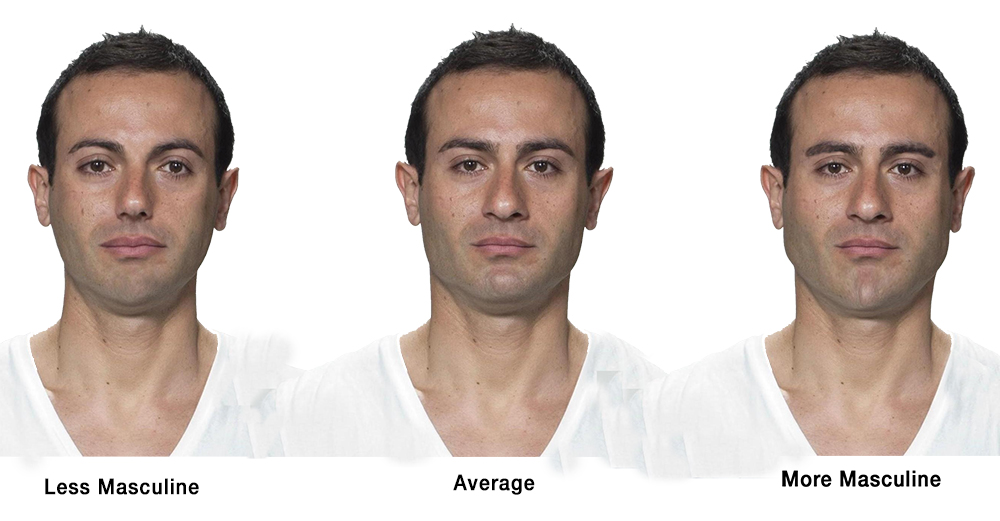
The signature image for this post demonstrates (IMO) a moderately masculine face.  This man has narrow eyes, a wide jaw bone, prominent cheekbones, a fairly robust brow ridge, facial hair, and a darker complexion.  He does not have a broad nose or significant face height below the nasal region.  His facial symmetry (see Appendix) is nearly perfect, generating overall attractiveness (and perhaps a touch of femininity). His expression is determined, if not slightly menacing, adding an artifact to his overall masculinity.

What is a Feminine Face?

Given the dimorphism between the sexes, it is necessary and instructive to consider the “feminine face” to access levels of facial masculinity.  Social psychologist Michael Cunningham at the University of Louisville found dimensions and proportions of the ideal female face: large eyes, small chin and nose, high cheekbones, and narrow cheeks.  These traits are signs that a woman has reached puberty.   The tiny jaw is essentially a monument to estrogen and obliquely to fertility – signaling the increased odds that she could get pregnant.  High eyebrows, dilated pupils, and broad smile signal excitement and sociability.  Cunningham also found that men are looking for lips that have “fullness, redness, and warmth.”

Hyperfeminine Face

When researcher David Perrett exaggerated the ways in which the prettiest female composite differed from the average composite, the resulting face was judged more attractive.  “It turned out that the way an attractive female face differs from an average one is related to femininity,” say Perrett.  “For example, the female eyebrows are more arched than males and exaggerating the difference from average increases femininity.”  Perrett created a “hyperfeminine” face in his studies by slightly changing the face to have larger eyes, a smaller nose, plumper lips, a narrow jaw, and a smaller chin. (See “Averageness and Exceptionality” in Appendix.)

The hyperfeminine face is considered attractive (if not beautiful) by both men and women.  The hypermasculine face is considered less attractive than average, especially by women.

Healthy Men Can Afford High Levels of Testosterone

Facial masculinity is a secondary sexual trait caused by sex-specific ratios of androgens (testosterone) and estrogens, affecting morphology (physical form and structure) and behavior.   It is hypothesized that women should find facial masculinity attractive in potential mates because masculinity may act as an honest signal for male health.  Only men with above-average health in adolescence can “afford” to produce high levels of testosterone that masculinizes the face.   Facial masculinity is positively associated with some aspects of men’s health and disease resistance.

Facial Masculinity May Signal Competitive Ability

Facial masculinity may signal competitive ability to other men and the ability to provide protection and resources.  It may also provide relevant information to potential mates and same-sex rivals regarding reproductive maturity, underlying health, formidability, and social status. More masculine-looking men tend to have more muscular physiques and greater physical strength, health, and competitive ability.

Facial Masculinity is Associated with Behavioral Dominance

Facial masculinity is associated with behavioral dominance, an open sociosexual orientation (level of “sapiosexuality”*), and higher social rank in same-sex dominance hierarchies.    It has been reported that square-jawed men start having sex earlier than their peers and attain higher ranks in the military.

Trade-off: Good Health vs. Good Parent

Masculine facial traits increase both perceived dominance and decreased quality as a parent.  High levels of testosterone have been linked to undesirable social traits such as aggression and decreased parental investment.   Again, women may face a trade-off between choosing a less masculine but more agreeable (and investing) long-term partner versus choosing a man whose masculine appearance indicates good health — but who may have less socially desirable traits. Thus, variation in preference for masculine men may reflect choices for more prosocial partners and nurturing fathers over possible indirect (genetic) and direct benefits associated with masculine facial traits.

“Masculine” Men and Likelihood of Sexual Infidelity

Masculine-looking men are perceived to be less warm, kind, and less paternally investing.   Further, masculine men state higher preferences for short-term mating than for long-term relationships.  They engage in more short-term relationships than their less masculine peers, and women accurately assign the likelihood of sexual infidelity for the masculine facial shape in static photographs.  Women find less masculine faces more attractive for a long-term relationship, perhaps because macho men are generally less committed.

Women Prefer More Masculine Men for Short-term Flings

Illustrating collusion or synergy related to a masculine man’s short-term mating preference, the results of 15 years of research consistently show that women find above-average masculine faces to be sexiest and most attractive for a casual sexual encounter.

Study Rated Degrees of Facial Masculinity

As reported in Adaptive Human Behavior and Physiology (2017),  Iris Holzleitner (Institute of Neuroscience & Psychology in Glasgow) published a comprehensive study of how women differ in their preferences for male facial masculinity.  Holzleitner recruited 563 women who rated the attractiveness of a set of male faces that had been manipulated to appear more feminine or more masculine. Masculine faces were altered to have a more robust jaw, narrower eyes and lips, and a wider nose. In many research studies, volunteers are only asked to compare one feminized face with one masculinized face; in Holzleitner’s study, volunteers individually rated faces of varying degrees of masculinity.

Example of Continuum of Facial Masculinity

Degrees of facial masculinity are depicted below as an illustrative example.  The “average” face is from a research data set; the “less masculine” and “more masculine” faces are alterations from the “average” made by web-master and photographer Tom Carroll, especially for this post.   Changes to the jawline, cheeks, chin, lips, eyes, and eyebrows exaggerate the difference between a “feminized” male face and a strong (perhaps “hyper”) masculine face; Holzleitner’s computer-generated facial changes were more subtle, systemized, and “mathematical” along a continuum. The average face depicted here is roughly equivalent to a “moderately” masculine face.

three faces of masculinity
Women Preferred the “Moderately Masculine”

Holzleitner found that women most preferred male faces that were moderately masculine. Very masculine or feminine faces were less appealing. However, the degree of masculinity a woman preferred in a man’s face depended somewhat on her own characteristics.

Sexual Orientation-Fluidity Effect

Not surprisingly, women who had some attraction to women tended to rate feminine male faces more attractive.  Whereas women who were exclusively attracted to men had a stronger preference for more masculine faces. “The more women were exclusively sexually attracted to men, the more attractive they found highly masculine faces,” reported Holzleitner.

Recent Research on Sexual Fluidity Effect 

Variations in the sexual orientation (degree of fluidity or “hetero-flexibility”) of self-identified heterosexual women influence preferences for male facial masculinity, according to recent research by Carlotta Batres (2020) published in the International Journal of Sexual Health.  Batres is a professor and director of The Preferences Lab** at Franklin & Marshall College.

Batres and colleagues asked 27,611 heterosexual women to report their level of sexual attraction to women, level of sexual attraction to men, hormonal contraceptive use, relationship status, attitude toward casual sex, and self-assessed attractiveness. The participants were then shown pairs of male faces and instructed to select which face from each pair they considered to be the most attractive.

Sixty-two Percent of Heterosexual Women Reported Some Attraction to Women!

Even though all the women identified as heterosexual, 62.6% reported some level of sexual attraction to other women. This finding was quite significant (if not surprising) by itself.  But more pertinent to the study was the finding that attraction to women influenced assessments of male attractiveness.

“Heterosexual” Women Who Are Attracted to Women Prefer Less Masculine Faces

Batres found the same effect as did Holzleitner.  Women with higher levels of attraction to other women were more likely to view less masculine-looking male faces as more attractive.

Attractive Women Did Not Prefer Feminine Faces

Women also differed in their preferences according to their self-rated attractiveness.  Women who thought they were high in attractiveness didn’t find feminine male faces very attractive at all, but less attractive women rated them moderately appealing. Both self-rated attractive and self-rated unattractive women agreed that moderately masculine men were the most appealing and that very masculine men were slightly less so (as in “order of preference above”).

More Attractive Women Want More Masculine Faces

Stated another way, more attractive women showed less tolerance for lower levels of masculinity than did less attractive women.  The more physically attractive the woman (by self-rating), the stronger preference for higher levels of masculinity.  More attractive women also showed greater discrimination than less attractive women in their preference for masculine faces.

Male-Female Polarity Phenomenon

Greater discrimination or more “choosiness” is a predictable behavior of more attractive women.  As uncovered in Batres’ research, this result is a phenomenon of male-female polarity:  beautiful women want and get more masculine men (men with masculine facial features, taller, and with more defined v-shaped torsos). This polarity seems biologically unconscious as well as predicted by “sorting” in the mating economy.  There is a “mate value” agreement: beautiful women have a high mate value and taller, masculine men generally have higher mate value than shorter and less physically masculine men.

Beautiful Women Can “Afford” More Masculine Men

Attractive women have more immunity from the costs of disloyalty often imposed by more masculine men.  Masculine men are less likely to abandon very beautiful women.  The costs are higher for less attractive women – those women calculate the risk and often “trade” for more “beta” character traits in their choice of a long-term partner.

Women Prefer Masculine Faces in Better Economic Conditions

According to a study appearing in scientific reports  (2019), women’s preference for facial masculinity is strongest under favorable ecological conditions.    Improved economic conditions reduce the need for parental investment from men.  Women may prefer a less masculine and more loyal mate under more tenuous economic conditions – conditions for which assured parental investment is most important.

Female Short-term Mating Increases in Favorable Economic Conditions

Women’s preferences for masculine faces, bodies, voices, and odors are stronger when considering short-term rather than long-term mates.  Economically favorable conditions and reduced need for parental investment may cause women to have more interest in short-term mates and thus more masculine men, referred to as higher “sapiosexuality.”  Under favorable economic conditions, women reported greater willingness to engage in less romantically committed relationships and were more likely to select masculine faces as most sexually attractive.

Holzleitner proposed that women in prosperous countries were more sexually liberated and economically secure, thus freer to make costly mate choices.   Holzleitner’s research does seem to provide further evidence that promiscuous women tend to prefer more masculine men.

Menstrual Cycle Affects Facial Preference

Women may be attracted to masculine-looking men at the most fertile time of their menstrual cycle.  This “ovulatory shift hypothesis” contends that a woman’s preference for more masculine partners as short-term mates may be strongest at the peri-ovulatory phase of the cycle.  In a study conducted in Scotland and Japan, researchers asked women to select one “face” they were most attracted to for a short-term sexual relationship.  In the most fertile week of their menstrual cycle, women preferred more masculine faces.   During the less fertile time, women chose men with more feminine-looking faces.  These men were seen as kinder and more cooperative but less strong and healthy genetically.  However, the choice of face did not vary for women using an oral contraceptive or those asked to choose the most attractive face for a long-term relationship.  Research supporting the ovulatory shift hypothesis is not conclusive.

Preference for Masculine Faces Associated with Poor National Health

Evolutionary mating theories propose that women overlook the costs of selecting less paternally investing masculine traits to secure benefits associated with phenotypic masculinity that could enhance offspring (genetic) fitness.  Indeed, preferences for facial masculinity were highest among women living in countries and states in the U.S. that have lower health and higher levels of pathogens.  These findings are bolstered by experimental studies reporting that exposure to pathogens result in higher preferences for facial masculinity.  This suggests that any social costs of selecting masculine partners may be circumvented under conditions where potential indirect (genetic) benefits may be realized.

Confusing and Contrary Research?

While some studies have shown a preference for more masculine traits in poor health conditions, other studies have shown a preference for less masculine traits in poor economic conditions (as stated above). Undoubtedly, poor economic conditions and poor health conditions go together in some cultural-geographical environments.  This appears to reveal confusing or incompatible research results.

Preferences Related to Homicide Rates and Income Inequality

Adding to the mix of data, research by DeBruine, et al. reported that women’s preferences for facial masculinity were strongest in countries with high homicide rates, male-on-male violence, and income inequality (indices of male intra-sexual competition) rather than reduced national health.

Conclusion

In my last post (Side-swiped: Evolutionary Mismatch and Sex Differences with Mobile Dating) I explained how physical appearance takes on a disproportionately large role in dating by mobile app.  A face flickers across the screen, and juices of attraction or disapproval are registered in an instant.  The degree of facial masculinity is recorded in old regions of the brain before a reason for sexual interest can be articulated in words.   (“The face is more honest than the mouth will ever be.”)

Women’s preference for a moderately masculine face aligns with the female long-term mating strategy of finding an “alpha-dominant” man who also reveals safety and loyalty in his face.  This preference is often a compromise or trade-off made by a woman depending upon her attractiveness and mate value, degree of attraction to women, economic security, the health and safety of her environment, and her situational desire for a short-term fling.  Even her menstrual cycle may play a role in the level of facial masculinity she “requires” for sexual attraction.

Studies broadly suggest that women’s perception of male attractiveness is sensitive to facial cues of masculinity.  These facial preferences are shaped by sexual selection, which dictates the benefits and costs associated with choosing a (facially) feminine or masculine partner.

In the world of sexual selection, a face is not just a face.

References

Batres, C; Jones. B.; Perrett, D., “Attraction to Men and Women Predicts Sexual Dimorphism  Preferences,” International Journal of Sexual Health online,  Jan. 21, 2020.

Burriss, R., Ph.D., evolutionary psychologist at Basel University, Switzerland. The Psychology of Attractiveness podcast.

DeBruine, L.M., et al.  “The health of a nation predicts their mate preferences: cross cultural variation in women’s preferences for masculinized male faces. Proc. R. Soc. Lond. B. Biol. Sci. 277 (2010).

Holzleiter, I. J., & Perrett, D. I, “Women’s preferences for men’s facial masculinity: Trade-off Accounts Revisited.”  Adaptive Human Behavior and Physiology (2017) 3:304-320.

Marcinkowska, U. et al., “Women’s preferences for men’s facial masculinity are strongest under favorable ecological conditions.” Scientific Reports, March 2019.

Notes 

*Sapiosexuality (SOI) refers to the desires for and attitudes toward short-term uncommitted and long-term committed sexual partners.   More sexually open or unrestricted people report high scores for sexual openness, more sexual partners, and may not place high importance on sexual monogamy. By contrast, people with a more restricted sociosexuality have fewer sex partners and place greater importance on monogamy, love, and fidelity.  SOI varies both within and between cultures in ways that conform to mating strategy theories. 

** The Preferences Lab examines the information that faces convey.  The lab’s website says:  “It takes only milliseconds for our brains to process someone’s face, and unconsciously we use facial cues to make a myriad of social judgments, ranging from how dominant someone is to how attractive we find them.”

Appendix

From Science of Attraction and Beauty

Bilateral Symmetry

Humans and most other animals are bilaterally symmetric.   The left and right sides of the body are basically the same, including the face in humans.    Small deviations from this symmetry are called “fluctuating asymmetry” (FAs).  Behavioral ecologist Randy Thornhill and other researchers have discovered a preference for symmetry (low FAs) and its influence on human perception of sexual beauty.  Men with symmetrical bodies tend to have symmetrical faces and bodies that are more muscular, taller, and heavier than those of men with less symmetrical bodies.   A bilaterally symmetrical face is a cue to genetic quality and developmental stability.

An Asymmetrical Male Face

asymmetrical male face example

Symmetry Linked to More Sex and Orgasms

Thornhill found that men with symmetrical bodies were more athletic and more dominant in personality than their peers. He also found that symmetrical human males started having sex three to four years earlier than asymmetrical males, have sex earlier in the courtship, and have two to three times as many partners.   

In 1995, Steven Gangestad and Thornhill surveyed 86 couples and found that women with highly symmetrical partners were more than twice as likely to climax during intercourse than those with low-symmetry partners.  When women have extramarital affairs, they tend to choose symmetrical men as partners.

Symmetrical women were favored too.  They have more sexual partners than less symmetrical females and may be more fertile.  Interestingly, women’s symmetry changes across the menstrual cycle.  They are more symmetrical (and presumably more attractive to their partners) on the day of ovulation.

Averageness and Exceptionality

Humans love “average” faces (koinophilia).  The more “average” you are, or closer to the mean of all people, the more attractive you are perceived to be.  From an evolutionary perspective, a preference for extreme normality makes sense, says researcher Judith Langlois: “individuals with average population characteristics should be less likely to carry harmful genetic mutations.”

Yet, paradoxically, the faces we find most attractive are not average!  Victor Johnson at New Mexico State University found the “ideal” female had a higher forehead than average, fuller lips, shorter jaw, smaller chin and nose, and more arched eyebrows. The most exquisite people are slightly away from average.  “Average faces are attractive, but they are not usually the most beautiful.  Maybe it’s the exaggerations of certain features the creates celestial features,” Johnson wrote. 

Baby Face Phenomenon                               

Large eyes, thick lips, a relatively short nose, and a large curved forehead are considered baby face traits.  Many studies indicate that this “baby face phenomenon,” or the tendency to find infant-like facial features attractive, occurs not only because these features suggest youth, but also because they elicit the same warm feelings as our typical response to babies, both human and animal.

Golden Ratio in the Face

The golden ratio or golden rectangle is one of the most satisfying of all geometric forms.  It is a mathematical relationship (a/b = (a+b)/a = 1.618…) that appears in all of nature and science:  plants, animal bodies, painting, architecture, sculpture and even music.  It has been called the “divine proportion.” 

The golden ratio occurs repeatedly in the dimensions of the human face and produces our perception of balance and physical beauty.  The human head forms a golden rectangle with the eyes at the midpoint.   The mouth and nose are each placed at golden sections of the distance between the eyes and the bottom of the chin.  The golden ratio can be found in more than twenty facial calculations.  Human facial beauty is based on divine proportion.  From Queen Nefertiti to Marilyn Monroe, beautiful women throughout history display the golden ratio in the face.


Please Note: Your comment may take up to 12 seconds to register and the confirmation message will appear above the “Submit a Comment” text. 

Side-Swiped: Evolutionary Mismatch and Sex Differences with Mobile Dating

Side-Swiped: Evolutionary Mismatch and Sex Differences with Mobile Dating

“With the rise of the mobile dating app, we are in evolutionary unprecedented waters.” 

                        ~ Justin Garcia, Kinsey Institute

Set in the cities and college campuses of Austin, New York City, Santa Cruz, and Plainfield, Illinois, HBO laid bare the lives of Gen Zers and their use of dating apps in the 2018 documentary, “Swiped – Hooking Up in the Digital Age.”  Based on what they uncovered, HBO may have intended “swiped” as a metaphor for being disappointed or blind-sided, in addition to noting the addictive action built into the phone and app design. 

A Generation Built to Swipe

Gen Zers (up to 24 years of age) and a small number of Gen Y.1 (25-29 years of age) were exposed to the internet and computers from a very young age. It is natural (if not cognitively conditioned) to connect to their world and others through a display screen.  But Tinder, Snapchat, Instagram, and Facebook deliver and create a reality that sometimes interferes or competes with real-life (IRL).  In “Swiped,” we see scenes of young people in a crowded New York City bar – but their attention is only on their phones.  One HBO interviewee said folks are “almost zombified, looking at their phones even when all together in the same space.”  “If you called someone these days, you would probably get labeled a psychopath,” joked another young man.

“Swiping” Market is Huge

Tinder estimated there were 1.5 billion swipes per day in 2018.  As a part of a 2.5 billion dollar dating industry, 40 million Americans use online dating.   Adults age 18 to 30 spend an estimated 10 hours a week on dating apps.  One out of two single people in the US has a profile on a dating app.

We Evolved in Small Groups with Few Potential Mates

Dating by mobile device may conflict with our evolutionary hard-wiring.  In an interview for “Swiped,” evolutionary psychologist David Buss explained the problem with dating apps:  “We evolved in the context of small groups ranging from 50 to 150 with limited geographical mobility. You would encounter perhaps a few dozen potential mates in your entire lifetime.  We take this small-group dating psychology and transplant it in the modern world with thousands of mates, and it triggers this short-term mating psychology in a way that never would have been triggered ancestrally.”  And with all of these options, the value of each person in the mating economy goes down.

Evolutionary Mismatch

The field of evolutionary psychology has become more interested in these instances of modern “evolutionary mismatch.”    “Since organic evolutionary processes take a long time to effect change, our minds are better suited to ancestral, pre-agricultural contexts than they are to modern contexts,” says Glenn Geher and Nicole Wedberg in their book Positive Evolutionary Psychology (2020).  Studies of pre-agricultural forms of diet and exercise (paleo fitness and movement) and ways to increase “social capital” in our cities are examples of solution-focused evolutionary psychology.  Mobile apps as currently designed may not be part of the solution.

We are engaging ancient biological parts of our behavior, but the platform is novel and unprecedented. With the rise of the mobile dating app, we are in evolutionary unprecedented waters,”  cautions Justin Garcia of the Kinsey Institute.

A Picture is Worth a Thousand Deceptions

The dating app photo, especially on Tinder, is everything.   Physical appearance overwhelms all other information and takes on a disproportionately larger role.  As described in the film by clinical psychologist Jennifer Powell-Lunder, mating strategies are evident on the apps: “men present in a very stereotypical male way – providers, hunters, puffing up their chests.  And women present in more sexual ways.”  Powell-Lunder identified a phenomenon brought on by the relative anonymity of the mobile app.  She called it the “Clark Kent syndrome.”  “Mild-mannered average guys get to feel like a Superman, powerful and sexually aggressive.”  This kind of dating is all “performative,” she says.

Male-Female Difference

Men and women use these apps differently.  Hinge CEO and founder, Justin McLeod, was interviewed in the HBO film:  “Women are more selective.  On the whole, a majority of women are looking almost exclusively for a relationship on these services.  The majority of the men are primarily looking to hook-up.”  Those looking for a hook-up have the upper hand in this new world.  Women in the documentary lamented: “Guys will have one girlfriend per network (Instagram, Twitter, Facebook, and Snapchat).”

Traditional Romantic Relationship vs. a Hook-Up

In a lecture to the Feminist Student Association at the University of Indiana, Garcia presented data from college students about which type of relationship they preferred — a traditional romantic relationship (TRR) or a  hook-up.  Sixty-three percent (63%) of the men said they preferred TRR, and 34% said they favored a hook-up.  Eighty-three percent (83%) of the women preferred TRR and just 13% wanted a hook-up.  One woman in the documentary said, “I want a boyfriend; I don’t want a fuck buddy.”  CEO and founder of Tinder, Sean Rad noted “80% of users are looking for a serious relationship.”  This is about right for the women, but not overall.  Rad might be exaggerating a big to make Tinder look a bit nobler.  In the film, females actively looking for hook-ups on Tinder were derisively called (by the men) “tinderellas.”

Men and Women Differ in Comfort Level of Hook-up Behaviors

Garcia also reported on women’s comfort level for certain hook-up behaviors compared to what was attributed to them by men (on a scale of -5 to +5).  Men overestimated a women’s comfort level with sexual intercourse and oral sex (both giving and receiving) by a significant margin.

 Design and Addiction of the App Architecture

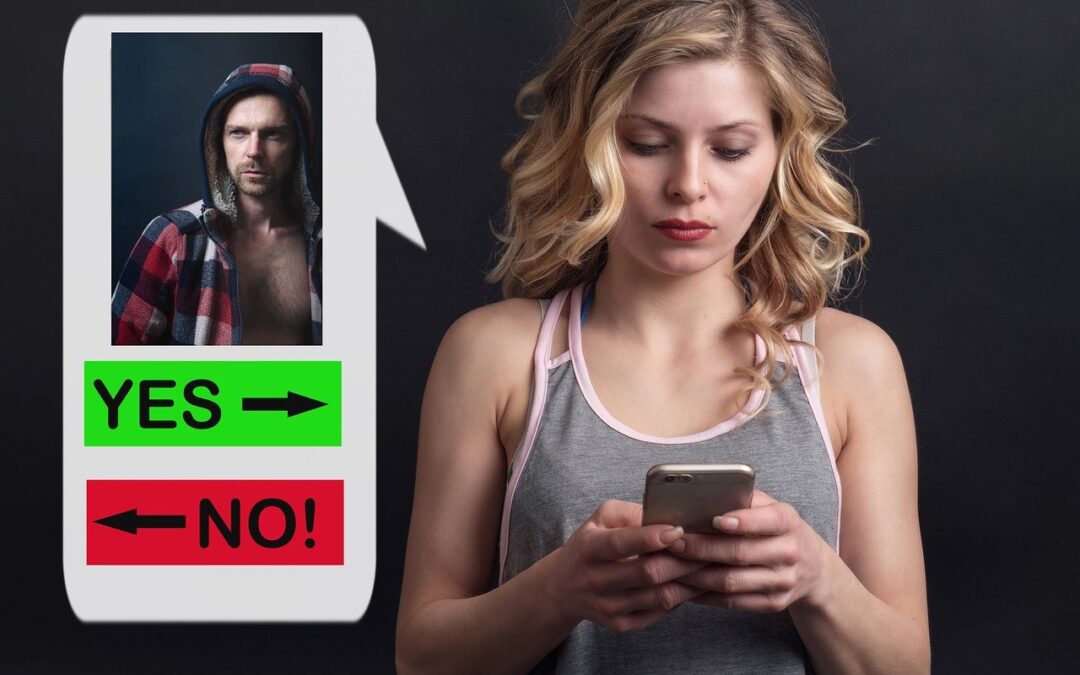
The architecture of dating apps is built for split-second decision-making  – are you “hot or not?”

Gamification is a well-researched design feature.  Swiping produces unpredictable yet frequent rewards – intermittent reinforcement based on the operant conditioning studies of B.F Skinner.  (Pigeons are the precursors to swiping-obsessed GenZers.) Visual pop-ups show a match with fanfare and a dopamine rush.  Yet, anticipation is a greater rush than the reward.  Like gambling addiction, swiping or sexual compulsion is more of a “high” than a genuine pleasure.

Effects On Emotional Health and Relationship Satisfaction

“I hate it that everything depends upon how you look,”  said a young woman from Austin.  One clinical expert interviewed by HBO said, “mobile apps cause us to feel like we are always dating, always promoting your product.”   A black woman from New York City spoke of emotional abuse from an online relationship.  “I was heartbroken.  I feel like he treated me like an object almost.”   A college student in Santa Cruz gave a male perspective:  “if you do care, you have to not show it; you act like you don’t.”

Women overall are wary and disappointed in the digital online environment.  Men are pleased and discouraged by dating using the apps.

The Hinge Difference?

McLeod says Hinge is “designed to be deleted.” Unlike his swipe-centric rivals, McLeod doesn’t want his user base to stay endlessly glued to the app. McLeod has drug addiction in his history – he understands this problem.  McLeod described Tinder “as a numbers game where users were betting to find a match after never-ending swipes.  It just turned into a game in a casino.”  McLeod realized that it was time for love-seekers to put themselves out there.  “It is about vulnerability and opening up and softening your edges.”

Hinge no longer conforms to the swipe template. Instead, users (as of in 2019) have to answer a choice of three prompts that encourage sensitivity.  Instead of the “hot selfie,” Hinge encourages “photos that lend themselves to a conversation.”

Hinge Inspired Modern Love

McLeod’s own love story is depicted in Episode 2 of Amazon’s highly praised Modern Love.   Dev Patel’s character builds an app called Fuse and reconnects with his soulmate just before she was supposed to marry another man.  In real life (IRL), McLeod flew to Europe and declared his love for his long-lost soulmate, Kate, one month before her wedding to another man.  McLeod and Kate got married and have a child.  McLeod’s real love story informs his approach to Hinge, although Hinge has been fully acquired by dating monopolist IAC Match Group, which also owns Tinder.

Does Bumble Empower Women?

“Bumble is a site where only women are going to make the first move,” explains a female Bumble executive interviewed for the documentary.   But does Bumble empower women?   Zoe Strimpel, a dating historian and columnist for The Sunday Telegraph, said, “Bumble is just codifying that women have to do more work – have the burden of dating – the communication and emotional work.”   Regardless of the questionable premise (IMO) that women have “the burden of dating,”  Strimpel “does not see how Bumble fixes the mistakes that Tinder has made.”

Gay Apps Maybe Provide a Needed Service

The documentary explains how dating apps and the internet generally have given gay men and lesbians more access to each other.  Garcia said the internet is good for the LGBTQ community in that regard.  But one man complained that it has cut down on “cruising” in person, which he described as fun and, more importantly, part of gay culture.  One gay Austinite said that when he sees a guy in a bar, he immediately goes to Grindr to find out more about him and even communicates to him through the app as he stands just 30-feet away.  One gay site gets a favorable mention.  SCRUFF is supposedly a top-rated and reliable app for gay, bi, trans and queer guys to connect. 

Physical Risk in the App Ecosphere

Online-related sexual assault has multiplied over the years.  According to general news and wellness site, Phactual, one out of every ten sex offenders uses online dating to meet people.  A 2018 Buzzfeed article told the story of an alleged “Tinder Rapist” who said he felt entitled to sex from a female he’d met on the dating app because “she wanted it and the Tinder app was for that.”

“Are dating apps contributing to rape culture?”   Mandy Ginsberg, CEO of IAC Match Group, avoided answering that question in the documentary, citing the company’s focus on safety tips for women.  (IAC Match Group owns Match, Tinder, Plenty of Fish, OK Cupid, Black People Meet, Senior People Meet, and now Hinge.)

Revenge Porn is a Nasty Artifact

As starkly depicted in the HBO documentary, sexting is also a risk.  One in 25 Americans has been the target of revenge porn – the unauthorized use and spread of nude photos.  Instagram photos of all types may lend themselves to reputation damage, even affecting employment and careers.  Tinder co-founder and CSO Jonathan Badeem seemed sympathetic but had no concrete plans (at the time of filming by HBO) to stop revenge porn or reduce the incidence of sexual assault associated with the app.

Future of the Apps and Mobile “Dating” Experience

“The use of apps will not slow down because there is too much money to be made,” according to Adam Alter, a social psychologist at New York University. He added, “the apps are getting better and better at designing experiences that are addictive.” Furthermore, virtual and augmented reality apps are coming!

 Through Eyes of Alex and Kyle

Midway through the documentary, we are introduced to an adorable couple in New York City.  Alex and Kyle found each other on an app and felt authentically connected as friends and lovers.  They had great simpatico and playfulness — enough trust and comfort to try to be with a third person.  (Alex, the woman, is a self-proclaimed “heteroflexible”).  They swiped together as a couple, looking for a woman to join them.  It was exciting and fun.  Their coupling seemed to work.  At the end of the documentary, we see them for the third time. Kyle and Alex sat on the bed and reflected on their relationship together. Now, it seems, they are not a couple.

 But Love is Sweet

 Kyle became distant, and he does not know why.  Kyle hooks-up with other women on Tinder. Alex seemed sad and resigned.  She wanted a real relationship with Kyle.  She tells the camera that expressing love is sweet. She can have other sexual encounters if she wants to (and does), but we get the impression that she just wanted a committed relationship with him.

“Tinder Exhausts Me”

 Alex finally says, “Tinder exhausts me but I use it to judge people, and I like to swipe.  I like doing the swiping, I always have.”  “Nothing good happens from Tinder,” says Kyle in response. Then, Alex turns to Kyle and gives him a penetrating look, “we met on Tinder.”

Summary

  • Digital apps produce a vastly different environment for short-term mating from what existed in our evolutionary past.
  • The focus on physical looks has dramatically increased in the digital environment. This change is especially significant in the overall mix of female sexual strategies.  Short-term mating for women has always put more emphasis on physical attractiveness, facial symmetry, and a man’s v-torso.  A woman’s predominant long-term strategy, which still operates on the apps, emphasizes character, resources, and commitment.
  • Young women are having a bit more casual sex because of this environment, but they are not necessarily more satisfied. (There was only one woman depicted in “Swiped” that seemed centered and comfortable with a non-monogamous lifestyle.)
  • Though women are experimenting more with casual sex and non-monogamy, 80% of women want or use the apps in hopes of developing a long-term relationship.  This confirms the hard-wired difference of mating strategies between men and women.
  • Few long-term relationships come from dating app hook-ups.
  • Women overall are wary and disappointed in the digital online environment.
  • Men are pleased and discouraged by dating using the apps.
  • HBO’s documentary does not explore the sex-ratio difference on college campuses (more women than men) that has also contributed to changes in the female approach to casual sex and intrasexual competition between women, and is the cause of multiple partners for men.
  • Women rightly fear rape and other kinds of abuse (physical and emotional) or assault.
  • Reputation damage and revenge porn have dramatically increased with the use of dating apps and the reach of the internet.


Please Note: Your comment may take up to 12 seconds to register and the confirmation message will appear above the “Submit a Comment” text. 

Want An Equal Marriage? Then Date As Equals

Want An Equal Marriage? Then Date As Equals

Based on “If You Want a Marriage of Equals, Then Date As Equals,” by Ellen Lamont in The Atlantic, February 14, 2020.

“I know it feels counterintuitive…..I’m a feminist,” the first woman said.  “But I like to have a guy be chivalrous.”

Heterosexual women with progressive-liberal political leanings often say they want an equal partnership with men. “But dating is a different story entirely,” according to feminist sociologist Ellen Lamont of Appalachian State University and author of  The Mating Game: How Gender Still Shapes How We Date. Lamont’s research found that such women expected men to ask for, plan, and pay for dates.  They also expected men to initiate sex, confirm the exclusivity of a relationship and propose marriage.  “After setting all those precedents, these women then wanted a marriage in which they shared the financial responsibilities, housework, and child care relatively equally,” wrote Lamont in an article for The Atlantic.  Very few of Lamont’s female subjects saw these dating practices as a threat to their feminist credentials or their desire for egalitarian marriages.  Lamont says they are wrong on both counts.

Glaring Disconnect – Progressive Beliefs vs. Lived Experience

Lamont noticed a glaring disconnect between straight women’s views on marriage and thoughts on dating.  Lamont found that once these women were married, it was difficult to “right the ship.”  The same gender stereotypes that they adopted while dating played out in their long-term partnerships.

Interviewing “Woke” Millennials

Lamont interviewed heterosexual and LGBTQ people in the San Francisco Bay area – highly educated, professional-track young adults.  Everyone she interviewed was quite vocal in their support of gender equality and readily accepted the label “feminist.”

Three-quarters of millennials in America support gender equality at work and home and agree that the ideal marriage is equitable.  Consequently, Lamont expected her female interviewees to epitomize feminist liberation.  Yet, when they thought of equality among men and women, they focused more on professional opportunities than on interpersonal dynamics.

Gender Equality Gains at Work – Not at Home

Lamont had long been interested in how gender influences behavior in romantic relationships. She was well aware that research showed more significant gains in gender equality at work than at home.   Americans with a college education now get married in their early 30s on average.  Young adults put their love life on hold while they invest in their education and establish a career.  Lamont’s female subjects expected their partner to support their ambitious professional goals.  The men said they desired and respected these independent, high-achieving women and saw them as more compatible partners as a result.

“It’s a Deal Breaker If He Doesn’t Pay”

“Can I be a self-sufficient, empowered woman and still enjoy it when a guy picks up the check?” appeared as a question in a recent Vogue opinion column.  Apparently, the answer is “yes.”  Many of the women Lamont spoke to enacted strict dating rules.  “It’s a deal-breaker if a man doesn’t pay for a date,” one 29-year-old woman said.  A 31-year-old woman said, “if a man doesn’t pay, “they just probably don’t like you very much.”  The women assumed that many of the men were looking for nothing more than a hook-up, so some of these dating rituals were tests to see whether the man was truly interested in a commitment.  A third woman, also 31, told Lamont, “I feel like men need to feel like they are in control, and if you ask them out, you end up looking desperate, and it’s a turnoff to them.”

Risk of Not Paying: Reduced Mate Value

Female commentators in the relationship advice genre for men have suggested that men pay for first dates (at least) as a default position, lest the man is viewed as:

  • Cheap (unnecessarily frugal and no fun)
  • Ungenerous of character (does not readily give to others – a serious red flag)
  • Poor (on a tight budget – definitely a limitation as a potential mate)
  • Not interested in the woman (a possible false negative)

It is no wonder that men err on the side of paying even if they hope for equity in a long-term relationship.  First, they have to “win the day” and protect their first impression – and their perceived mate value.

“I Like a Guy to be Chivalrous”

On dates, the women talked to Lamont about acting demure and allowing men to do more of the talking.  Women, they said, were more attractive to men when they appeared unattainable, so women preferred for the men to follow up after a date.  None of the women considered proposing marriage; that was the man’s job.  “I know it feels counterintuitive…..I’m a feminist,” the first woman said.  “But I like to have a guy be chivalrous.”

Men Want These Rituals?

Not all of the heterosexual women Lamont interviewed felt strongly about these dating rules.  “Yet even the few women who fell into this category,” says Lamont, “tended to go along with traditional dating rituals anyway, arguing that the men they dated wanted these rituals, and the women just didn’t care enough to challenge the status quo.”  Yet, some men admitted to Lamont that they had run into “conflicts” with strong-willed women.

Men Sometimes Resisted

The heterosexual men Lamont interviewed claimed that a woman’s assertiveness took the pressure off them.  While some liked paying for dates, feeling that the gesture was a nice way to show they cared, others were resistant.  One man told Lamont that he splits the cost of a date fifty-fifty.  “Just because I carry the penis does not mean that I need to buy your food for you.  You’re educated or want to be educated; you want to be independent  – take your stance.”

Undoing Gender Roles in Marriage Was Difficult

Lamont found that when men and women endorsed these traditional gender roles early in their relationship, undoing those views in marriage was difficult. The married men she interviewed often left caregiving and housework to the women and considered themselves primarily breadwinners and decision-makers.  Time-use surveys in the U.S. show that women still do about twice as much unpaid labor in the home as men.  One woman said of her husband, “he’ll take our son on bike rides with him.  But in the middle of the night, I’m the one getting up.”

Set Up Expectations from the Outset

The majority of LGBTQ people Lamont interviewed wanted no part of the dating scripts they saw as connected to gender inequality.   “We have explicitly said we’re not normal or traditional so that we can write the script ourselves.”  Most noteworthy, the LGBTQ interviewees set up the expectations of equality from the outset of dating, not after it. This approach shifted their understanding of what was possible for intimate relationships, and they, for the most part, had more equal long-term relationships as a result.

Outside of the Heterosexual Mating Dynamic

LGBTQ individuals espoused similar ideals about equity but were more likely to reject and resist dominant courtship scripts.  This resistance is not surprising to evolutionary psychologists.  Once outside of the male-female mating dynamic (based on sexual selection for reproduction) and the co-evolutionary “arms race” of competing male-female sexual psychologies, it is expected that such courtship rituals would have less relevance.

Sociology vs. Evolutionary Psychology

According to fellow academics who reviewed her book, Lamont uses the “sociological imagination” to interpret her data.  A focus on the relationship between individual agency and larger social structures represents the customary sociological view of the bidirectional relationship between individuals and society.

Lamont does not seem to understand or acknowledge the evolutionary power of male-female differences in mating strategy that undergirds traditional courtship scripts.  Traits that have a long evolutionary history for successful mating either supersede or interact with existing social structures.  Confidence and displays of status and competence are critical attractors for women; they are unconsciously embedded in many traditional courtship rituals.

It is Not “Counterintuitive” – It is Sexual Selection

“I want a man who’s kind and understanding. Is that too much to ask of a millionaire?”  ~ Zsa Zsa Gabor

Women want both power (resources) and kindness in their mates. Women have a natural attraction and sexual charge for alpha traits (which are preeminently desired) but also have a secondary need for safety and loyalty (beta traits) to ensure long-term mating success and ongoing provision and protection of children.  Male beta traits are more correlated with progressive-liberal political leanings and likely incorporate favorable views of feminist ideology; these traits mostly signal kindness, not power.

Female Competing Preferences – the Trade-off Problem

Because status and power do not easily co-exist with loyalty and kindness, women must often choose between these traits (what evolutionary psychologists call the “trade-off problem”) in an attempt to find the right combination in a chosen mate.  Men of status and power usually get the first or longest “interview” with women.  The sexual attraction to them is strongest; the hope is that the man will turn out to be loyal and authentically generous – at least for that particular woman.

Double Trouble for Men

Women’s competing mate preferences often cause double binds for men.  (See Psychological Double Binds Imposed on Men.)  The man wants to please a woman, but she may be confused from moment to moment or in a constant state of dilemma and tension about what she wants and needs.  She wants a chivalrous suitor AND an egalitarian partner.  (To be fair, those behaviors are not necessarily mutually exclusive.)

Trade-off Problem in Era of Female Empowerment

“A showdown between traditionalism and egalitarianism is underway.”  ~ Ellen Lamont

The “trade-off” problem for women has become particularly acute during the modern era of female empowerment and feminist cultural framing; the “shadow self” of female biological imperatives has become more hidden yet prone to “leak out” with mixed messages to the surface of present-day male-female mate selection and romantic-sexual relating.

Lamont uncovered these mixed messages in her research. The first step in addressing a double bind, hypocrisy, or a mixed message is to see it and name it for what it is – or write a book about it, in Lamont’s case.

Dating As Equals – “I Want This and That”

Here are a few mixed messages (expression of needs) from women related to the issues of “dating as equals.”  Men often process them as menacing double-binds.   It is challenging to find a compromise or middle ground in response, although it is not impossible for an emotionally intelligent and strong man.

As Lamont discovered, these needs often lurk underneath the contemporary tension between men and women in heterosexual relationships.  They operate on a continuum but are magnified here without nuance to bring clarity to their evolutionary roots and power —  and to demonstrate the reason why they are so “undiscussable.”

Even liberated women might say:

  • “I want full equality of economic power and opportunity, but I also want to mate with a man who has as much or more power than me, and preferably more power than other men.”
  • “I will rail against gender power inequality while I actually want to partner and have sex with a man who is at the top of the power hierarchy.”
  • “I want a man who embraces feminist positions politically while being an alpha among his peers.”
  • “Please have the willingness and capacity to provide, be generous, make decisions, be chivalrous, and offer protection. I prefer that you offer to pay for most everything and never expect me to pay for you.  I do not want to embrace the role of ‘receiver of gifts’ even though it turns me on.”
  • “I want to be seen as taking care of myself. Provide for me in some way but do not patronize or disempower me as you do that.”
  • “Please help around the house! But your domestication may remove my sexual charge for you.”  (This possibility has been found in a study or two.)
How “Gender” Still Shapes How We Date

Lamont’s research and book look at how people with diverse gender identities and sexualities date, form relationships, and make decisions about commitments as they negotiate an uncertain romantic landscape.  She uncovers how “gender” still shapes how we date.

Lamont’s decidedly liberal subject sample makes a strong case that espoused progressive cultural values do not dramatically change the courtship behavior of heterosexuals.  Evolutionary mate selection dynamics, biological imperatives, and the nature of male and female sexuality most often supersede new cultural norms.  Women want men who show confidence, initiation, and generosity –  the capacity to use resources on their behalf.

Conclusion

Lamont says that most heterosexuals engage in courtship rituals that reinforce gender differences despite claiming a desire for egalitarian relationships with equal division of work/household labor and financial independence of both partners.  Lamont makes the case that by clinging to traditional courtships scripts, young adults unwittingly undermine the gender revolution they say they embrace.

Epilogue

 “Ultimately, what was revealed (it seemed to me), unspoken but acted upon, was that the ‘old male’ was still very much desired by women for the security they delivered.” 

~ Steven Fearing, Origins of Mating Straight Talk – Reasons and Reflections

References

Lamont, E. “If You Want a Marriage of Equals, Then Date As Equals,” The Atlantic, February 14, 2020.

Lamont, E. (2020). The Mating Game: How Gender Still Shapes How We Date.

Please Note: Your comment may take up to 12 seconds to register and the confirmation message will appear above the “Submit a Comment” text. 

The Male Sexual Deficit: Social Fact of the 21st Century

The Male Sexual Deficit: Social Fact of the 21st Century

the”‘“Feminists insist that men’s greater demand for sexual activity is an outdated myth. Recent sex surveys prove the myth to be a fact and one that the social sciences have yet to address.”  

~ Catherine Hakim

Men want more sex than women (in statistical aggregate with individual differences).  This is not a criticism of men or a judgment of women.  This is just the way it is. We were designed this way over eons of time. The fact that men want more sex than women comports directly with the evolutionary evidence of sexual selection and the science of human mating. It reflects and is predicted by the difference between the sexual excitation system dominant in men versus the sexual inhibition system dominant in women.  (See prior posts.)  Only the questioning of this fact seems surprising.

Unsatisfying Sex Does Not Account for the Deficit

I have recently written about why heterosexual women may not want the sex they are being offered (Why Women Are Bored in Monogamous Relationships and Addressing Barriers to Female Sexual Pleasure – Let’s Get Educated).  But the prospect of unsatisfying sex does not account for the disparity of desire between men and women and ultimately the male sex deficit.  The “male sexual deficit” (also called surplus male sexuality) is the condition of men not getting enough sex.

The Male Sexual Deficit is Caused By:
  1. Women generally have a lower sex drive (sexual motivation) — the predominance of their sexual inhibition system (responsive desire). Men have a higher need for sexual activity and a need for more variety of sexual partners.
  2. Women find only a few men “suitable.” Female selectivity is a critical sex difference and evolutionary adaptation. The criteria of mate choice in a woman’s long-term mating strategy reveals “choosiness” for a narrow cluster of traits that define a “suitable” mate.  Related to “suitability,” there is a wide attraction disparity between men and women; men find a majority of women attractive; women find the majority of men unattractive.  (This fact is mostly undiscussable in the dating advice marketplace.)
  3. A severe supply and demand imbalance in the mating market that disadvantages men – the result of a lower female sex drive and “choosiness.” Available and willing women are in short supply compared to the significant demand by interested men.
  4. Women often do not want the “kind of sex” offered by their male partner, causing relative boredom, disinterest, and reduced sexual activity.
  5. There is an increase in the percentage of women who identify as lesbian or bi-sexual in practice.  Female sexual fluidity is growing. Women’s inherent sexual plasticity is leaving men on the sidelines.
Male Sexual Deficit in the Twenty-First Century

This post is named after and draws from a paper written by British sociologist Catherine Hakim.  It also captures the wisdom of evolutionary psychologists pertinent to this topic, primarily the work of David Buss. (See bios in the Appendix.)

Hakim describes the sexual deficit among men as a universal phenomenon in modern societies.  This phenomenon “emerged” during her research on sexual cultures, internet dating, and marriage markets.

Harbingers and Evidence of the Deficit: Sex Differentials Around the World

“The sex differentials in sexuality remain large, substantively important, and are found in all cultures, including the sexually liberated societies of Scandinavia.”  ~ Catherine Hakim

Hakim reviewed studies conducted worldwide over the last 30 years and reported a long list of “sex differentials” between men and women.  Below are just a few examples from various countries.

  • The most commonly reported sexual problem is the lack of interest in having sex.  In all countries, the rate of women is at least double the rate for men at all ages.
  • Men are four times more likely than women to agree to sexual approaches from their partner (38% of men versus 11% in Finland).
  • A majority of women regard love as a precondition for sex, while a majority of men reject the idea. (Sweden)
  • Men express two to ten times more enthusiasm for trying every variation in sexual activity. (Britain)
  • Men are three times more likely to prefer several concurrent lovers. (Estonia and Sweden)
  • Regular masturbation is two to three times more common among men in Sweden, Australia, Finland, and Britain.
  • Men are three times more likely to have frequent sexual fantasies and to use erotica of all kinds.
  • Casual sex was regarded as acceptable by a two-thirds majority of men vs. a one-third majority of women in Britain.
  • Men reported extra-marital affairs twice as often as women. Only in France, Spain and Italy do men and women begin to converge in their acceptance and practice of affairs.

A cross-cultural study of 29 countries showed that sex differences in desire and sexual interest are universal, but the gap between men and women is larger in male-dominated cultures than in liberal western democracies.

Male Sexual Deficit in the United States

Denise Donnelly (University of New Hampshire) analyzed a sample of 6,029 married persons in the United States to determine the correlates of sexual inactivity in marriage and to see if sexually inactive marriages were less happy and stable than those with sexual activity.  Donnelly found that about 1 in 7 marriages in the U.S. are largely “sexless” — characterized by little to no sexual intimacy (“dead bedrooms” is a popular subreddit). Typically, this happens because one member of the relationship refuses to engage in sex.  It is most often the woman.  Although sexually inactive marriages are not uncommon, Donnelly concluded that they are not happy or stable marriages. Thus, lack of sexual activity may be a danger signal for many marriages.

Adverse Effects of Male Sex deficit

Hakim believes the male sexual drought negatively affects society, fracturing families and potentially leading to violence and crime.

Hakim says, with some controversy, that the male sexual deficit helps to explain sexual harassment, sexual violence, rape, infidelity, and a rising demand for commercial sexual services that is almost exclusively male.  (Below, I will provide some contrary and perhaps more reliable evidence about sexual coercion from evolutionary psychology.)

Commercial Sex Services Demonstrate the Deficit

Commercial sex services have existed in all societies, whether they are treated as legitimate or not.  The male sexual deficit explains why, in all societies, customers for the sex industry are men almost exclusively. For instance, in Greece and Italy, 40% of men have bought sexual services compared to less than 1% of women.

An International Labor Office (ILO) study of the sex industry found that demand for erotic services grows as a country (or individual) becomes more affluent; therefore, overall demand is rising.

Demand for such services from women is minuscule in all cultures, and this is not due to women’s lack of economic resources.  Some poor men will find the money if necessary but affluent women are rarely tempted. The sex industry has always been highly stratified, with a diversity of services at all price levels, because male demand exists at all income levels.

Sex Work is Lucrative But Not a Cure for the Deficit

Men’s ambivalence towards women working in the sexual entertainment industry may be because women exploit men’s “weakness” effectively. Women can earn 10 – 40 times more than in conventional jobs.  The sex industry is the sine qua non of the “erotic-economic” bargain but does not significantly depress the male sexual deficit.  (See “Erotic-Economic Bargain — the Ultimate Exchange in the Mating Economy” in Dynamics in the Mating Economy – Domain #1 of Male-Female Difference.)

Cause #1 of the Deficit:  Lower Female Sex Drive

“This gap in desire between men and women is seen in every country and culture where sex surveys have been done. The received wisdom that men always want more sex than their wives is not a stereotype, but a fact.” ~ Catherine Hakim

Measure of Desire in Developed Countries

Inside Hakim’s data set, Finnish sociologist and sexologist Osmo Kontula identified (2009) 12 measures of sexual desire (see Appendix) and offers this summary of four decades of sex research in developed countries:

  • Younger men experience sexual desire twice as frequently as women.
  • Older men experience sexual desire four times as often as women in the same age group.
  • As a result, male sexual desire is compatible with the level of desire in women approximately 20 years younger.
  • Overall, male sexual desire is manifested at least twice as often as female desire, and men would like to have sex twice as often as women.
  • The gap in sexual desire between men and women grows over time.
Female Sex Drive Is More Plastic

The national surveys on sex differences around the globe are corroborated by more detailed studies of the sex drive by Roy Baumeister and other social psychologists.  Those surveys suggest the differences in sexuality between the sexes may be due to the female sex drive being more plastic, malleable, and responsive to social influences (See Cause #5 below), whereas the male sex drive is less compliant (Baumeister, 2000, 2004).

Women’s Lower Interest Is Not a Disorder

Marta Meana, clinical psychologist and researcher in women’s sexuality, concluded (2010) that discrepancies of sexual desire within relationships are the norm rather than the exception, generally due to the woman’s lower interest in sexual activity.  She says clinicians should not treat this as a sexual disorder since very few women are distressed by their lack of desire per se.  Instead, they are worried about the impact on their relationships.

Men Want More Sex Partners – More Evidence of the Deficit

Evolutionary psychologist David Schmitt (2003) studied 16,288 individuals residing in 52 nations (2003) and found sex differences to be culturally universal without a single exception.  Men said they wanted 1.87 sex partners over the next month; women wanted only .78.  Over the next decade, men said they wanted six partners on average; women said they wanted two.  In Middle East countries, such as Lebanon and Turkey, men wanted 2.5 sex partners over the next month. In South America, 35% of men wanted more than one sex partner over the next month, but only 6% of women did.  In Japan, where levels of sex drive appear to be unusually low, six times more men (18%) than women (2.6%) wanted more than one sex partner.

Sex Difference in Rates of Infidelity is Narrowing

The infidelity rate between men and women has narrowed since sexologist Alfred Kinsey found (in 1953) that twice as many men as women had experienced at least one sexual infidelity (50% vs. 26%).  Recent studies show that men cheat with a larger number of partners, and women are choosier even in this domain, typically having a single affair.  And of those women, 70% cite love or emotional connection as the key reason for the affair. This finding points more toward the mate-switching function of female infidelity than a woman’s desire for sexual variety.  (See Mate Switching Hypothesis.) Men’s affairs are more motivated by sex with someone new, especially if they have no sex at home.

Consenting to Sex with Strangers – Sex Differences

Studies of consenting to have sex with strangers found that 75% of men approached by female confederates said “yes” to the question: “will you go to bed with me tonight?”  Nearly 100% of women said “no way” to the request from male confederates.   Most men who declined asked for a raincheck.  (The first study was done in Florida in 1989; it was later replicated in Austria, Denmark, and the Netherlands.)

“The psychological and behavioral evidence all points to the same conclusion,” says Buss, “men and women differ profoundly in their desire for sexual variety.”  (As explained in Why Women Are Bored in Monogamous Relationships, a woman may need or want a variety of experiences with the same partner.)

Unfulfilled Longings 

“The large and profound sex difference in the desire for variety is not something that merely rattles around in men’s heads,” says Buss.   “Many men are burdened by lust for a variety of different women, constant cravings that cannot ever be fully satisfied.  Sexual desire sometimes bursts forth into action.”  It explains the philandering of such men like Hugh Grant, Arnold Schwarzenegger, and Charlie Sheen, who had wives or girlfriends and presumedly were not experiencing much sexual deficit.  But “it also explains,” says Buss,  “the rage of ‘incels,’ whose sexual desires remain forever unfulfilled as they watch women they want from the sidelines of the mating market.”

Men Have a Higher Sex Drive – Period

“Evolution has equipped men with a higher sex drive,”  says Buss. This is reflected in several sexual adaptations:

  • Men become sexually aroused more easily than women, especially to visual stimuli.
  • Men have more frequent and spontaneous sexual fantasies.
  • Men spontaneously think about sex twice as often as women do every day.
  • Men desire to have sex more frequently than do women.
  • Men average 679 circulating units of testosterone; women’s average is a tenth of that.

“In short,” says Buss, “the gender differences in sex drive create a gap. The less interested person has more power over if and when sex will occur, and women are often less interested.”

Causes # 2 and 3 of the Deficit:  Female Choosiness and the Mating Marketplace

“Female choosiness – deciding who qualifies for interaction, relationship escalation, and sexual access is a first principle in human mating.  ~ David Buss

Women find few men “suitable” as mates.  Female “choosiness” coupled with a lower sex drive creates a severe supply and demand imbalance in the mating market that disadvantages men.  Women who are available and willing are in short supply compared to the great demand by interested men.  As a result, many men lose out or opt-out of the market, causing a vast “surplus” of male sexuality. It is precisely this female selectivity,” says Buss, “that creates sexual conflict, sometimes expressed as resentment by those who fall below the threshold.”

Women Liked Very Few Profiles

Buss cites a study that placed 14 fake male and female profiles on Tinder and analyzed the responses to them.   Over eight thousand (8,288) men liked the female profiles, compared to just 532 women who liked the male profiles.  Although men on Tinder swiped right on hundreds of female profiles, fewer than 1% of women reciprocated that liking.

Few Women Actually On Ashley Madison

Investigative research revealed that 99% of female profiles on Ashley Madison were fake.  In reality, although there were 20 million men actively using the cheating site, only 1,492 women, less than 1% of the total user base, actively used the site.

Examples of Female Choosiness

Buss shares the story of a female friend who tried online dating.  She was described as a successful, intelligent, and attractive academic, no doubt with high mate value. She received more than 500 responses in two weeks.  However, after the end of her exhaustive screening process, she sent only one reply out of the 500.   And after a coffee date with him, “she concluded he did not exceed threshold.”  Another woman told Buss that she used Tinder and swiped right on less than .8 % of the men she saw and met only .6 % of that group, resulting in a .005 % of the total men she saw.

Attraction Disparity – the Pernicious Underbelly of the Deficit

The choosiness and caution demonstrated by women as compared to men are reiterated in Buss’s new book:  When Men Behave Badly.  Buss found that men, on average, find women more attractive than women find men attractive.  The difference is BIG!

In a study, men rated women’s attractiveness along a bell curve.  Sixty (60) percent of the women were rated by men as “average” to “very attractive.”  The women rated only 17% of the men from “average” to “attractive.”  Women rated 58% of the men as below threshold or unattractive.  Ouch.

Eons of Sexual Selection Demonstrate the Disparity

The attraction disparity is demonstrated by eons of sexual selection for the alpha male and men’s behavioral co-evolution to acquire hierarchal power and social status to be that alpha male.  Attraction disparity gives women the upper hand in the sexual marketplace.

Men Lower Their Standards

Contributing to the attractive threshold gap is men’s willingness to lower their standards for casual sexual encounters.  Men are willing to date down when it comes to sex.

Supply and Demand Forces in the Mating Marketplace

In the human mating economy, men primarily sell, and women mostly buy; this is the predominant evolutionary dynamic. Thus, the buyer (female chooser) significantly controls the marketplace.

All mate selection behaviors are driven by supply and demand forces for sexual access to the best or highest-mate-value mates.  Fertile (and consensually most “beautiful”) women are in great demand, and the supply of men interested in them creates significant differences in behavioral dynamics – leading to a multitude of male initiation strategies, misreading of signals by women (male “over-perception bias”), and a reproductive variance curve.

Most Men Want the Same Women

Simply said, roughly 80% of men compete for 20% or less of the same (highest mate value) women in the overall mating economy.  Interested men are plentiful in this market (as driven by biological-hormonal imperatives), and receptive women are scarce.   Supply and demand forces skew odds in favor of female choice and dramatically work against the odds of a man being chosen.

Pursuer and Pursued “Are Not” The Same People

The 180% difference between a buyer and a seller in the mating-sexual economy is dramatic in its psychological impact.   It affects motivation, the origination of desire, perceptions of risk and safety, and ultimately the experience of sexual scarcity or abundance.

The psychology (lived experience) of the sexual initiator and pursuer is vastly different than the psychology of the one pursued and the one who chooses among her pursuers.  This general difference between men and women cannot be overstated. (See “We Are Not the Same People” in Appendix)

Mate Value is the “Currency” of the Deficit

Mate value (and assessed mate value trajectory of men) rules the marketplace.  Men with resources, status, and larger physical attributes (especially height) have greater mate value than men who do not.  Women’s mate value is primarily determined by physical characteristics of beauty, waist-to-hip ratio, and other signals of fertility.  Mate value drives the initial mate selection process.  Mate value includes elements of character and other preferred traits as courtship continues into the period of relationship maintenance.   But human sexuality is primarily designed to choose and access sexual partners, not keep them over time.

“In or Out of Your League”

It is no accident that we commonly rate ourselves and others on a “1-10” point scale.  While there is a tendency for both sexes to over-rate vs. under-rate themselves, we generally know if our desired partner is “in or out of our league.”   If we are a “7,” we strive to bargain successfully for a “7-9.”   Men, especially, who know they are seen as a “5” or below, lust hopelessly after unattainable women who are a “9” or “10.”  This understandable tendency is biologically, not rationally inspired.  There is painful despondency for both sexes related to the invisibility of low mate value.

Reproductive Variance – There Has Always Been a Male Sexual Deficit

“Reproductive variance” refers to the variability of reproductive success for human males and females.  More women have sex and reproduce in the general population than do men, as shown by genetic studies.  For men, the difference between men who did not reproduce (the have-nots) and the men who reproduced prolifically (the haves) is very wide.   For women, there is much less variance; most women reproduce, and the number of children they have is constrained by their biology.

Most Men are Losers in the Mating Game

DNA studies by Jason Wilder and colleagues revealed that approximately 80% of women in human history have reproduced compared to about 40% of men.  The human population is descended from twice as many women as men.

Male Sexual Deficit and Female Choice

The male sexual deficit is an expected “collateral damage” of female preferential mate choice.   Men operate as best they can within this power imbalance, and women use their “erotic capital” (a term coined by Hakim, see Appendix) to achieve their mating objectives.

Less Deficit On Campus

There are now fewer men than women on U.S. college campuses.  That gives those men a sex-ratio advantage and works against a pervasive male sexual deficit.  A sexual deficit remains for the male “losers” of mate competition on college campuses, but some men are getting laid right now that might not have 10 to 15 years ago.

Misperceptions About Mate Value – An Artifact of the Deficit

People differ profoundly in how desirable or valued they are on the mating market.  Differences in desirability create havoc in at least two fundamental ways, according to Buss.  The first centers around misperceptions.  Although both men and women can err in their self-perceived mate value, research shows that men are more likely than women to be overconfident in a variety of domains.

Men experience higher self-esteem than women – a sex difference that emerges at puberty. Men have higher estimates than women of their physical attractiveness.  Consequently, men are more likely to err in overestimating their desirability on the mating market.

Some Men Are Dumb and Dumber

                                    “So you are telling me there is a chance?”  Lloyd, Dumb and Dumber

In the movie Dumb and Dumber, Lloyd (Jim Carey) asks Mary (who is comically out of his league), “so what are my chances?  “Not good,” she says.  “You mean not good like one in a hundred,” Llyod optimistically inquires. “No, not good like one out of a million,” Mary concedes. Nevertheless, Lloyd’s optimism is undeterred.  He thinks he has a chance.

The over-perception bias among men – a belief that women may be interested in them, is a much-studied tenet of mate selection and is related to error management theory.  It is better to lose a potential mating opportunity with a direct pursuit (a false positive) than lose an opportunity by not trying (a false negative).

Everybody Wants the Best Deal in the Mating Market

According to researchers Bruch and Newman (2018), both sexes pursue partners in the mating market who are 25% more desirable than they are.  One of Buss’s colleagues asked, “why am I being pestered by men I don’t care about, but the men I am genuinely attracted to seem to show so little interest in me?”  Buss told his colleague that she is an “8” chasing after “10s” but being pursued by “6s.”

Cause #4 of the Deficit:  Women Do Not Want the “Kind of Sex” Being Offered

Repetitious, unimaginative sex by a long-term partner may produce relative boredom, disinterest, and reduced sexual activity by women.  See post Why Women Are Bored in Monogamous Relationships for discussion of this cause of the male sexual deficit.

Cause # 5 of the Deficit:  Female Sexual Fluidity is Growing

Female sexual fluidity is growing. There is an increase in the percentage of women who identify as lesbian or bi-sexual in practice.   Women are turning away from men for romance and connection; they prefer the company of women for a variety of socio-cultural reasons (e.g., memes of “toxic masculinity and the “me-too” movement).

Liberal Generation Zs – An Increasingly Fluid Population

A recent Gallup poll found one in six (15.9%) Generation Z adults (ages 18-23) identify as LGBTQ.  LGBTQ identification is lower in each older generation, including 2% or less of respondents born before 1965.  Young people who are politically liberal identify as LGBTQ at astronomical rates.  Gallup found nearly thirty-one percent (30.7) percent of Gen Z liberal adults identified as LGBTQ.

This phenomenon and female sexual fluidity is an extremely important topic for one or more future posts on this site.

Buss Disputes Male Sexual Deficit as Source of Sexual Coercion

Buss disputes that the male sexual deficit is the primary source of sexual coercion – an idea called the “male deprivation hypothesis” studied by evolutionary psychologists. Buss shares his research findings and a prolific body of research in his new book When Men Behave Badly.  Sexual coercion is more often perpetrated by high-status males than by low-status males suffering from a sexual deficit. (Buss disagrees with Hakim’s assertions on this point.)

Buss would agree that the male sexual deficit is a contributing cause of infidelity and the demand for commercial sex services because it triggers the powerful motivation by men for sexual variety.  From zero sex partners in a “dead bedroom” marriage to one or more partners outside of that marriage is a significant improvement in sexual variety.

But Male Violence and Sexual Deficit May be Linked

There is compelling evidence that overall male aggression, violence by so-called “incels” (involuntary celibate men), and mass shootings are linked to a lack of sexual relationships, male loneliness, and a condition of low status. Low status is perhaps the most salient, but all three are related.  This topic deserves separate treatment in this space and will be done along with a review of Buss’s books When Men Behave Badly and The Murderer Next Door.  Suffice to say, Hakim and evolutionary psychologists may agree on the general point about violence and the male sexual deficit.

Future Trends of the Male Sex Deficit

According to Hakim, several factors suggest that the male sex deficit will not disappear and might even grow in the 21st century:

  • A decline in the frequency of sexual intercourse (inside and outside marriage) in Britain, the USA, Germany, Finland, Japan and other countries.
  • Women’s increasing economic independence allows them to withdraw from sexual markets and relationships that they perceive to offer unfair bargains, especially if they do not want children.
  • Changes in national sex ratios towards a numerical surplus of men help women re-set the rules in developed societies. (I am dismissive of the influence of more males as an important driver of the male sexual deficit. There would be a deficit even if the sexes were equal in numbers.  Female preferential choice primarily determines the deficit.)
Conclusions

According to Catherine Hakim, the male sexual deficit in developed societies is an indisputable, universal social fact of growing importance.  The research appears to support this conclusion.

Evolutionary psychologists believe the male sexual deficit is predicted by female preferential choice in mate selection.  Also, the sexual deficit among heterosexual men helps explain why men are the principal customers for commercial sexual entertainment, most likely to have affairs, and engage in some forms of violence.

References

Anderson, E. (2012).  The Monogamy Gap:  Men, Love, and the Reality of Cheating.

Baumeister, R. (2000). “Gender differences in erotic plasticity: The female sex drive as socially flexible and responsive.”  Psychological Bulletin 126 (3): 347-374.

Baumeister, R. (2004). “Gender and erotic plasticity: Sociocultural influences on the sex drive.”  Sexual and Relationship Therapy. 19: 133-139.

Bruch, E.E. and Newman,  M.E.J. “Aspirational pursuit of mates in online dating markets.”  Science Advances, 4, no. 8 (2018).

Donnelly, D; (1993).  “Sexually inactive marriages;” The Journal of Sex Research, Vol. 30, Issue 2.

Kontula, O. (2009). “Between Sexual Desire and Reality: The Evolution of Sex in Finland.” Population Research Institute, Helsinki.

Meana, M. (2010). “Elucidating a women’s (hetero) sexual desire: definitional challenges and content expansion.”  Journal of Sex Research,  47 (2-3): 104-122.

Mustanski, B. (2011)  “How often do men and women think about sex?”  Psychology Today, December 6.

Peplau, LA. (2003). “Human Sexuality: How do men and women differ?” Current Directions in Psychological Science 12 (2): 37-40.

Schmitt, D.P.  “Universal sex differences in the desire for sexual variety: Tests from 52 nations, 6 continents, and 13 islands.”  Journal of Personality and Social Psychology, 85, no. 1 (2003).

Appendix

Kontula’s 12 Measures of Sexual Desire

  1. thoughts, fantasies, and spontaneous arousal
  2. desired frequency of sex
  3. desired number of sexual partners
  4. frequency of masturbation
  5. continuous willingness to engage in sex
  6. the emergence of sexual desire in youth
  7. seeking out experiences and initiating them
  8. desiring a variety of experiences
  9. investing resources for sex
  10. attitudes favorable to sexuality
  11. infrequent absence of sexual desire
  12. self-assessed degree of desire

Catherine Hakim

Catherine Hakim is a British sociologist who specializes in women’s employment and women’s issues.  She is currently a Professorial Research Fellow at the Institute for the Study of Civil Society (Civitas). She has published over 100 articles in academic journals and over a dozen textbooks and research monographs. 

Hakim is best known for her criticisms of many feminist assumptions about women’s employment.  Her “preference theory” seeks to provide an empirically based predictive explanation for the differentiated choices women make between paid productive work and unpaid “reproductive” work in affluent modern societies.

Hakim defines “erotic capital” as an individual’s beauty, sexual attractiveness, enhanced social integration, liveliness, social presentation, sexuality, and fertility that can provide opportunities to advance in life. Hakim says erotic capital plays a subconscious role in daily life decisions, such as career offerings, enrichment opportunities, and social networking.    Hakim asserts that current dating apps and subsequent decisions for marriage are driven by a woman’s erotic capital and a man’s economic capital.   (I have named this the erotic-economic bargain.)

David Buss

David Buss is a professor of psychology at the University of Texas at Austin.  He is the author of leading textbooks on evolutionary psychology,  The Evolution of Desire, The Dangerous Passion, The Murderer Next Door, and Why Women Have Sex, co-authored with Cindy Meson.  His most recent book is When Men Behave Badly – The Hidden Roots of Sexual Deception, Harassment, and Assault.  Buss has written for multiple publications and received numerous awards, including designation as one of the fifty most influential psychologists in the world.

We Are Not the Same People
(Steven Fearing, 2010)

You are the people of the Adored

I am the people of the Longing. 

We are not the same kind of people at all.

You are the people who receive the desire;

I am the people who feel the desire like a wound in my body. 

You are the people who receive “gifts”.

I am the people who fight other men in the material world so that gifts may be given. 

You are the people (who are not fat or ugly) who live in the act of choosing.  I am of the people who hope to be chosen.

You are of the people who choose when you want love and sex.

I am of the people who wait with longing to be chosen.

You are the people who enjoy the adoration of 50 offers.

I am of the people who are mostly lost, one among the 49 others.

You are the people who receive the gifts and the offers with no risk.

I am of the people who must constantly risk and suffer the feedback of a hundred offers avoided, discounted, or rebuked.

You are of the people who speak of no jealousy because you rarely lose love to another person who was chosen instead, and because 50 more offers to you await your response.

I am of the people who have lost you to another person many times.  That wound in my heart is a gaping, angry hole.

Sometimes the people of the longing try to fill the hole with God, with service, with drugs, or a belief in the possibility of a transformed world. The people of the longing try to fill the hole with meaning.  It rarely works to stop the longing. 

You are the people of the adored.  I am the people of the longing. 

We are not the same people.


Please Note: Your comment may take up to 12 seconds to register and the confirmation message will appear above the “Submit a Comment” text.