Double Bind Dilemmas for Women in Leadership
On July 20, Republican Representative Ted Yoho called Representative Alexandria Ocasio-Cortez “disgusting” and a “fucking bitch” on the steps of the U.S. Capitol. Ocasio-Cortez eloquently rebutted Yoho on the House floor saying, “This issue is not about one incident. This is not new. And that is the problem. It is cultural. It is a culture of lack of impunity, of accepting violence and violent language against women and an entire structure of power than supports that.”
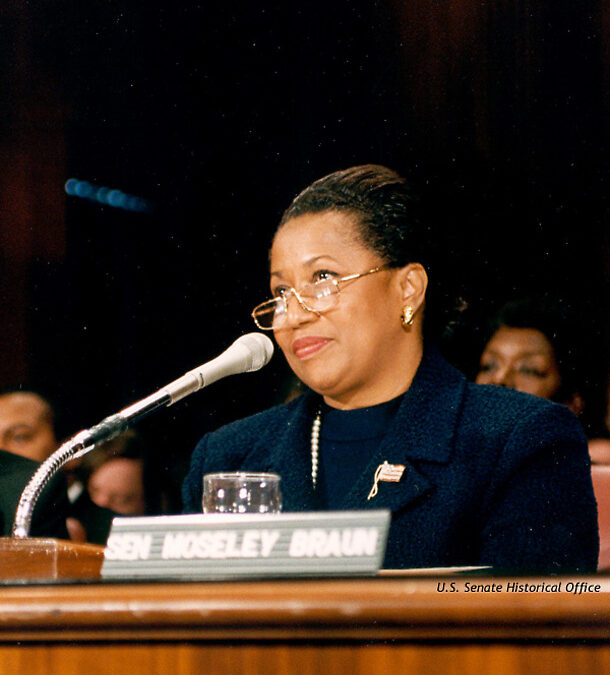
When Carol Moseley-Braun was elected to the U.S. Senate in 1992, she was the first female African American senator. As she recounted to listeners of NPR’s Hidden Brain in 2016, Braun assumed that racism would be a more formidable obstacle to her success as a U.S. Senator than gender bias. But that is not what happened.
When Braun made impassioned pleas on the floor of the Senate supporting her positions for voting rights and gun control (to name a few), all her male colleagues heard was the voice of a shrill black woman — at least that was the disappointing and humiliating narrative Braun felt in her soul.
“I think in some regards the gender biases are more profound and more central to our culture than even the racial ones, and that to me was a surprise,” she said.
Damned if You Do, Damned (or doomed) if you Don’t
I have described potential double binds in the context of women’s mating strategies in Double Binds Imposed on Men.
But what about the double binds that women face?
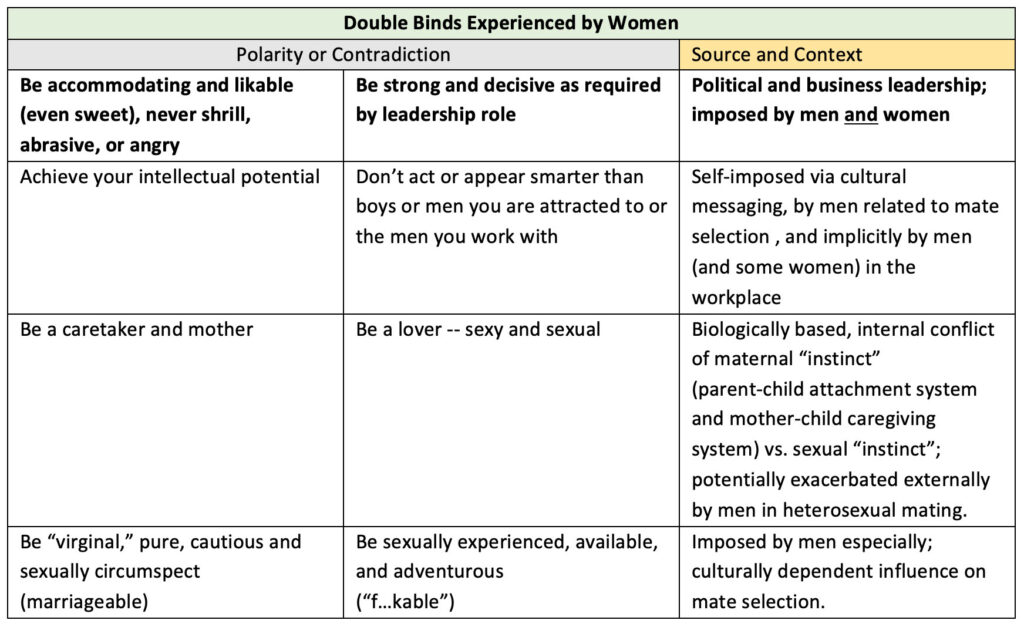
Women face double binds that involve the biological, evolutionary, and cultural application of mate selection and relationship dynamics. (See chart at end of post.) I will address them another time. For now – let’s address a pressing concern: There are double binds facing women in American leadership.
Caution Ahead
Braun’s experience was a cautionary tale. Hillary Clinton’s 2016 presidential candidacy appeared to underscore the problem. Leaders must sometimes be strong, tough, assertive, and decisive. Yet women leaders are expected to be accommodating and likable (even sweet), and never shrill, abrasive, or angry. This is an untenable dilemma.
The double bind that challenges women in political and corporate leadership affects all of us. It not only impedes the advancement and service of individual women, but it also reduces our nation’s capacity for problem-solving, policymaking, and innovation. Women leaders in politics and business bring sensitivities, interests, and emotional intelligence that improve our decision-making and enhances our health and cultural well-being.
There are evolutionary roots to this double bind. They include sex differences, preferences for spheres of influence (group systems vs. family), and adaptations for the division of labor.1 But we can and must move beyond the “shadow” of our evolutionary causations in order to secure the future health of American democracy.
Biases that Women Face – Embedded Societal Expectations
A Pew Research Center study (2017) asked people: “what traits or characteristics do you think society values most in women and in men?” Respondents said men were valued (in rank order) for their honesty and morality (33%), professional and financial success (23%), ambition and leadership (19%), strength and toughness (19%), hard work (18%), and physical attractiveness (11%). Women were valued for their physical attractiveness (35%), empathy, nurturing and kindness (30%), intelligence (22%), honesty and morality (14%), ambition and leadership (9%), and only 5% for strength and toughness. Notably, when asked what trait women should not have, 28% of respondents mentioned traits related to ambition, leadership and assertiveness, far more than any other trait or characteristic.
These are very strong headwaters of bias to swim against for women aspiring to and serving in leadership roles.
Research on Gender Stereotypes
Research by Madeline Heilman (Professor of Psychology, New York University) focuses on gender stereotypes and bias, particularly when it comes to leadership. In one study, Heilman asked volunteers to evaluate a high-powered manager who was coming into a company. When the candidate was presented as a very ambitious and high-powered women, the person was seen as unlikeable; but not so when the very same person was presented as a man. Heilman says “we have conceptions about these jobs and these positions and what is required to do them well, and there’s a lack of fit between how we see women and what these positions require.” Double binds arise in our minds because our minds are trying to align our stereotypes about men and women with our stereotypes about leadership.
These biases are not just held by men. They are held by both sexes, which explains why female leaders encounter derision and suspicion from both men and women.
Gender Attributions about Emotions
Researcher Lisa Feldman-Barrett at Northeastern University (How Emotions Are Made, 2017) had subjects look at faces of men and women and assess their emotions and the context of that emotion. When looking at male faces expressing emotion, respondents said the man was just having a bad day – or something bad had happened to him. Whereas, when women expressed emotion, they were described as neurotic or unstable. Men’s emotions were attributed to what was going on around them, but women’s emotions were seen as shaped “by their nature.”
Feldman-Barrett found that if women expressed too much emotion, they were seen as unsuitable for leadership or unstable in some way. Emotional men were seen as mostly rational or level-headed. But if a woman did not express enough emotion, they were seen as not warm, empathetic, or trustworthy (the “Hillary effect”). Apparently, a woman can get in trouble for expressing emotion and for not expressing emotion. This is a toxic double bind.
“Women Take Care and Men Take Charge” — Redefining Leadership Itself
Although the Pew survey results align with an understanding of biological sex differences and mate selection trait preferences, what is “natural” is not necessarily good for us. Even if gender stereotypes have a deep evolutionary past, they cause no win-situations for women leaders in our present-day politics, and that hurts all of us.
“The female gender role is based on the stereotype that women are nice and kind and compassionate,” says social psychologist, Alice Eagly (Through the Labyrinth: The Truth About How Women Become Leaders, 2007). By contrast, “in a leadership role, one is expected to take charge and sometimes demonstrate toughness – make tough decisions and be assertive in moving the organization forward, and sometimes fire people for cause.” The good news, says Eagly, is that our views of men and women are changing, and our ideas about the meaning of leadership are changing.
Indeed, it is time to redefine what it means to be a leader in the American political arena. The less we see leaders as alpha males, the easier it will be to see women as leaders. Fortunately, that redefinition has been going on in the corporate world for many years.
Three Predicaments
Catalyst2 is an organization that supports “workplaces that work for women.” They have identified three “predicaments” (double bind dilemmas) that women leaders face:
1. Extreme perceptions: too soft, too tough, and never just right. When women act in ways that are consistent with gender stereotypes, they are viewed as less competent leaders (too soft). When women act in ways that are inconsistent with such stereotypes, they’re considered unfeminine (too tough).
2. High competence threshold: Women leaders face higher standards and lower rewards than male leaders. Women have to prove they can lead over and over again and constantly manage stereotypical expectations.
3. Competent but disliked: Women leaders are perceived as competent or likable, but rarely both.
The Hillary Trifecta
Hillary Clinton embodied all three predicaments. She was seen as shrill, cold, and not emotional. (But not in private.) The standards for judging her performance as Senator and Secretary of State were always very high. And her competence, while arguably beyond reproach, made her somehow unlikeable. From the seven-minute standing ovation she received as the first student to speak at a Wellesley College commencement, Hillary had the additional problem of being one of the first women of her generation to break with the traditional role of wife. She was the first First Lady to have an office in the West Wing of the White House.
Strategies to Dismantle the Leadership Double Bind
Catalyst suggests three strategies for dismantling the women’s leadership double bind:
1. Interrupt bias. Speak up if you hear colleagues use words that reinforce negative gender stereotypes such as, “she is abrasive”,” “she is so emotional,” or “she talks too much.” Alexandria Ocasio-Cortez spoke up.
2. Use the same standard for women and men when evaluating employees. Reverse the gender of the person you are evaluating to see if it makes a difference in your language or assessment.
3. Be a visible champion. Promote the accomplishments of women and actively advocate for their development and advancement, thus serving as a role model for others to do the same.
Redefining Leadership is Actually Old News
The field of organizational development has been redefining leadership for 50 years. Beginning in 1970 with the ground-breaking Center for Creative Leadership, the field gained momentum with such landmark books (and practices) as Peter Senge’s The Fifth Discipline (1990), Roger Schwartz’ The Skilled Facilitator (1994), and William Isaacs’ Dialogue and the Art of Thinking Together (1999). The science and art of participatory decision making and teamwork has been clear in its message: the process of generating information and making decisions (process leadership) are as important as content, task, or subject matter expertise. Women arguably have a more natural affinity (both interest and skill) for process leadership than do men. It is, of course, totally within the capacity of men to do this. I certainly did in my career as a facilitator and group process designer.
Busting the Double Bind Paradigm
A Zen master says to his pupils: “If you say this stick is real, I will beat you. If you say this stick is not real, I will beat you. If you say nothing, I will beat you.” One pupil, however, found a solution by changing the level of communication. He walked up to the teacher, grabbed the stick, and broke it.
A redefinition of leadership includes (as in the practice of process facilitation) a redefinition of the double bind itself. A double bind is built inside a box of “either/or” thinking. Collaboration is built on “both/and” thinking. There is an entire discipline of problem-solving and thinking skills for generating collaboration and consensus. As a fun warm-up, organizational development consultants sometimes facilitate comedy improv exercises to practice a variant, “yes/and” thinking. Can we get Mitch McConnell and his buddies into a month-long retreat?
Interdependent Polarities
A double bind can often be seen as an interdependent polarity.3 There is a sweet spot between likable and strong, in a “dance” of situation and context. Whereas men tend (on average) to be more binary thinkers, women (on average) are good at “both/and” thinking if left to their own devices. Organizational consultant Tim Arnold (The Power of Healthy Tension: Overcoming Chronic Issues and Conflicting Values, 2017) encourages leaders to embrace a healthy “tension.” Perhaps double binds are not a problem to solve but instead a tension or paradox to manage.
Signs of Progress – Membership Has its Privileges
The 116th U.S. Congress (2019-2021) has 127 women (23.7 percent) — the highest percentage ever. But less than 1 in 4 women lawmakers does not make new a political “culture.”
The New York Times recently addressed the seven biases that women face: “In Her Words: 7 Issues, 7 Days.” “Women in Politics” (day 6) noted that in 2019, Nevada became the first state legislature to have more women — 23 out of 42 seats in the Assembly. Women make up 40 percent or more of the legislatures in Colorado, Oregon, Washington, and Vermont, with Maryland almost at that percentage. A balance of more women in political leadership should help reduce the prevalence and toxicity of double binds that women face.
Beyond the “Pantsuit”
A year after Braun was elected to the U.S. Senate, she and Senator Barbara Mikulski broke the unwritten rule that women were not allowed to wear pants on the Senate floor. In what she calls the “pantsuit episode,” Braun explained: “I was wearing my nice outfit, I thought, and I walked onto the Senate floor and gasps were audible.” That was in 1993 – only 23 hears before Hillary Clinton would become the first female presidential nominee for a major political party, pantsuits and all. Leadership had a new look. But biases and double binds? Not so much. We still have work to do.
1. Gender/sex-based spheres of influence and the development of human culture is a very important area of focus and will be explored more in this space at a later time.
2. Founded in 1962, Catalyst is a leading research and advisory organization that works with business and professions to build inclusive environments and expand opportunities for women at work using practical tools and proven solutions to advance women into leadership.
3. There is much more to be said about interdependent polarities in relationships (and not just heterosexual relationships). As explored by Esther Perel and others, here are some key polarities: predictability vs. novelty, security vs. adventure, autonomy vs. surrender, comfort vs. excitement, and freedom vs. commitment.
Please Note: Your comment may take up to 12 seconds to register and the confirmation message will appear above the “Submit a Comment” text.