Political Divide – Part 3: Review and Introduction to Moral Foundations

Political Divide – Part 3: Review and Introduction to Moral Foundations

I have striven not to laugh at human actions, not to weep at them, not to hate them, but to understand them ~ Baruch Spinoza, Tractatus Politicus, 1676

Below is a summary/review of key ideas from Parts 1 and 2 of this series that come (mostly) from research compiled by Hector Garcia in Sex, Power and Partisanship, How Evolutionary Science Makes Sense of Our Political Divide (2019).  As with the chart on male-female evolutionary affinity in the Appendix, I am highlighting aggregate, research-driven observations that do not describe a particular individual or attempt to explicate the continuum of human behavior.

The Meaning of Righteousness

This post also introduces the tenets of Jonathan Haidt’s moral foundations theory in preparation for a deep dive in my next post.  Drawing from Haidt’s brilliant book (The Righteous Mind), I will outline the moral foundations of liberals, conservatives, and libertarians.  Stay tuned for that in Straight Talk Tuesday on December 8.

Review of Key Ideas from Parts 1 and 2

Let’s revisit some important ideas from Evolutionary Science and Our Political Divide: The Root of  It – Part 1 and Root of Our Political Divide – Part 2: Post-Trump Authoritarianism.

Male-centric and Female-centric Strategies
  • Conservatism is a male-centric strategy shaped by the struggle for dominance in mate competitions, while liberalism is a female-centric strategy derived from the protracted demands of rearing human offspring.
Daddy vs. Mommy
  • Liberals (essentially Democrats) represent the “mommy” party (coined by Chris Mathews) with a focus on our health and welfare, including Social Security and Medicare.
  • Conservatives (essentially Republicans) represent the “daddy” party with a focus on economic security and national defense. Conservative moral values arise from what George Lakoff (Moral Politics), calls the “strict father family” model.
Freedom Has At least Two Meanings
  • Conservatives promote individual freedom (within constraints of group norms) and self-reliance, primarily defined as freedom from government.
  • Liberals promote fairness, equality and freedom from injustices. The root of liberalism is the effort to rein in dominant males to prevent them from monopolizing resources that impinge upon the evolutionary fitness of those with less power.
Personality Matters
  • Liberalism is characterized (on the Big Five Personality Scale) by an openness to experience (xenophilia).
  • Conservatives show more conscientiousness (preference for order and control) and a preference for more “closed” cognitive systems as measured on the Big Five Personality Scale. Conservatives score more highly than liberals on measures of following rules, traditionalism, and dedication to the existing way of doing things.
In-group vs. Out-group is Damn Near the Entire Ball Game
  • Conservatives have a strong preference for in-group members and show more ethnocentrism and xenophobia (fear of outsiders) than liberals. Xenophobia helped our ancestors avoid diseases from outsiders.  Because ancestral men could not leave their group for fear of death, xenophobia towards outsiders and dominance over other groups was evolutionarily sensible. (See Haidt insight #5 below.)
Conservatives are More Disgusted by Pathogens and Sexual “Stuff”
  • Conservatives have more “disgust” sensitivity than do liberals. They show more fear of pathogens and disapproval of “nonnormative” sexual behaviors.
Women and Liberals Are More Empathic
  • Women and liberals show more empathy than men and conservatives. Less empathy among men had evolutionary “fitness” benefits.
  • Women and liberals are more concerned with fairness and turn-taking than conservatives.
Conservatives Have a Dominance and Masculine Orientation
  • Conservatives are more comfortable with social hierarchies and score higher on the Social Dominance Orientation scale than do liberals.
  • Conservatism is correlated with masculinity, physical stature, and spatial abilities used to survive a harsh ancestral environment.
Conservatives are Triggered More by Threat
  • Conservatives (especially men) may exhibit authoritarian personality traits when triggered by “threats” from outsiders and the experience of economic displacement.
Six Moral Foundations

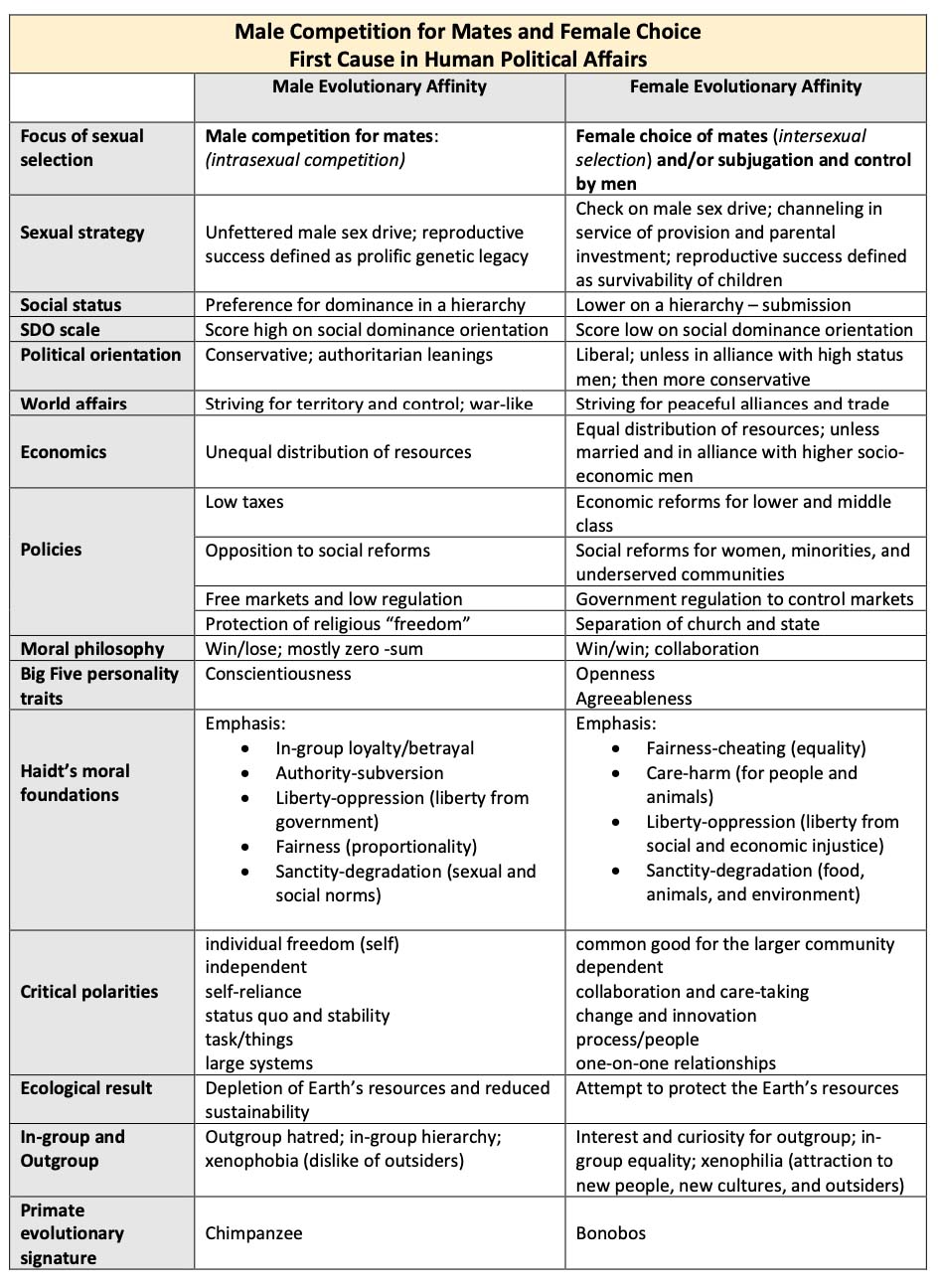
In the next (and last) post in this series,  I will explain the moral foundations theory of Jonathan Haidt.   Haidt uncovers the sources of belief that “create” liberals and conservatives and reveal why folks identify with, and vote for, Democrats or Republicans.  Haidt has named six moral foundations central to the human experience: care/harm, fairness/cheating, loyalty/betrayal, authority/subversion, sanctity/degradation, and liberty/oppression.   Haidt claims that liberals primarily use three foundations – care/harm, fairness/cheating, and liberty/oppression, whereas conservatives utilize all six.  Haidt’s moral foundations are signified on the “first cause” chart in the Appendix becuause they adhere to male versus female evolutionary polarity.

Instinctual Legitimacy of Both Sides

Haidt tells us that moral psychology is not just about how we treat one another, it is also about binding groups together, supporting essential institutions and living in a sanctified and noble way.  Moral foundations theory provides very important insights about the instinctual legitimacy on each side of the political divide.

How to Engage is Not Based on Reason

In my next post (December 8), I will also share thoughts about how we might engage each other in a way that allows more understanding, compassion, and acceptance.  As you will witness, neither the content nor the process of unification is based on reason or facts.  For now, as preparation for details about the moral foundations, let’s reflect on ten insights from Haidt’s research (adapted from Creative Conflict Wisdom’s Blog, 2012).  Keep these in mind for holiday conversations; I will give more practical tips on December 8.

Ten Insights from Jonathan Haidt

“Your mother and I are separating because I want what’s best for the country and your mother doesn’t.” ~ Cartoon caption from The Righteous Mind, p 318

1. Intuitions come first, strategic reasoning second.

The “Elephant” (our automatic self-righteous pattern recognition) directs the “Rider” (our rational conscious brain) much of the time, and in conflict, makes us invent (retroactively) rationalizations for our positions, without much account of our real interests, let alone the interests of the other side.

2. There’s more to morality than harm and fairness.

Much of the world adds loyalty, authority, sanctity, and liberty to their moral sensibilities (moral foundations). The spectrum of moral foundations is broader in non-Western societies (and among conservatives).

3. Pluralism is not relativism.

There is a plurality of ideals, but they are finite.  “Everything doesn’t go,” but we can understand other ideals even when we don’t share them.

4. Morality binds and blinds.

We are products of multi-level selection and in tension between our selfish and groupish tendencies.  Religion helps create ever larger moral communities. Our moral frameworks create group cohesion but also blind spots about how the frameworks operate inside us.

5. We have a “hive switch.”

We have a capacity to transcend self-interest, like bees acting in unison for the hive. But, we are predominantly structured for hierarchy with in-group versus out-group psychological mechanisms. (The “entire ball game” above.)

6. We are not as divided in politics as moral dualists (Manichaeans) would have you believe.

Some people are “good” and some are not, but our minds are designed for groupish righteousness that makes those distinctions suspect.

7. We are deeply intuitive creatures.

Our gut feelings drive our strategic reasoning.

8. It is hard to connect with those who live in different moral matrices.

But it is not impossible to connect with another person if you acknowledge and understand their moral foundations.

9. Look for commonality.

Before wading into morally-based arguments, establish some trust, show some interest, and listen for what you have in common.

10. Some things are sacred to others as some things are sacred to you.

Don’t try to “bargain” as if the sacred is not part of the equation.  Jerusalem is not for sale by Jews, Israelis, Muslims, or Christians, but that doesn’t mean we can’t find some way out of that conflict.   Consider the conflicts about wearing a mask and following Donald Trump – even that evokes the sacred.  (With a nod to #3 above — not “everything goes.”)  As Haidt says, “We are all stuck here for a while, so let’s try to work it out.” 

Appendix

Nature provides a first draft, which experience then revises; built-in does not mean unmalleable; it means organized in advance of experience. ~ Gary Marcus, neuroscientist

The chart below is a meta-theoretical understanding of male and female evolutionary tendencies and captures many insights from Parts 1 and 2 of this blog series.

Please Note: Your comment may take up to 12 seconds to register and the confirmation message will appear above the “Submit a Comment” text. 

Root of Our Political Divide – Part 2:       Post-Trump Authoritarianism

Root of Our Political Divide – Part 2: Post-Trump Authoritarianism

Trump’s appeal resides on the primordial plains of Africa, where human leadership preferences were formed by the brutalities of daily living. ~ Hector Garcia

As part of a post-mortem on the presidential election, I will turn my attention to the “slide” of conservatism into full-blown authoritarianism — from a “normal” conservative fear of outsiders into the xenophobic overload that characterizes the authoritarian personality.

The Divide Inside the Mandate

Joe Biden got more raw votes than any presidential candidate in history. In comparison to the percentage of votes garnered by winning Presidential candidates in the past 30 years, only Barack Obama in 2008 got a higher percentage of votes (52.9) than Joe Biden. Most pundits would call this a strong mandate. But for many of us, this did not feel like a repudiation of Donald Trump – not the kind of cathartic dismissal we were hoping for. Seventy million Americans voted for Donald Trump, more votes than he received in 2016. Democrats lost seats in the House. State legislatures did not get more ‘blue” and the Senate portends a doubtful (yet still possible) majority for Democrats.

We Are More Tribal Than Ever

We are a tribal nation in a tribal media ecosystem. Even if Biden had won by 10 million or more votes, we would still be a nation of roughly 20-30 million Americans with a latent or activated authoritarian personality. It behooves us to understand who they are and how they “happened.” Authoritarianism in America is not going away with the defeat of Donald Trump. Far from it. Columnist Dana Milbank wrote on November 6: “The next couple of years could be ugly and unproductive. But gone will be a president who daily weakens democracy with authoritarian tendencies. Out will be a man who fuels our basest instincts with racism, vulgarity, vitriol, violence, self-dealing lies and conspiracy theories.” Yes, this particular despot is gone as President (not as leader or media mogul), but his followers and their subjective grievances remain in the American family.

My God — It Took A Pandemic

As Molly Ball most aptly put it (Time, November 5), “Win or lose, Trump has engineered a lasting tectonic shift in the American political landscape, fermenting a level of anger, resentment and suspicion that will not be easy for his successor to surmount. Even with a Biden win, “it’s still that case the an openly bigoted aspiring authoritarian not only won the presidency but captured the complete loyalty of one of two major political parties, and – but for a once-in-century-pandemic, he might have been reelected.”

Revisiting The Root of It – Part 1

In my last post, Evolutionary Science and Our Political Divide: The Root of It – Part 1, I provided evidence that:

  1. Human mating strategies (sexual selection) undergird our political affiliations and are extricability linked to evolved sex differences between men and women. A male-centric reproductive strategy is shaped by struggles for dominance in mate competitions, while a female-centric strategy is shaped by demands of rearing offspring.
  2. There is a fundamental gender gap in partisan political preference. Females tend to be political liberals (the “mommy party”) and males tend to be political conservatives (the “daddy party”) based on the evolutionary adaptations required of each sex.
  3. Conservatives (and men) are more comfortable with social hierarchies than liberals. Women lead the charge to check the impulses of dominant and authoritarian men unless they want to mate with them (a common collusion in primate and human mating).
  4. The psychology of in-group vs. outgroup and xenophobia vs. xenophilia, are driving forces of political affiliation. Conservatives are more xenophobic than liberals and men are more xenophobic than women.

This post will build on the above tenets with a closer look “downstream” into the roots of authoritarianism. Authoritarianism comes out of the aspirations for dominance among men and the fears and hopes of those who follow such men. I will address the psychology of social dominance and touch on the politics and psychology of the aforementioned gender gap, especially related to male identity. I will draw from a variety of post-election analyses but will start with foundational insights from Hector Garcia’s groundbreaking book (central to Part 1 of this series): Sex, Power, and Partisanship: How Evolutionary Science Makes Sense of Our Political Divide.

Struggle to Maintain Dominance Hierarchies

Hector Garcia sums up the implied motivation of the despotic leader: “Among humans, as among all social animals, a higher position on the dominance hierarchy affords preferential access to territory, food, and mates. And so, while political science rarely describes socioeconomic stances in evolutionary terms, the struggle to maintain dominance hierarchies, or to equalize them, reflects our long history of vying for position in rank-stratified primate social groups. Moreover, if conservatism reflects an extreme form of the male brain (see Evolutionary Science and Our Political Divide: The Root of It – Part 1) and liberalism its inverse, then we would expect to find evidence that conservative economic policy is embedded in a male reproductive strategy, and liberal economic policy in a female reproductive strategy. And this is exactly what we find.”

Authoritarianism is a product of our male-gendered psychology forged through the pressure of male mate competition. ~ Hector Garcia

Social Dominance Orientation

Political scientists have developed a measure called Social Dominance Orientation (SDO) to reflect the extent to which an individual wishes his or her group to be dominant over another group. People who score higher on the SDO scale favor hierarchy-enhancing ideologies and policies, whereas those lower on SDO tend to favor ideologies or policies that lessen hierarchies. SDO has been consistently found to predict conservatism and its corollaries, including economic conservatism and racial prejudice.

Men and Conservatives Favor Hierarchies

Men score higher on SDO than women. This difference holds across age, culture, nationality, religion, income level, educational attainment, and political ideology. Political conservatives generally score higher on SDO than do liberals. Men with high testosterone levels tend to have higher SDO scores. Those with high SDO are more likely to support war.

High SDO Disfavors Domestic Policies But Favors Patriotism

SDO also has implications within groups. It correlates negatively with domestic policies such as affirmative action, social welfare programs, support for women’s rights, and issues concerning the sexual control of women. Higher social dominance not only disfavors the out-group, but it also favors the in-group. Accordingly, SDO is associated with greater patriotism – a commitment to the larger tribe. Patriotism is a more strongly expressed value of conservatives and Republicans.

“Father Knows Best”

In George Lakoff’s 1996 book, Moral Politics, he examined how political values tend to arise from the fact that we are all first governed in our families. The way your ideal family is governed is a model for the ideal form of government. This is often how your real family is governed, though some people rebel and adopt an opposite ideal.

Conservative moral values arise from what Lakoff calls the “strict father family.” In this model, father knows best. He decides right and wrong. He has the ultimate authority to make sure his children and his spouse accept his worldview and uphold his authority. It is his moral duty to punish his children painfully when they disobey. If his “children” do not prosper, they are not disciplined and so deserve their poverty. Responsibility is thus taken to be a personal responsibility, not a social responsibility. You are responsible for yourself, not for others.

Who’s On Top?

“All politics is moral, ” says Lakoff. “Voters don’t vote their self-interest. They vote their values.” This is how Lakoff saw the conservative-based moral hierarchy in 1996:

  • God above man
  • Man above nature
  • The disciplined (strong) above the undisciplined (weak)
  • The rich above the poor
  • Employers above employees
  • Adults over children
  • Western cultures above other cultures
  • Men above women
  • Whites above nonwhites
  • Christians above non-Christians
  • Straights above Gays
Trump Supporters Have a Strict Father Morality

Conservative policies flow from the strict father worldview and this hierarchy. Trump is an extreme case, though very much in line with conservative policies of the Republican party and with an authoritarian personality. Most Trump supporters have a strict father morality. The Trump presidency gave them self-respect. Their self-respect is more important than the details of his policies, even if some of those policies hurt them. (See “What’s the Matter With Kansas Redux” below.)

Strict Father Can Be Despotic

Fred Trump was the quintessential strict father for his son, Donald. He brow-beat him into the ways of dominance. By the time Donald was sent to the military school, he was ready to put it into practice. Donald thrived in the hierarchical environment of military school and learned the efficacy and “joy” of being a bully. He learned the ways of authoritarianism directly from his mean and despotic father, a loveless mother, and a military school education that supported and developed his personality as a top-dog abuser.

Trump embodies the classic authoritarian leadership style: simple, powerful and punitive. ~ Amanda Taub

Despot’s Apprentice

According to Brian Klass (The Despot’s Apprentice: Donald Trump’s Attack on Democracy), our exiting President checked all the boxes in the despot’s playbook:

  • Scapegoated minorities
  • Attacked the press
  • Put cronies in a position of power
  • Promoted outright nepotism
  • Used office for personal economic gain
  • Spread misinformation about opponents
  • Called for the jailing of opponents
  • Did not agree to a peaceful transfer of power
The Authoritarian Personality

Since WWII, many social scientists sought to understand the psychology that gave the world Hitler. Drawing from that research, psychologist Robert Altemeyer devised a concept called ring-wing authoritarianism and created a short survey instrument (RWA) to measure it. The RWA is the most widely used assessment of the authoritarian personality.

Altemeyer’s research found four strongly held beliefs and behaviors that characterize the authoritarian personality:

  1. submission to authorities
  2. conforming to social conventions and rules perceived to be endorsed by society
  3. aggressiveness directed against persons perceived to be sanctioned by authorities
  4. general aggression against outsiders
“Stomping Out the Rot”

Using the RWA in 2019, Monmouth University Polling Institute found that the stronger the Trump supporter, the higher the person scored on the RWA. People strongly disapproving of Trump scored 54, while those who supported him had an average score of 119, more than twice as authoritarian as Trump opponents.

In the Monmouth poll, over half of Trump’s supporters agreed with the statement: “Once our government leaders and the authorities condemn the dangerous elements in our society, it will be the duty of every patriotic citizen to help stomp out the rot that is poisoning our country from within.” This authoritarian aggression is a central part of the RWA personality.

Authoritarian Nightmare

In their book, Authoritarian Nightmare (2020), John Dean and Altemeyer analyzed data from a previously unpublished nationwide survey that showed a desire for strong authoritarian leadership among Republican voters. Altemeyer and Dean described Trump supporters as “submissive, fearful, and longing for a mighty leader who will protect them from life’s threats.” They found shockingly high levels of anti-democratic beliefs and prejudicial attitudes among Trump backers, concluding: “Trump supporters will be a potent pro-authoritarian voting bloc in the years to come. Even if Donald Trump disappeared tomorrow, the millions of people who made him president would be ready to make someone else similar president instead.”

Allegiance to Leader – Animus to Outsider

Right-wing authoritarianism (RWA) indicates passive deference to authoritarian leaders. SDO indicates a willingness to target outside groups. These two psychological motivations will often, if not always, be in synch with another. Like SDO, RWA is associated with xenophobia, being closed to experience, and political conservatism.

These two constructs reflect survival strategies underlying the conservative political stance: targeting outsiders (SDO) while following authorities who protect them against an external threat (RWA).

Rise of American Authoritarianism — We Saw This Coming

An amazingly prescient piece about authoritarianism in America appeared in Vox, on March 1, 2016 (written by Amanda Taub). Donald Trump had not yet won the Republican nomination for President but political scientists, sociologists, and psychologists were convening behind the scenes with alarm — like astronomers from separate observatories who finally resigned themselves to the reality that a comet was heading toward earth. A 2016 exit poll out of South Carolina had found that 75 percent of Republican voters supported banning Muslims from the United States; another poll found a third of Trump supporters were in favor of banning gays and lesbians from the country. Twenty percent said Lincoln should not have freed the slaves.

GOP Attracted the Authoritarians

In their book, Authoritarianism and Polarization in American Politics (2009), Marc Hetherington and Jonathan Weiler predicted Trump’s rise. They concluded that the GOP, by positioning itself as the party of traditional values and law and order, had unknowingly attracted a vast and previously bipartisan population of Americans with authoritarian tendencies.

“Whatever Action Is Necessary”

While at the University of Massachusetts, Mathew MacWilliams did his dissertation on the authoritarian psychological profile (of followers, not dictators). MacWilliams found that when these followers feel threatened, they look for strong leaders who promise to take whatever action is necessary to protect them from outsiders and prevent the changes they fear. This was a survival-based response to xenophobic overload.

How Many Are There?

Pollster Kyle Dropp of Morning Consult found that 44% of white respondents nationwide scored high or very high on his authoritarian survey questions. More than 65 percent of people who scored highest on authoritarianism were GOP voters. At the other end of the scale, the pattern reversed. People who scored low on authoritarianism were 75 percent Democrats.

The size of this new constituency in the U.S. is now bigger because of Trump, or at least more toxic and dangerous. They are fueled by continuing threats of social change and an out-of-control social media that activates latent authoritarianism by selling threat from outsiders.

“Sliding” into Authoritarianism

 The “slide” from conservatism into authoritarianism takes:

  • a despotic, authoritarian, rhetorically clever leader
  • continued economic displacement and social-cultural change, and
  • a degraded media and informational ecosystem that amplifies the feeling of threat and “activates” authoritarian impulses.
“Activating” Authoritarians

According to researcher Karen Stenner (The Authoritarian Dynamic, 2005), there is a certain subset of people who hold latent authoritarian tendencies that can be triggered or “activated” by the perception of physical threat or by destabilizing social change. What might look on the surface like bigotry, Stenner suggests, is really more of a generic susceptibility to messages about any group identified as objects of concern. Returning to Altemeyer’s research above, this illustrates aggressiveness directed against persons sanctioned by “authorities” such as Trump, Twitter, and Fox News.

Action-side of Authoritarians

“Whatever action is necessary” looks like a plot to kidnap the Governor of Michigan. It looks like a “Trump train” bearing flags and banners, swarming around a Biden-Harris campaign bus on a stretch of I-35 in Hays County, Texas. Trump joked about this on the campaign trail and gleefully criticized the FBI for wanting to investigate. Trump-supporter caravans also blocked traffic in New Jersey and New York. The Republican convention provided a prominent speaking slot to a white couple from St. Louis who face felony charges for brandishing guns at racial-justice protestors. According to authoritarian researcher Stanley Feldman, it is the scale of the desired responses, the action side that most distinguishes authoritarians from the rest of Republicans.

Authoritarians Will Still Be Here

What Amanda Taub (Vox) said in 2016 looks even more true four years later: “If Trump loses the election, that won’t remove the threats and social changes that triggered the ‘action side’ of authoritarianism. The authoritarians will still be here. They are a real constituency that exists independently of Trump. They will look for candidates who will give them the strong, punitive leadership they desire. And that means Donald Trump could be just the first of many Trumps in American politics, with potentially profound implications for the country.”

Authoritarianism and Masculine Identity

Conservative columnist and Senior Fellow at the Ethics and Public Policy Center, Mona Charen, asked on November 7, 2020, “what does this election tell us?” One of her answers pointed to masculine identity:

There is a problem with masculinity in this country. The gender gap is now a chasm; we need to think more deeply about how we are raising men.

Dark Triad and Male Identity Anxiety

Authoritarian followership includes a heavy dose of male identity anxiety, perceived threat from outsiders, and a willingness to act-out to defend “territory” and unconsciously, defend access to mating opportunities. Trump is macho by design (developmentally and genetically) and embodies the “dark triad” personality: narcissism, Machiavellianism, and psychopathology. Trump’s attention-seeking narcissism is perfect fuel for finding and encouraging male followers who feel a threat to their manhood.

Losers in the Mating Game

In a prior post (Dynamics in the Mating Economy: Domain #1 of Male-Female Difference), I explain the “reproductive variance” between men and women throughout our evolutionary history: essentially, compared to women, most men do not reproduce — they are losers in the mating game. As proven by DNA studies, most authoritarian men in human history were sexually prolific. This dynamic — the fact of winner-take-all sexual access, is relevant to the discussion of the male identity crisis that looms in the underbelly of the male authoritarian personality and fuels its xenophobia and grievances.

“Young Male Syndrome” Around the World

Young men often enter mate competition with fewer resources to offer woman, what behavior ecologists call “embodied capital.” When young men face the peril of being shut out of the mating game, violent risk-taking has been an evolutionarily sensible strategy. Today, risk-taking and antisocial behaviors are strongly associated with being young and male across societies world-wide and men at their reproductive peak tend to be most inclined to violence, a phenomenon known as young male syndrome.*

These Boys Are More Angry Than Proud

The Proud Boys are a far-right, neo-fascist, male-only organization that promotes and engages in political violence. They feature “action-oriented” authoritarianism, white male grievance, and sexual control of women.

Proud Boys believe that men, especially white men, and Western culture are under siege. They officially reject white supremacy although members have participated in racist events. The name is derived from the song “Proud of Your Boy” from the musical adaptation of Disney’s film Aladdin. In the song, Aladdin apologizes to his mother for being a bad son and promises to make her proud. Proud Boys founder, Gavin McInnes, says the song is about Aladdin apologizing for being a boy. Proud Boys purportedly recruit right-wing, 15-30-year-old white males from the suburbs or exurbs.

Hispanic Men Looking for the Tough Guy

In the 2020 presidential election, Trump made inroads with Hispanic men in Texas and Florida. Former Texas Representative Jason Villalba says Trump’s macho image really resonated with Latino men in Texas who are focused on being strong and tough in the face of adversity.

University of Texas professor Eric McDaniel created a white masculinity threat index that measures the extent to which people believe that white males have become a discriminated-against group. McDaniel found that Hispanic men were more likely than white women, Hispanic women, or Black men, to believe that whites and men were discriminated against at higher rates than Blacks, Hispanics, Asians, women, gays, and people who identify as transgender. Only white men scored higher than Hispanic men on the index, suggesting an affinity (identity) between Hispanic and white men that might explain the durability of Trump’s appeal.

Trump As Folk Hero

Sociologist Arlie Russell Hochschild (The Atlantic, October 29) said that many white men feel their gender and race have been vilified. Their economic prospects are bad and the American culture tells them that their gender is also bad. So they have turned to Trump as a type of folk hero, one who can restore their former glory. Exposing themselves and others to the coronavirus is part of that heroism. One male Trump supporter told Hochschild, “Trump is willing to accept risk to win for the American people and Joe Biden is sitting in his basement.”

Subjective Truth: They’re Cutting In Line

For her 2016 book, Strangers in their Own Land, Hochschild interviewed folks in Louisiana and found their “deep story,” the emotional feels-as-if truth of their lives. She heard the metaphor of a long line of Americans standing on a hill, waiting to get to the top — to the American dream. But as they stand there, tired and eager, they see certain people are cutting the line in front of them. They see women, African Americans, and immigrants getting ahead, boosted by the government and its affirmative-action programs.

Many white men, in particular, feel “shoved back in line,” she writes. Unable to draw confidence from their mostly nonexistent wealth, or their jobs which are steadily moving offshore, they turn to their pride in being American, she said.

Identity Politics for White Men

Trump has allowed his male supporters to feel like “moral” Americans and superior to those they consider “other” or beneath them. Trump may not always represent his supporters’ economic self-interest, but he feels their emotional self-interest. Hochschild asserts “Trump is, in essence, the identity politics candidate for white men.”

In Search of the Lost Heroic

Men in this community, she said, are starved for a sense of heroism. They don’t feel good about themselves. Confronting the coronavirus is a way to show stoicism and to feel heroic again. Hochschild’s subjects think they can handle the virus just like Trump handles everything. “He’s kind of a bad boy, and they relate to that.” A Trump supporter from McKinney, Texas said, “the president comes off as a man; he doesn’t come off as weak.”

Degradation of Our Information Culture

Fake news consumption has tripled since 2016 according to a study by the German Marshall Fund. Facebook is a much greater vehicle for disinformation today and that information is tailored to increase attention for a specific user in a way that is pernicious and destructive to the rational processing of facts. US demand for news that is either distorted or plain false continues to grow – such as news about the pandemic or QAnon conspiracy theories.

Post-media Rhetoric – “Twitter Dee and Twitter Dumb”

In her recent book, Demagogue for President: the Rhetorical Genius of Donald Trump, Jennifer Mercieca explains how Trump ran as a dangerous demagogue and also a heroic demagogue. Trump used rhetorical strategies to polarize, delegitimize, and demonize but also strategies to bring people “closer.” (Each strategy, with its Latin name, has been observed throughout history.)

Mercieca says Trump was the first true “post-media rhetorical presidency.” Even though he relied dramatically on Fox News, he had the ability to go directly to the people and around the media via Twitter. These rhetorical strategies were particularly effective with the authoritarian personality.

What’s the Matter with Kansas Redux

As described in Thomas Frank’s book in 2004 (What’s the Matter with Kansas?), the white working class abandoned the Democratic party because of cultural arguments related to abortion, guns, religion, and same-sex marriage. Republicans convinced (“it’s the messaging stupid!”) these white voters that cultural arguments were more important than their dire economic circumstances. Then Republicans governed with a bait and switch. They delivered a conservative economic agenda (except for fiscal responsibility), cutting taxes on the wealthy, undoing business regulations, and undermining the social safety net that actually hurt these working-class voters.

Working-class Republicans?

There have been some claims (Benjamin Wallace-Wells in The New Yorker and columnist David Brooks) that the 2020 election revealed a potential multiracial working-class Republican party. I don’t buy it, at least not as it relates to actual working-class policies. Thomas Frank’s analysis still rings true. Yes, Trump supporters and authoritarians are decidedly populist and anti-elitist (though who is elitist changes to fit the rhetorical moment). But authoritarians don’t think much about organized labor. Working-class people voted for Trump based upon other appeals — anti-socialist propaganda, racist xenophobia, and outright machoism. If they stay with the Republican party, they are in for more bait and switch as it relates to their social and economic well-being. Trumpism is populist nationalism with a high dose of white grievance. This is more identity politics than is practiced on the Left.

Epilogue – First Step Toward Healing

While this post is a cautionary note about the nation’s political divide and a recognition of the challenges presented by so many authoritarian-leaning Americans citizens, let it be clearly proclaimed: Americans have chosen a next President who is the polar opposite of a despot and bully. Americans have fired a narcissist and hired a man with an extraordinary capacity for empathy. If Donald Trump was the authoritarian “infection,” Americans have just course-corrected with a powerful “antibiotic” — a first step toward healing.

My last post in this series will present a way forward to understand the moral foundations of liberals, conservatives, and libertarians, and a possible way to acknowledge what is held sacred by those who affiliate with each of those political orientations.

References

*Margo Wilson and Martin Daly, “Competitiveness, Risk Taking and Violence: the Young Male Syndrome” Ethology and Sociobiology, 6 no.1, (Jan. 1985) p. 230

Please Note: Your comment may take up to 12 seconds to register and the confirmation message will appear above the “Submit a Comment” text. 

Root of Our Political Divide – Part 2:       Post-Trump Authoritarianism

Evolutionary Science and Our Political Divide: The Root of It – Part 1

Male competition for mates and sex differences are first cause in human political affairs.

Since the advent of agriculture in human societies, nearly all impulses for male power and authoritarianism, and expressions of male dominance in a social hierarchy, have ultimately been the result of men competing for sexual access to women. All disputes over territory and wars between nations have their roots in out-group competition and the rewards of that competition for increasing mating opportunities. All causes of the unequal distribution of resources throughout all of human history are linked causally to the male reproductive strategy.

All impulses to check male authoritarianism come from men and women who lack resources and equality and exist at the lower end of a social hierarchy. Women primarily lead the charge to check the impulses of authoritarian men unless they want to mate with them. Liberal policies that strive to equitably distribute resources are more frequently backed by women.

Conservatives, and especially conservative men with power, are mostly interested in pursuing and maintaining male dominance and resist policies and governmental rules that change the status quo. Conservatives are most aligned with male needs and a male mating strategy. Liberals policies are more linked to a female mating strategy which focuses on the caretaking of children and other human beings.

Evolutionary Politics

The application of evolutionary science to our current political environment is quite revealing and instructive. In Sex, Power, and Partisanship: How Evolutionary Science Makes Sense of Our Political Divide (2019), Hector Garcia explores how evolutionary adaptations explain and predict our Left-Right political divide and a litany of issues. This post (and the one to follow) relies heavily on Garcia’s insights and the book’s 533 references of scholarship covering a broad range of disciplines.

Garcia applies the evolutionary lens to conservatism versus liberalism, equality versus hierarchy, and “big ape” authoritarianism; he reveals the “politics” of human mating strategies as a story of resource acquisition, sexual control, and the power of tribes. The underbelly of our political instincts has deep ancestral roots.

Planting and Staying Put Changed Everything

The study of human evolution shows that for most of our existence as a species, individual and community interests were in rough equilibrium. Our forging ancestors sought status, like all primates, but they generally acquired the highest status by doing things that benefited the group. Hunter-gatherers kept greed in check by employing guilt and shame among the group. Cooperation was essential to survival. Before agriculture, there were restraints on competition and evidence of coordination inside of the tribe.

With the advent of agriculture and civilization, a split began to occur. Individuals could acquire hitherto unimaginable status by accumulating wealth and power – often at the expense of family and community. Once agriculture drove out foraging, the need to cooperate was no longer essential to survival. It became every man for himself, except competition between tribes (out-groups) led to the development of coalitions and subsequent war between tribes and nations.

Size of the Tribe and Food Storage

Hunter-gatherer “tribes” tended to range in size from an extended family to a larger band of no more than about 100 people. Tribe-size groups were easier to regulate from within because hunter-gatherers could not store vast amounts of food to leverage their power base; there were limits to how much wealth and influence they could acquire. But when humans began to master agriculture, things changed drastically. Men used this power to achieve reproductive success in a zero-sum game. Zero-sum games are the root of inequality.

The Split

In the United States, the split between individual interests and community interests has become embedded in two ideologies: conservativism and liberalism. Conservatives promote individual freedom and self-reliance, primarily defined as freedom from government. Liberals promote fairness and equality and freedom from injustices suffered by a large segment of the community. In a later post, I will explain the foundations of morality that have shaped these positions. It is actually more complex than “individual vs. community,” but self-interest and the common good exist in a state of tension in most political ideologies. Understanding the moral foundations of conservatives and liberals is the only way for us to “listen to learn” from one another.

“Daddy Party” and “Mommy Party”

Republicans protect us with strong national defense; Democrats nourish us with Social Security and Medicare. Republicans worry about our business affairs. Democrats look after our health, nutrition, and welfare. It’s the traditional American family. “Daddy” locks the door at night and brings home the bacon. “Mommy” worries when the kids are sick and makes sure each one gets treated fairly.  ~ Chris Mathews (1991).

Gender/Sex and Political Affiliations

The existence of a fundamental gender gap in American political party affiliation has been reported for years. In 2009, Gallop concluded their survey analysis with this: “The fact that the gender gap persists not only across age groups, but within major racial, ethnic, and marital-status groups, reinforces the conclusion that a gender difference in political orientation is a fundamental part of today’s American political and social scene.”

In 2020, the gender gap has widened even more. The New York Times/Sienna College poll of July 16, 2020, found that women favored Biden by 22 points. White women with a college degree favored Biden by 39 points. The Wall Street Journal poll in August of 2019 found that white/non-college men favored Trump by 45 points, 67-22 percent.

“Barring a giant polling error, the 2020 election will witness the largest gender gap in partisan preference since women gained the franchise” (New York Intelligencer, “Men and Women Have Never Been More Politically Divided,” October 19, 2020).

Stereotypes and Political Affiliation

Political scientist Nicolas Winter looked at US survey data from the American National Election Study from 1972 to 2004 and that found voters overwhelming used more masculine stereotypes to describe GOP candidates and more feminine characteristics to describe Democrats.

In another study (2006), political scientist Monika McDermott administered the Bem Sex Role Inventory (BSRI) to 780 Americans, along with a series of questions about their political beliefs and behavior. The BSRI is one of the most widely used instruments to assess gendered psychology. For feminine traits, the BSRI asks participants to rate how much the following descriptors apply to him or her: “understanding, sympathetic, warm, loves children, compassionate, gentle, eager to soothe hurt feelings, affectionate, sensitive to the needs of others, and tender.” Masculine traits were described as “willingness to take risks, forceful, strong personality, assertive, independent, leadership ability, aggressive, dominant, willing to take a stand, and defends own beliefs.”

McDermott found that men and women who scored high on femininity were significantly more likely to identify as Democrat, and men and women who scored high on masculinity were more likely to identify as Republican.

Why Do Sex-Based Partisan Differences Exist?

Political partisanship arises from sex-based approaches to perpetuating our genes. Conservatism is a male-centric strategy shaped by the struggle for dominance in male competitions within-and-between groups, while liberalism is a female-centric strategy derived from the protracted demands of rearing human offspring.

Not all men enact a conservative strategy, nor do all women enact a liberal strategy. But we do see sex-based leanings — two bell curves, one tilting toward the political right for men, and one tilting to the left for women, with significant overlap between the curves.

Partisan Politics and Reproductive Dominance

The tribalistic flavor (us vs. them) of political conservatism, with its emphasis on female sexual control and hawkish territorial nature, is rooted in male mate competition – the ageless biological struggle for reproductive dominance. Male competition for women turns out to be the core driving force behind political issues.

The winner-take-all mentality of conservative economic policy is based on male competition for mates. War is team-based male-mate competition. The coalitionary psychology of men was forged by the risk of being annihilated by the outside tribe – and the potential gains of taking over the rival tribes’ territory, resources, and women. Militaristic logic embedded in that psychology maps squarely onto the hallmark values of political conservatism. It is from the context of violent male mate competition and its most heightened expression, war, that we are able to most fully understand the masculine tenor of conservative political psychology.

Roots of Liberalism

The roots of liberalism have arisen from the timeless effort to rein in dominant males and to prevent them from monopolizing resources and impinging on the evolutionary fitness of those with less power. Liberalism is based on the prodigious human task of raising children, a critical survival enterprise championed by women and provisioned by the “Mommy” parties of the world.

Big Five Personality Traits

Social scientists have developed various models for understanding human personality, the most widely researched of which is known as the “Big Five.” The Big Five personality traits are openness to experience, conscientiousness, extroversion, agreeableness, and neuroticism. Cross-cultural studies strongly suggest that Big Five patterns of interacting with the world are genetically based universals. Human personality traits, especially openness to experience, reliably correlated to political orientation.

Liberal Openness

Openness to experience is a hallmark of the liberal political orientation. This personality dimension reflects not only an openness to new things, policies, and programs, but also to other people. Liberals demonstrate xenophilia, an attraction to new cultures, and even outsiders. High openness is also related to sensation-seeking and a general appreciation for novelty and adventure. There is a moderate correlation of openness to the trait of extroversion – the tendency to be talkative and seek social interaction.

One large study (Gerber et al., 2010) of over twelve thousand Americans examined the Big Five personality traits as predictors of core social and economic values, as well as self-reported political ideology (a five-point scale ranging from very liberal to very conservative). The authors found that higher openness was associated with greater liberalism across all three measures of orientation.

Conservatives Fear Disease and Outsiders

Could fear of disease translate into fear of outsiders and political conservatism? Research has shown that individuals who have a higher perceived threat of disease show more ethnocentrism, greater xenophobic attitudes toward foreigners, and increased willingness to stigmatize socially marginalized groups. This is particularly ironic in the time off Covid-19 but will make sense in the context of conservative “moral foundations” described in a future post in this series.

Xenophobia: Membership Has its Privileges

Xenophobia is a dislike of outsiders and a corresponding preference for in-group members and values. This is not just about “outside” people and their physical differences, but also about differences related to language, customs, dress, sexual orientation, religion, nationality, political party, and even sports teams. This preference often manifests as a sense of patriotism and loyalty. Conservative political ideology predicts prejudice against an outside group. If xenophobia reflects an adaptation that helped our ancestors avoid contagious diseases from outsiders, we would expect to see xenophobia in modern times and conservatives exhibiting more fear of contagion.

Patrilocality and Human Warfare

Historically, humans have been mostly patrilocal – that is, women often left their natal group (i.e. more adapted to outsiders) whereas men stayed put with their male relatives. The resulting concentration of male blood relatives encouraged strong, trusting, and cooperative male bonds based on shared genes. The love and trust that related men have for one another have had profound implications for the human condition across time. Higher relatedness gave men greater confidence in risky cooperative enterprises, such as war. Patrilocality in human groups is associated with more frequent warfare.

Human Males Are Like Chimpanzees

Primatologists Richard Wrangham and Dale Peterson write that among four thousand mammals, only chimpanzees and humans follow this pattern of patrilocality, accompanied by “a system of intense, male-initiated territorial aggression, including lethal raiding into neighboring communities in search of vulnerable enemies to attack and kill.” Chimpanzee males are extremely hostile to outside males, thus males rarely transfer between groups. Any male attempting to transfer would be killed by the males of the out-group. By contrast, 50-90 percent of female chimpanzees transfer to other groups to breed once they reach sexual maturity. Whereas male transfers are seen as sexual competitors carrying foreign genes, females are welcomed as potential mating partners. (Again, the female-centric roots of xenophilia.)

Xenophobia and Band of Brothers

Thus, xenophobia is concentrated among men and has caused real dangers for them. Most of the world’s perpetrators of violence are men, but most of its victims are also men. The United Nations recently found that globally, 80 percent of homicide victims are men.

If ancestral men could not leave their group for fear of death, then turning inward to their band of brothers, remaining xenophobic toward outsiders, and favoring dominance over other groups was evolutionarily sensible. The over-representation of men among conservatives and the preponderance of male interests embedded in conservative ideologies reflect these ancient selection pressures on men. (I will come back to xenophobia in post #2 of this series.)

Conservatives Are “Disgusted”

Research consistently finds a higher disgust sensitivity related to self-placement on the Left-Right spectrum. One study of 31,045 men and women from 121 countries found that those who self-rated as conservative showed significantly higher disgust sensitivity than those who self-rated as liberal.

Disgust sensitivity (as well as fear of disease) can translate into fear of outsiders. Researchers found that those with higher disgust sensitivity were more likely to see immigrants and foreign ethnic groups as less than human, and scored higher on measures of political conservatism, social dominance orientation, and right-wing authoritarianism. Research in this area links the fear of pathogens to disapproval of nonnormative sexual behaviors, which suggests that our sexual morality is rooted in adaptations designed to help us survive reproduction in a world filled with pathogens. (I will address social dominance orientation and right-wing authoritarianism more in-depth in the next post.)

Conservatism, Conscientiousness, and Closed Systems

Conscientiousness (a Big Five personality trait) is consistently associated with political conservatism. Conscientiousness relates to orderliness and control of one’s environment. According to a study by Alain Van Heil and colleagues reported in the Journal of Personality, a preference for closed systems is related to cognitive rigidity, or lower cognitive complexity – the ability to grasp alternative perspectives or dimensions and synthesize those varying perspectives into a cohesive framework. An example offered by Garcia: saying “All immigrants are criminals,” instead of reasoning, “Some immigrants my commit crimes, but many do not, and there are a variety of factors that may lead to such behaviors” (p. 60).

Conservatives Are More Rule-oriented

Related to conscientiousness, conservatives in the US score higher than liberals on measures of following rules. This is linked to the conservative value of traditionalism and dedication to the existing way of doing things – a resistance to social change. Conservatives tend to favor harsher punishment for rule-breakers, such as the death penalty and longer prison sentences.

Political Affiliation and the Autistic “Male” Brain

One theory that might explain the conservative, male-centric personality is proffered by British developmental psychologist Simon Baron-Cohen. He argues that autism is an extreme variant of the male brain. Autism is over-represented by males in a 10-1 ratio. Baron-Cohen also describes how men prefer “closed systems” that are predictable, factual, rule-based, knowable, and to some extent, controllable. Again, these ways of processing information are linked more reliably with the “conscientiousness” of conservatism and in opposition to the “openness to experience” of political liberals.

Theory of Mind

Important differences between females and males that Baron-Cohen uses to explain autism are glaringly present between liberals and conservatives. Being able to read the mind of another human (thoughts, emotions, intentions) is called theory of mind (ToM). The inability to read minds is one of the hallmarks of autism. There is much evidence that women outperform men on theory of mind (ToM) tasks and are better at understanding the minds of others.

Brain Morphology and Theory of Mind

The brains of men and women (morphology and function) exhibit vastly more similarities than differences. Even so, existing differences have meaningful implications for our political psychology.

While few studies to date have measured the difference in the theory of mind between liberal and conservatives, two neuroimaging studies give us some interesting clues. One study measured gray-matter volume and found those self-identified as liberal exhibited greater volume in the anterior cingulate cortex, a brain region implicated in the theory of mind and feeling the pain of others. Conservatives had greater brain volume in the amygdala — the fear center of the brain.

Another study examined MRIs of Republicans and Democrats. Republicans showed greater activation in the amygdala, and Democrats had more activation in the cingulate insula, a brain region also activated in theory of mind tasks. Mindreading differences between liberals and conservatives may be a function of differences in brain structure.

Women and Liberals Show More Empathy

Any research finding of difference between women and men will have a rough correlation to differences between liberals and conservatives, respectively. For instance, women score higher on questionnaires that measure empathy. Girls from one year of age show more empathy to others’ suffering than do boys. Liberals show more signs of distress about violence and suffering than conservatives and tend to score higher on empathy measures.

Language, Gender, and Political Affiliation

Women have better language skills. A Gallup poll (2001) found that those who identified as being liberal were more likely to be bilingual than moderates or conservatives. Other studies show that liberals score higher than conservatives on verbal ability and vocabulary tests. (And girls develop vocabularies faster than boys.) Lower verbal ability has also been associated with right-wing authoritarianism and a high social dominance orientation. (I would gladly supply the eight studies behind this section upon request.)

Fairness and Turn-taking

Females are generally more concerned with fairness and males are more concerned with dominance hierarchies. These tendencies are observed early. One study found that girls exhibited twenty times more turn-taking than boys and boys exhibited competitive behaviors fifty times more than girls. Boys often form dominance hierarchies. Girls, on the other hand, spend more energy trying to solve differences using politeness, tact, and diplomacy. Boys are more incline to intra-group and intergroup dominance. Boys don’t let losers forget who won. Girls more often try to make the players feel equal and deemphasize who won. Intergroup dominance among male competitors continues into adulthood and is seen everywhere from professional sports teams to street gangs to militaries.

Primacy of Fairness for Liberals

In my next post, I will expound at length about the moral foundations of liberalism and conservativism. Suffice to say now, the concept of fairness (meaning equality) is a sacred value for liberals. In one large international study (34,476 subjects) conducted by Jesse Graham, liberals agreed to such statements as “when the government makes laws, the number one principle should be ensuring that everyone is treated fairly.” Graham found that fairness concerns are reliably higher among those identifying as liberals.

Conservatives and Social Hierarchy

Conservatives are more comfortable with social hierarchies, tend to oppose policies such as affirmative action, and participate little in efforts to redirect social wealth. Research has found that conservatives score higher on the Social Dominance Orientation scale (SDO). In my next post, I will explore and assert the benefits of a conservative framework that are somewhat independent of their comfort with social hierarchies.

“Conservatives” Helped Our Ancestors Survive – a Prologue to Moral Foundations

There is a significant relationship between conservatism, masculinity, physical stature, spatial abilities, and many other adaptations that are geared for using violence to survive a harsh, ancestral environment. There is evidence that less empathy among men has fitness benefits. A lack of empathy has utility in male mate competition and for killing in warfare. Natural selection doesn’t care what traits get passed on. Sometimes the advantage can involve empathy, and at other times, suppressing it. It is not difficult to imagine how suppressing empathy would help in the heat of battle. In a similar vein, intolerance for ambiguity would be useful in dangerous environments such as combat. When the stakes are life and death, it makes more sense to think in black and white terms.

Conclusion of Post #1 — The Roots of Our Political Divide

The differences found between men and women related to cognition, affect, language, social behavior, and brain morphology, strongly mirror the same differences between liberals and conservatives and are directly correlated to male and female mating strategies. “Stereotypes about liberalism having a feminine quality and conservatism a masculine one, have empirical backing and are rooted in our neuropsychology, which was shaped by selective pressures of the natural and social environments of our ancestors. In turn, our evolved political orientations reflect those pressures. While there have been many explanations for what drives our political stances, few have as much explanatory power as the strategies we employ to survive and reproduce” (Sex, Power and Partisanship. p.64-65).

Stayed tuned for Post #2 in this Series, the Roots of Our Political Divide

In the next post (#2 of “Roots”), I will address social dominance orientation (SDO), right-wing authoritarianism, the politics of sexual control, and much more. After that, I will unveil the brilliant work of Jonathan Haidt on the moral foundations of liberalism, conservativism, and libertarianism, and address related issues of motivated reasoning in the post-objectivity era.

References

Gerber, A. et al., (2010). “Personality and Political Attitudes: Relationships across Issue Domains and Political Contexts,” American Political Science Review, 104.

Graham, J. et al., (2011). “Mapping the Moral Domain,” Journal of Personality and Social Psychology, 101.

Kanai, R. et al., (2016). “Political Orientations Are Correlated with Brain Structure in Young Adults,” Current Biology 21, no. 8.

McCue, C. & Gopoian, D., (2000). “Dispositional Empathy and the Political Gender Gap,” Women & Politics, 21, No. 2.

McDermott, M., (2016). Masculinity, Femininity, and American Political Behavior.

Schreiber, D. et al. (2013). “Red Brain, Blue Brain: Evaluative Processes Differ in Democrats and Republicans,” PLoS ONE 8, no. 2.

Van Heil et al., (2010). “The Relationship between Social-Cultural Attitudes and Behavioral Measures of Cognitive Style: A Meta-Analytic Integration of Studie,” Journal of Personality 78, no. 6.

Please Note: Your comment may take up to 12 seconds to register and the confirmation message will appear above the “Submit a Comment” text. 

Root of Our Political Divide – Part 2:       Post-Trump Authoritarianism

Evolutionary Science and Our Political Divide: An Introduction

# 1 – Introduction and Personal Assessments

I am temporarily setting side my series on the domains of difference in sexual psychology and response in order to explore how our current political divide is rooted in evolutionary science and psychology. I will attempt to answer a central question:

What is the basis for a conservative or liberal political ideology and/or the difference in values between a Republican and a Democrat?

In the next two posts, I will address how the differences between men and women relate to liberalism, conservatism, social dominance (hierarchy), authoritarian impulses, and war. Based primarily on the work of Hector Garcia in Sex, Power and Partisanship, I will argue that a male-centric reproductive strategy is shaped by struggles for dominance in mate competitions while a female-centric strategy is shaped by the demands of rearing offspring. Many conservative and liberal interests and positions flow from those different priorities.

I will address a framework for personal values (the moral foundation theory of Jonathan Haidt) that elucidates the difference between a conservative and a liberal, and also touch on the personality traits (the “Big Five”) that give us more clues to political differences. I will examine our “argument culture” in this post-objectivity era of the media and the underlying psychological biases in decision-making and motivated reasoning.

Before we get to these daunting topics, please consider taking one or more personal assessments as an adjunct for self-awareness and preparation to connect with the content to come. All assessments come from YourMorals.Org.

Go there to register (see instructions below) for these assessments if you want your results delivered to you immediately. Otherwise, you may view the assessments without registering using the links below. Assessments are listed in relative importance to the upcoming posts, but all add nuance to this discussion. They answer the following questions about you:

What are your attitudes toward various groups in society?

Find out with the Social Dominance Orientation Scale, under “Attitudes Toward Groups” at YourMorals.org.

Why do you care about some virtues and issues more than others?

Find out with the Moral Foundations Questionnaire, under “General Moral Constructs” at YourMorals.Org.

What is your relationship to authority?

Find out with The RWA Scale, under “Generality Personality Measures.”

How do you rate on the five aspects of personality?

Find out by taking the Big 5 Personality Scale, also found under “Generality Personality Measures.”

The election “season” is upon us. Let’s understand what is going on beneath the surface of our political divisions and the rhetorical rancor that surrounds us. I might end the last post in this series with some healing wisdom from Brene Brown.

Click here to register at YourMorals.org: https://www.yourmorals.org/register.php

  • Click “save” after completing the webform.
  • After you are registered, click on “complete list of studies.” It will take you to the page where you can find the assessments in the categories listed above.

Please Note: Your comment may take up to 12 seconds to register and the confirmation message will appear above the “Submit a Comment” text. 

Long-term and Short-term Mating Strategies: Domain #2 of Male-Female Difference

Long-term and Short-term Mating Strategies: Domain #2 of Male-Female Difference

“…to an extraordinary degree, the predilections of the investing sex —females, determine the direction in which the species will evolve. For it is the female who is the ultimate arbiter of when she mates and how often and with whom.” ~Sarah Blaffer Hrdy, The Women That Never Evolved, 1981

Would You Go to Bed With Me?

In a study on a college campus, confederate men walked up to women, and confederate women walked up to men and said:

“Hi, I’ve been noticing you around town lately and I find you very attractive.”

Then they (eventually) asked:

“Would you go to bed with me tonight?”

All the women said “no,” and were offended, insulted, and just puzzled by the request to go to bed.

Seventy-five percent of the men said “yes.” Many of the men who declined the offer were apologetic, citing previous commitments.

This is an often-cited series of experiments in social and evolutionary psychology conducted by Russell Clark & Elaine Hatfield. These experiments were replicated in France with the same results.

How Receptive are Men versus Women to Sexual Invitations?

In a study by Buss and Schmitt (1993), college men and women rated how likely they were to consent to sex with someone they viewed as desirable if they had known them for only an hour, a day, a week, a month, six months, a year, two years, or five years. Both men and women said they would probably have sex after knowing a desirable potential mate for five years. At every shorter interval, men exceeded women in the reported likelihood of having sex. After knowing someone for only one week, men were positive about consenting to sex.

Women Unlikely to Consent to Sex

Women, in sharp contrast, were highly unlikely to consent to sex. Men were only slightly disinclined to having sex with someone they had known for only one hour; for women, sex after one hour was a virtual impossibility.

Long and Short-term Mating Strategies — Differences Between Men and Women

The predominant theory in evolutionary psychology suggests humans have both long-term and short-term mating strategies. These studies unmask the differences between men and women in their mating strategies.

Second Domain of Differences in Sexual Psychology and Response

This is the second in a series of posts that explain the domains (see Appendix) of difference between men and women in their sexual psychology and response. Tendencies related to short and long-term mating strategies apply to the general population of male and female heterosexuals but do not predict the unique sexuality of a particular man or women. (See introduction to the series: Male-Female Differences in Sexual Psychology and Response.)

This post will explore the following differences:

  1. General psychological factors related to mating strategies
  2. Objectives, costs, and benefits of short-term and long-term mating strategies for men and women
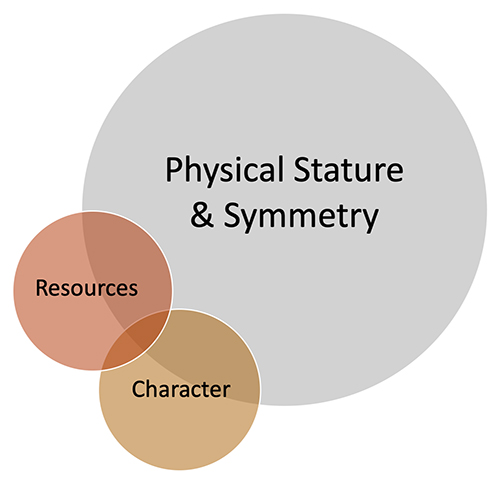
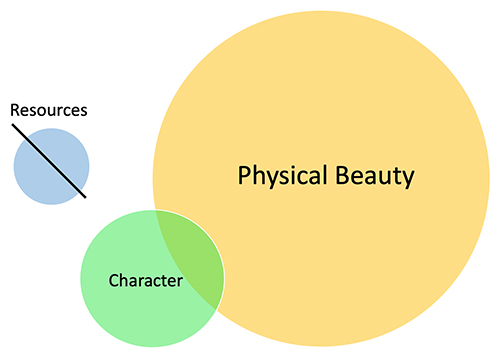
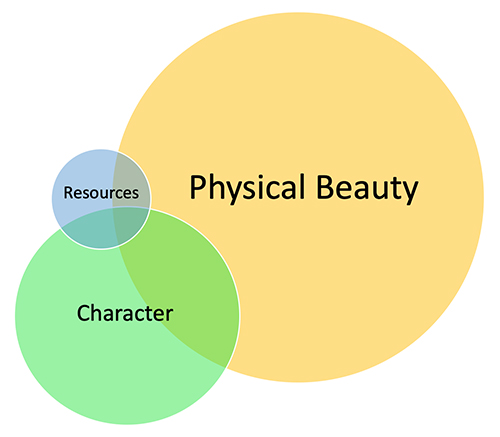
  3. Relative importance of trait preferences for each strategy along three dimensions: physical attractiveness, resources, and character, illustrated by Venn diagrams.
At-a-Glance Summary of this Post
  •  A long-term mating strategy is essentially rooted in commitment and monogamy.
  • A short-term mating strategy allows or prefers casual sex with more than one partner.
  • Women’s predominant mating strategy is long-term vs. short-term by a wide margin.
  • Men’s predominant mating strategy is short-term but their long-term strategy is almost equal for reasons also tied to evolutionary benefits.
  • The human mating economy is primarily fueled (implicitly) by the intersection of men’s short-term mating strategy and women’s long-term mating strategy.
  • Men’s short-term mating strategy is emboldened by their perceived mate value.
  • Women’s short-term strategy is correlated with low self-esteem.
  • Lower mate value men benefit most from a long-term strategy.
  • High mate value women (commonly with high self-esteem) choose a long-term strategy and benefit most from that strategy.
  • Men have lower standards for short-term mates, requiring almost no traits other than physical attractiveness.
  • Women’s short-term strategy emphasizes physical stature of the man, with some concern for resources and character.
  • Women’s short-term strategy, while secondary, reveals complex motivations and is used to secure resources, access better genes, switch mates, and sometimes secure a long-term partner.
  • Men’s short-term strategy gives great emphasis to physical attractiveness, has a small concern for character, and no concern for resources.
  • Men’s long-term mating strategy has character requirements, some resource considerations, and an emphasis on physical attractiveness.
  • Women’s long-term strategy has a great need for resources and character, with physical attractiveness prioritized in a third position. Resources and character are often subject to trade-offs in mate selection.
  • Long-term and short-term mating strategies operate as concurrent functions (like dual processing switches) sensitive to context and environmental conditions.
  • Female choice in mate selection is the most powerful force on the planet – determining the mating strategies of both sexes.
General Sex Differences in Long-term and Short-term Mating Strategies

The above studies underscore several differences in male-female sexual psychology and response, as noted in: Dynamics in the Mating Economy: Domain #1 of Male-Female Difference.

  • Women have the psychology of choice and an abundance of sexual attention during their reproductive years; men mostly do not have choice or an abundance of mating opportunities.
  • Men (mostly) have the psychology of sexual scarcity.
  • Women have the psychology of caution and fear — sexual inhibition and “brakes” on sexual activity and the experience of risk. Women fear being physically hurt, left to fend on their own with a child, or suffering reputational damage.
  • Women are prone to have regret or guilt about what they did in the sexual and mating realm.
  • Men are prone to have guilt and regret about what they did not do.
  • Men fear being humiliated and rejected.
  • Men are driven by a spontaneous, initiating sexual psychology (spontaneous desire) and women are characterized by a cautionary, “response desire.”

Mating Strategies Introduction

“Today’s dating scene has become a global uncontrolled experiment in competing mating strategies. Men and women are locked in a run-away arms race of male sexual escalation tactics vs. female commitment escalation tactics. Science-minded singles have a new self-consciousness as fitness displayers, mate choosers, gene replicators, and social primates.” ~ Evolutionary Psychologist, Geoffrey Miller (YouTube – 2019)

Long-term Mating Strategies

A long-term mating strategy for men involves attracting and securing a mate who will provide sexual fidelity. A long-term mating strategy for women seeks sexual fidelity and provision of resources and protection of children over time. Women have predominantly a long-term mating strategy (and sex “drive”) that most often seeks a single-sex partner who is committed to her and the potential offspring that might result from their mating. A women’s long-term strategy creates caution and selectivity in accepting male advances. The desired benefits of a woman’s long-term strategy influence male sexual access and thus much of male behavior. (See Mate Selection Science.)

Short-term Mating Strategies

A short-term mating strategy attempts to maximize immediate sexual access and sexual partners. Men have evolved with mostly a short-term-mating strategy (and sex “drive”) but also employ a long-term strategy for several evolutionary advantages. A man’s short-term mating strategy fuels desire for contact with women for any possible chance of a romantic or sexual encounter. Although much less predominant, a woman’s short-term mating strategy may include a complex set of motivations. (See Why Women Have Sex.)

Dual Processing Switches

Long-term and short-term strategies for men and women operate as concurrent functions sensitive to context and environmental conditions. They are not binary operations but more like dual processing switches with a range or “volume” on each at any moment in time. They may function in parallel like a thermostat, modulating the influence of other mode to keep a particular sexual personality in balance or at its “set” point. Sexual strategies by men and women are influenced by age and especially a woman’s fertility window.

Big Cojones — Evidence of Short-term mating

Evidence of short-term mating is seen by the size of human male testes; they are larger than the highly monogamous gorillas and orangutans, but smaller than the more promiscuous baboons, bonobos, and common chimpanzees. Bigger testes mean more sperm competition and more short-term mating.

Sperm Volume

Also, sperm volume increases related to the amount of time a couple has been apart since their last encounter. This increase in sperm insemination is precisely what is expected if humans had an ancestral history of casual sex and marital infidelity. The fact that men carry a physiological mechanism that elevates sperm count when their wives may have had opportunities to be unfaithful points to an evolutionary history in which humans had extramarital affairs at least some of the time.

 
“Collision” of Strategies

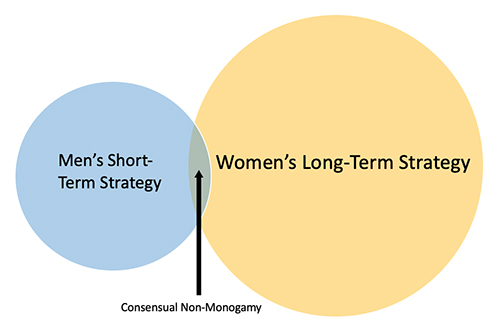
The human mating economy is primarily fueled (implicitly) by the intersection of men’s short-term mating strategy and women’s long-term mating strategy (See Human Mating Strategies). This “collision” of a man’s short-term mating strategy and a woman’s long-term mating strategy continues to shape gender-specific sexual behavior in modern times and causes more selectivity, caution, and different sexual responses by women as compared to men. Mating strategy “conflict” is resolved by accommodation and negotiation in a process of mate value sorting within the mating economy. It is highly dependent upon individual context. Desire is mitigated by costs, benefits, and availability for both sexes.

Diagram #1: “Collision” of Mating Strategies

venn diagram: collision_of_mating_strategies
Subset Strategies

Humans also have “subset” mating strategies or mating behaviors that intersect with basic long and short-term strategies, including serial mating and extra-pair copulation (EPC) – i.e. infidelity or consensual non-monogamy. Which mating strategy is adopted very much depends on individual mate value. Those higher in mate value can more easily implement their preferred mating strategy. In general, higher mate value women focus even more on a long-term strategy and higher mate value men may focus even more on a short-term strategy. Mating strategy can also be influenced by the sex ratio in the local mating pool and operation of social/cultural norms in the local environment.

Humans Employ Strategic Pluralism

Ultimately, what people want in a long-term mate can be quite different from what they want in a short-term mate. Humans employ “strategic pluralism” — a variety of strategies and tactics when it comes to mating. There are multiple routes to mating success.

Women’s Long-term Strategy

Women’s long-term mating is driven by genetic characteristics and interests of our species: internal fertilization, an extended period of gestation, prolonged infant dependence on mother’s milk, and the need for relatively “high” male parental investment compared to other primates. In addition to protection and a provision of resources, a woman’s long-term strategy seeks character traits that ensure stability and loyalty to her and her children over the long-term.

Trade-offs Between Resources and Character

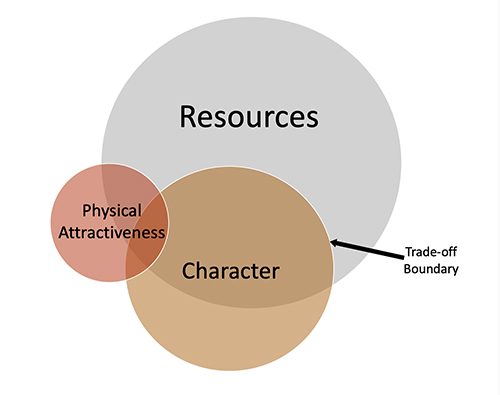
What is often more salient in female mate selection and relationship satisfaction is the tension between the two preferences inside the female long-term strategy: resources and character. A woman’s long-term mating strategy often involves ambivalence and internal confusion related to her desire for a mate with resources and status, and her preference for loyalty, kindness, intelligence, and character traits for parenting. (See “trade-off boundary” on diagram below.) In America, resources usually win this game of mate selection preference, often with rationalization and denial about the lack of optimal character.

Diagram #2: Women’s Long-term Mating Strategy

Venn diagram: women's long-term mating strategy

Benefits of Women’s Long-term Mating Strategy

  • Significant resources from mate
  • Parental investment
Costs of Women’s Long-term Mating Strategy
  • Restricted sexual opportunity
  • Sexual obligation to mate

The benefits far outweigh the costs and have pre-eminent value in female mate selection — and thus overall power to influence sexual access and all domains of male behavior.

Women’s Short-term Strategy

Women are found to prefer features related to muscularity, strength, fitness, and masculinity – traits associated with symmetry, in their short-term mates. They also look for stable character traits (minimal levels of generosity and kindness) and a fair amount of resources. While the following gives considerable attention to the complexities of a woman’s short-term strategy, it bears repeating that this strategy is not dominant in female mate selection; it is secondary and selective.

Diagram #3: Women’s Short-term Mating Strategy

venn diagram: women's short-term mating strategy
Benefits of a Woman’s Short-term Strategy

Women have a short-term mating strategy that brings several benefits. According to David Buss (Evolutionary Psychology, The New Science of the Mind, 1999), there are three classes of benefits (among a few other hypotheses) that are supported by research:

  1. Resource acquisition. Women could engage in short-term mating for the immediate exchange of meat, goods, or services. Ancestral women may have also engaged in short-term mating in order to obscure the paternity of her offspring (“paternity confusion”) and elicit resources from more than one man. In addition, short-term mating may have brought protection (a resource) from other males when the primary mate was not present.
  2. Genetic benefits. Short-term mating potentially brings enhanced fertility. It may also bring superior or diverse genes from a high-status male, thus giving offspring a better chance of survival against environmental change. Also, the “sexy son” hypothesis suggests that male progeny of such men are very attractive to women in the next generation, thus securing a positive genetic legacy.
    • Physical Stature Equals Genetic Fitness. Women’s prioritization of physical features in short-term partners is consistent with strategic pluralism theory that says women may seek genetic fitness in short-term partners. (Gangestad and Simpson, 2000). According to this “good genes” theory (Thornhill and Gangestad, 1993), women are attracted to men who effectively advertise having genes that are resistant to local pathogens.
    • Ovulation and Short-term Mating Success. Research has found that women value such characteristics (including the scent of symmetrical men) even more around the time of ovulation. As a result, symmetrical and muscular men have greater short-term mating success compared to their relatively asymmetrical and non-muscular peers. They have more sexual partners and are more desirable as affair partner.
  3. Mate Switching Hypotheses. While preferences for traits associated with high-testosterone (muscularity, strength and facial symmetry) tend to support the hypothesis that women seek genetic benefits in short-term mating, recent research and DNA evidence has cast some doubt on this as a motivation and has drawn more attention to the “mate switching hypothesis.” (See Mate Switching Hypothesis).

David Buss (Evolutionary Psychology, The New Science of the Mind, 1999) identifies three reasons for a woman’s short-term mating strategy (infidelity or extra-pair copulations) that confirm a mate switching hypothesis.

Hit the Road Jack

One study found that extra-pair mating made it easier for a women to break up with their current partner — what Buss calls “mate expulsion.” David Buss and Cindy Meston report (Why Women Have Sex, 2009) that women have affairs to test the waters to see if there is someone better out there for them, in an attempt to “trade-up” for a better partner. Women have affairs if they think their relationship may be dissolving. And women cultivate “back-up mates.” As Buss likes to joke in quoting a female research participant, “men are like soup; you always want to have some on the back burner.”

From a Short “Flight” to a Long “Flight”

According to “sexual strategies theory” (Buss and Schmitt, 1993), by being open to short-term relationships, women can increase their options for long-term ones. They can solicit the interest of many men and use this wider net to evaluate long-term mates, or they may be able to turn short-term relationships into long-term ones. If women use short-term mating to assess or attain long-term relationships, they may prioritize the same traits in short-term partners that they prioritize in long-term partners.

More Clues to Mate Switching and Sex Differences

There are other clues to explain the infidelity (short-term mating strategy) of women as reported by Buss –clues that fortify a mate switching objective.

  1. Women who are sexually or emotionally unhappy have affairs. This is not true for men. Men do not often report marital unhappiness as a reason for an affair. According to Buss, men can be relatively happy in their marriage and still have affairs. The issue of emotional dissatisfaction appears to be specific to women.
  2. 70% of women become emotionally involved with or fall in love with their affair partner. In contrast, only about 30% of men do.
  3. As stated above, qualities desired by women in an affair partner are often similar to the qualities desired in a long-term mate. Women want character traits (e.g. kindness) and resources in an affair partner, just not as much as in a long-term mate. This is not true for men. For example, women usually want intelligence in an affair partner. For men, intelligence in an affair partner is mostly irrelevant. Desiring the same qualities in an affair partner further supports a view that the female long-term mating strategy is significantly more adaptive in evolution than the short-term mating strategy.
Self-esteem in Women

Studies have shown that a woman’s self-esteem is a significant predictor of short-term-mating. Women scoring low on self-esteem tended to have a greater number of sex partners, one-night stands, and a preference for short-term sexual relationships.

Costs of Women’s Short-term Strategy
  • Risk of a sexually transmitted disease
  • Risk of pregnancy
  • Reduced value as long-term mate
  • Greater risk of physical and sexual abuse
  • Risk of withdrawal of resources from husband

While the benefits noted above seem compelling, the costs of a woman’s short-term mating strategy far outweigh the benefits and produce a “response desire” and “braking” pattern of female sexual response. These costs directly influence female sexual response and sexual psychology. (See Spontaneous and Response Desire – the Underbelly of Heterosexual Mating.)

Men’s Short-term Strategy

“There seems to be no question but that the human male would be promiscuous in his choice of sexual partners throughout the whole of his life if there were no social restrictions. The human female is much less interested in a variety of partners.” ~ Alfred Kinsey

Evolutionary adaptation has dictated a preference by men for a short-term mating strategy. Trivers’s (1972) theory of parental investment and sexual selection provides a powerful reproductive basis for expecting sex differences. Men, more than women, are predicted to have evolved a greater desire for casual sex and a variety of partners. The same act of sex that causes a woman to invest nine months of internal gestation obligates the man to practically no investment.

Premium On Female Beauty

Men’s short-term strategy puts an immense premium on physical beauty and fertility. Character traits required of a woman are minimal (i.e. “don’t be dangerously crazy”) and resources are not required at all. Men’s short-term strategy is more predominant than their long-term strategy, but the difference is less pronounced behaviorally in modern times.

Diagram #4: Men’s Short-term Mating Strategy

venn diagram: men's short-term mating strategy
Restraints on Men’s Short-term Mating Strategy

Although men could potentially conceive more offspring if they were promiscuous instead of monogamous, there may have been at least two restraining factors of evolution against male promiscuity. Reproductive success depends on the survival of one’s offspring. Children have a better chance of survival if two parents contribute. Men who were highly promiscuous may not have been able to support all their offspring, and thus may not have been as genetically successful as more monogamous men.

Women Have to Consent

As suggested by Roy Baumeister and Dianne Tice (The Social Dimension of Sex, 2001), a second possible restraining factor on male promiscuity is an obvious one: the question of whether a male can get a lot of potential mates if females won’t consent to mate with him.

Promiscuous Male At Possible Disadvantage

Men not predisposed to mate in long-term relationships might not have left enough offspring for a totally promiscuous genetic tendency to proliferate. According to Baumeister and Tice, males thus evolved to mate in long-term relationships to raise their children to adulthood, and also evolved a tendency to be more open than females to a wider variety of mating opportunities. Perhaps this greater need for compromise between monogamy and promiscuity can also explain why men have a greater variety of sexual practices and interests than women.

Put A Ring On It

David Buss suggests (Evolutionary Psychology, The New Science of the Mind, 1999), that men, even in ancestral times, who failed to commit might not have attracted any women at all. Women’s requirement for consenting to sex could have made it costly for men to pursue a short-term strategy exclusively. In the economics of reproductive effort, the costs of not pursuing a permanent mate may have been prohibitively high for most men.

High Mate Value Men Like Short-term Mating

High mate value men (on the “Self-perceived Mating Success Scale”) tended to have sex at an earlier age, a greater number of sex partners, and more sex relative to their lower mate-value counterparts. And high mate value men scored higher on the “Sapiosexuality Inventory” suggesting that they are pursuing a short-term mating strategy. These are measures of the holy grail of sexual turn-on for women: self-confidence. This is what “cocky” really means. (BTW, penis size does indeed contribute to this self-confidence — to being “cocky.” (See Undiscussables.)

Men Lower Their Standards

Buss and Schmitt (1993) found that men desire more partners and lower their standards for short-term mating. Men in this study expressed lower standards than women on forty-one of the forty-seven characteristics named as potentially desirable in a casual mate. For brief encounters, men required a lower level of charm, athleticism, education, generosity, honesty, independence, kindness, intelligence, loyalty, sense of humor, sociability, wealth, responsibility, spontaneity, cooperation, and emotional stability.

Closing Time Phenomenon

Relatedly, men shift perceptions of attractiveness near closing time in a singles bar regardless of how much alcohol they have consumed. With this “closing time phenomenon,” women just look better and better as the night wears on. In contrast to men, most women can obtain a desirable temporary mate without having to relax their standards at closing time.

Sex Ratio Effect on Short-term Mating for Both Sexes

Men shift to brief encounters when more women are sexually available (positive sex ratio), satisfying their desire for variety. Correlated to that, women on college campuses today will shift toward more short-term mating because the surplus of women causes more intra-sexual competition. When there is a surplus of men, in contrast, both sexes shift toward a long-term mating strategy marked by stable marriages and fewer divorces.

Benefits of Men’s Short-term Strategy
  • Potential to reproduce; more sex partners
  • No parental investment
Costs of Men’s Short-term Strategy
  • Risk of sexually transmitted diseases
  • Some resource investment
  • Less protection for genetic children
  • Acquiring a reputation as a womanizer
  • Suffering violence from husbands, brothers or fathers
  • Retaliatory affairs by wives or a costly divorce

The benefits of the male short-term mating strategy have shaped the evolution of male neurology and physiology and influenced male behavior, especially sexual initiation and intra-sexual competition. But costs do mitigate this strategy, especially in modern times.

Men’s Long-term Strategy

For long-term mates, men still put a premium on physical beauty and markers of health and fertility for initial attraction. Buss and Schmitt (1993) studied 37 cultures and confirmed the universal desire for physical attractiveness in a long-term mate. But men also want a woman who is faithful and kind. Resources are considered but are usually a distant third in importance. As stated above, men who are willing to commit to a long-term relationship have a wider range of women from which to choose.

Marriage in the U.S. Favors Men With Resources

As discussed in Dynamics in the Mating Economy: Domain #1 of Male-Female Difference, marriage patterns in modern America confirm the fact that men with resources are most able to actualize their preferences.

Diagram #5: Men’s Long-term Mating Strategy

venn diagram: men's long-term mating strategy
Benefits of Men’s Long-term Strategy
  • Increased paternity certainty
  • Improved social competitiveness of children
  • Sexual and social companionship, especially for “beta” males
Costs of Men’s Long-term Strategy
  • Restricted sexual opportunities
  •  Heavy parental investment
  • Heavy relationship investment

The benefits of men’s long-term mating strategy tend to outweigh the costs in most cultures in modern times. Pair-bonding and relative monogamy is the norm in most modern societies.

References

Buss, D. M., (1999). Evolutionary Psychology, The New Science of the Mind.

Buss, D. M. & Schmitt, D.P. (1993) “Sexual strategies theory: An evolutionary perspective on human mating.” Psychological Review, 100, 204-232.

Clark, R. D. & Hatfield, E. (1989). “Gender differences in receptivity to sexual offers.” Journal of Psychology and Human Sexuality, 2, 39-55.

Dibble, et al (2015, June 11). “Simmering on the back burner: communication with and disclosure of relationship alternatives.” Communication Quarterly, 63(3), 329-344.

Gangestad, S.W. & Simpson, J.A. (2000). “The evolution of human mating: Tradeoffs and strategic pluralism.” Behavioral and Brain Sciences, 23, 573-587.

Li, P. (2008). “Intelligent Priorities: Adaptive Long- and Short-term Mate Preferences,” in Mating Intelligence, eds., Geher, G., & Miller, G.

Thornhill, R., & Gangestad, S..W. (1993). “Human facial beauty: Averageness, symmetry and parasite resistance.” Human Nature, 4, 237-269.

Trivers, R. L. (1972). “Parental investment ad sexual selection.” In B. Campbell (Ed.), Sexual Selection and the Descent of Man, (pp.136-179).

Appendix

 
Domains of Male-Female Differences in Sexual Psychology

1. Behavioral dynamics in the mating economy

2. Long-term vs. short-term mating strategies

3. Trait preferences and priorities for mate selection

4. Physical attraction and perceptions of beauty

5. Concordance between physiological response and psychological desire

6. Spontaneous desire vs. response desire

7. Sex and love-making that fuels desire

8. Accelerator vs. brake: sexual excitation and inhibition systems

9. Brain structures: sexual pursuit and visual stimuli

10. Hormonal differences

11. Variety and novelty

12. Sexual mentation and “sex drive”

13. Influence of context

14. Female competing intentions and imposed double bind 

15. Sexual orientation (and preference) fluidity and response variability

16. Orgasm – purpose and characteristics

17. Meta emotions

18. Romance and desire, together and apart

19. Psychology of monogamy

20. Infidelity – reasons and response

21. Jealousy – triggers, tactics, and consequences

22. Sexual fantasies


*Assumptions of Mating Straight Talk
  • Men and Women have similarities as human beings, and aggregate differences from each other, that are primarily a function of biology and evolutionary adaptation. Our similarities do not often cause conflict. But our differences, and the denial of those differences, often cause “trouble”.
  • Men and Women have differences that we must acknowledge and understand in order to have satisfying heterosexual (romantic and sexual) relationships.
  • Men and Women have differences that we must acknowledge and understand in order to bring clarity to the “politics” of sex and gender.
  • Men and Women need “straight talk” (radical honesty) in order to uncover and accept our differences.
  • Men and Women need straight talk about our differences in order to empower one another for co-creative relationships.

Please Note: Your comment may take up to 12 seconds to register and the confirmation message will appear above the “Submit a Comment” text. 

Dynamics in the Mating Economy: Domain #1 of Male-Female Difference

Dynamics in the Mating Economy: Domain #1 of Male-Female Difference

“There are a number of mechanical devices which increase sexual arousal, particularly in women. Chief among them is the Mercedes-Benz SL500.” ~ Lynn Lavner

Twenty-two Domains of Difference (See list in Appendix)

This is first in a series of posts that will explain the twenty-two domains of difference between men and women in their sexual psychology and response. (See introduction to the series: Male-Female Differences in Sexual Psychology and Response.) Differences are based on statistical aggregates of all men and women from authoritative research studies. These are tendencies that apply to the general population of male and female heterosexuals but do predict the unique sexuality of a particular man or woman. It may be instructive, however, to understand our foundational “wiring” – the evolutionary adaptations that remain active in modern human mating. Most of these domains of difference can affect the equilibrium of our relationships.

Behavioral Dynamics in the Mating Economy – Domain #1
This post will explore differences related to:

  1. General psychological sex differences in the mating economy (an overview)
  2. The influence of money, status, and resources in the mating economy
  3. The operation of the mating economy as a market place – the haves and have-nots
  4. The nature and influence of the “bargain” of exchange between men and women
  5. The psychological difference between the pursuer and the one pursued

General Sex Differences in the Psychology of the Mating Economy:

  • Women have the psychology of choice and an abundance of sexual attention during their reproductive years (this is mostly good, but sometimes bad); men mostly do not have choice or an abundance of mating opportunities. Beautiful women have immense choice in the mating economy and rich men have the greatest opportunity to be chosen.
  • Men (mostly) have the psychology of sexual scarcity and activation of the sympathetic nervous system as pursuer and competitor with other males.
  • Women have the psychology of caution and fear — sexual inhibition and “brakes” on sexual activity and experience of risk. Women fear being physically hurt, left to fend on their own with a child, or suffering reputational damage.
  • Women are prone to have regret or guilt about what they did in the sexual and mating realm.
  • Men are prone to have guilt and regret about what they did not do. (Lack of courage to initiate toward a woman.)
  • Men have fear of humiliation and being rejected. This fear is “existential” in its impact – it evokes the very essence of manhood and worth because it goes to the core of evolution: male sexuality and the passing on of the genetic code. Men’s fear of humiliation is mostly understood by women but the male psychology of existential threat is not acknowledged, understood, or given an empathic ear.
  • Men have anger that comes from this threat and the lack of sexual access; there are no easy answers to this in the mating economy. The psychology of the haves and have-nots is ubiquitous across many domains of social life in the West.
  • Some women experience their own existential angst related to the need to have a child; this too is encoded into sexual expression. The female sexual “instinct” interfaces with the maternal/care-taking instinct.
  • Women also have fear, anger, and grief about being over-looked or no longer being desired by the men that are acceptable to them as mates. This is a loss of “erotic power.”
  • Women often experience a significant trade-off problem in their mate selection decision-making between choosing a man of status (financially successful) and choosing a man with a loyal and generous character. Both trait profiles are required. Men do not have this particular trade-off dilemma in their mate selection psychology nor any other trade-off problem as significant as that in their long-term mating strategy. (This will be explored in a future post, Domain #3: Trait Preferences and Priorities in Mate Selection.)
  • Men are driven by a spontaneous, initiating sexual psychology (spontaneous desire) and women are characterized by a cautionary, “response desire.” (See Spontaneous and Response Desire – the Underbelly of Heterosexual Mating.) I will explore this in Domain #6: Spontaneous Desire vs. Response Desire.
  • Finally, the psychology of the mating economy is haunted by the undertow of the erotic-economic bargain: the exchange of beauty and fertility for resources and protection. The dynamic of this exchange is anchored in the fundamental objectives of human mating strategy and reproduction. In modern times, it is characterized by motivated reasoning used to deny its existence. This is the psychology of collusion, rationalization, and avoidance. The erotic-economic bargain has political implications.

Supply and Demand Forces in the Mating Marketplace
In the human mating economy, men mostly sell and women mostly buy; this is the predominant evolutionary dynamic. The buyer (female chooser) significantly controls the marketplace.

All behaviors of mate selection (intersexual selection by women and intra-sexual competition primarily by men) are driven by supply and demand forces for sexual access to the best (highest mate value) mates. Fertile (and consensually most “beautiful”) women are in great demand and the supply of men interested in them creates significant differences in behavioral dynamics – leading to a multitude of male initiation strategies, misreading of signals by women (male “over-perception bias”), and a reproductive variance curve in the human population: more women have sex and reproduce in the general population than do men, as shown by genetic studies (see below).

Most Men Want the Same Women

Simply said, roughly 80% of men compete for 20% or less of the same (highest mate value) women in the overall mating economy. Interested men are in great supply in this market (as driven by biological-hormonal imperatives), and receptive women are scarce. Supply and demand forces skew odds in favor of female choice and dramatically work against the odds of a man being chosen.

Pursuer vs. Pursued

The 180% difference between a buyer and a seller in the mating-sexual economy is dramatic in its psychological impact. It affects motivation, origination of desire, perceptions of risk and safety, and ultimately the experience of sexual scarcity or abundance.

The psychology (lived experience) of the sexual initiator and pursuer is vastly different than the psychology of the one pursued and the one who chooses among her pursuers. This general difference between men and women cannot be overstated.

Male intra-sexual competition (men competing against one another) has unique behavioral and psychological dynamics. The psychology of female intersexual selection (preferential mate choice) – the experience of being pursued, is a mixed bag. It can be exhilarating to be adored and desired, until it is not. Women’s intra-sexual competition (women competing against one another) for male attention is a different behavioral phenomenon than male-on-male competition. (I will explore intra-sexual competition in Domain #2: Long-term vs. Short-term Mating Strategies.)

Erotic-Economic Bargain – the Ultimate Exchange in the Mating Economy

The exchange of physical beauty and fertility (erotic power) for economic power (and/or protection) is the perennial bargain of human mating over eons of time. This bargain is rooted in the willingness and capacity for parental (economic) investment from the man and the reproductive (sexual) access allowed by the women in response to that investment.  It is the unconscious infrastructure of heterosexuality.  The ability of a man to protect and provide for children is the key ingredient and evolutionary force driving this mate preference by women; it is the trigger for her sexual availability. Her youth and fertility is her erotic power — a power that controls and influences male aspiration for social dominance, economic power, and competition with other men. Female erotic power fuels the fire of male sexuality. Sexual access to women is the penultimate motivation and prize. The strength of a man’s preference for physically attractive women and a woman’s preference for financially successful men works conjointly in relationship to their mate value. At the upper end of their respective mate value, there is an assortative pairing of the beautiful with the rich.

Renegotiating the Bargain?
In recent decades, the erotic-economic bargain may be undergoing a bit of renegotiation with surface or cosmetic changes that comport with our particular political moment. Female empowerment and independence from men is progressing and evolving in its influence. But most evidence “on the ground” of the modern dating scene (with some nuances related to older or senior Americans) does not show a movement away from our ancient, evolutionary adaptations; there has not been a significant change in the foundational priorities and preferences for a partner by men and women. Content analysis of dating websites reveal that women explicitly ask for “financially secure” or “professional” partners roughly twenty times more often that men do.

 Foundational Collusion
Although the exchange of sex for resources is a shared agreement, it is often implicit and “secretly” held – that is what is meant by “collusion.” Men and women have vastly different parts to play in holding the agreement in place. This foundational collusion of exchange influences all other pieces of the heterosexual “puzzle.” To be clear, even though the erotic-economic bargain is often not explicit or conscious, it fertilizes (sorry for the pun) the soil of human reproduction.  The erotic-economic bargain is largely “undiscussable.”

Mate Value is the “Currency”

Mate value (and assessed mate value trajectory of men) rules the marketplace. Men with resources, status, and larger physical attributes (especially height) have greater mate value than men who do not. Women’s mate value is primarily determined by physical characteristics of beauty, waist-to-hip ratio, and other signals of fertility. Mate value drives the initial mate selection process. Mate value includes elements of character and other preferred traits as courtship continues into the period of relationship maintenance. But human sexuality is primarily designed to choose and access sexual partners, not keep them over time.

“In or Out of Your League”

It is no accident that we commonly rate ourselves and others on a “1-10” point scale. While there is a tendency for both sexes to over-rate vs. under-rate themselves, we generally know if our desired partner is “in or out of our league.” If we are a “7”, we strive to bargain successfully for a “7-9.” Men, especially, who know they are seen as a “5” or below, lust hopelessly after unattainable women who are a “9” or “10.” This understandable tendency is biologically, not rationally inspired. There is painful despondency for both sexes related to the invisibility of low mate value. Narratives in comedy, television, literature, and film often use mate value mismatches as fodder for entertainment.

Assortative Mating is the Visible Part of the Iceberg

Assortative mating is the tendency to be attracted to someone who is similar in age, socio-economic status, educational attainment, geographic location, physical appearance, and facial attractiveness. Someone who is “in our league.” Linked to mate value, assortative mating is the dominant process in the mating market. Assortative mating is the part of the iceberg that is visible above the water; below the surface is the erotic-economic bargain that may influence how things sort out.

Definition of a Good Deal

Assortative mating demonstrates the power of “mate value” attributions about self and others. These value assessments fuel strategic mating behavior toward the people we desire, or at least determine who we actually end up with. People self-sort according to their mate value; traits and priorities are unconsciously or consciously ranked and considered as a whole. The mate value of most people is limited, so one cannot attract a committed partner who is at the maximum of every desired trait. Trade-offs are made. But the definition of a “good” deal in the mating game can be traced to how well the erotic-economic bargain is maximized in the favor of each person, considering their individual mate value and the availability of potential partners in the local mating pool.

Mate Value Sex Differences and Assortative Mating
Assortative mating is a neutral process with regard to sex differences over-all. Men and women seek similarities along many dimensions of background, and the market naturally brings them a partner with an equal mate value. The assortative mating process does match for equivalent mate value, but the mate value of a woman is powerfully defined by her physical beauty, and the mate value of a man is largely based on the size of his financial resources.

Trait Preferences and Perceptions of Attraction

Mate selection research has documented many shared preferences of men and women; they seek love, kindness, intelligence, and good health in their mates (as they uniquely define those traits). When entering a relationship, women place greater emphasis on the immediate access to resources in order to assess a potential mate’s willingness and ability to invest in her; if a man does show immediate investment in a relationship, the woman is typically more likely to have sex with him. (Spreecher, Sullivan, & Hatfield, 1994).

“The two sexes often engage in this exchange of reproductive currencies with men looking to exchange investment for sex and women preferring to exchange sex for investment.” (Kruger, 2008).

Emphasis on Attractiveness and Financial Prospects

Males and females rate the characteristics of physical attractiveness and financial prospects differently. The degree of emphasis that women place on the importance of a man’s financial prospects has been well documented (see references). The different valuation of these two traits is consistent throughout the world, with men placing a higher value on physical attractiveness and women placing a higher value on financial prospects. Men are generally indifferent to the financial prospects of women (Buss, 1989). But a woman’s preference for a mate with financial prospects also influences her perception of a man’s physical attractiveness.

Money and Beauty are Directly Correlated

Psychological researchers Richard Urdy and Bruce Eckland did a study of men and women to predict marital and socio-economic status fifteen years into the future. They used attractiveness ratings based on high school annual pictures. Results showed that a man’s level of resources was directly correlated with the level of physical attractiveness of his partner. Attractiveness allowed females to secure highly educated husbands with a high income. Money and beauty were correlated in a positive and linear relationship. 

The Car Makes the Man

Gregory Shuler & David McCord (Western Carolina University) used subject ratings from the website “Hot or Not” and found a linear and positive relationship between the value of a man’s car and the degree of attractiveness perceived by women. A man was depicted with three different cars: a decrepit Dodge Neon, a Ford Focus, and a Mercedes C Class C300. He was rated most “hot” when pictured with the Mercedes.

As reported in the British Journal of Psychology (April, 2009), researchers Michael Dunn and Robert Searle found that men positioned with a high-status, silver Bentley Continental GT were rated significantly more attractive than when the man was positioned with a red Ford Fiesta ST. When the conditions were reversed by sex, men did not rate women as more attractive in the high status vs. low-status condition; it had no influence. 

“Costly-signaling” by Men

Since women have a preference for men with resources, men have evolved strategies for the purpose of demonstrating this characteristic for women. Strategies include boasting about one’s resources, the derogation of a competitor’s status, ambition or resources, and displaying conspicuous consumption when in potential mating scenarios. Men tend to increase spending on luxury items (like a car) that indicates “costly-signaling” as a display of expendable income that could be potentially be allocated to a mate.

Diamonds Are A Girl’s Best Friend

Other studies have shown a positive and linear correlation between female physical beauty and the monetary values of engagement and wedding rings. The value and expenditures for courtship and nuptial gifts increase with the physical attractiveness of the female. In a study by researchers Jaime Cloud and Madalyn Taylor (“The Effect of Mate Value Discrepancy on Hypothetical Engagement Ring Purchases”), women desired greater resource investment to compensate for a lack of physical attractiveness in their male partners.

Reproductive Variance: the Haves and the Have-nots

“Reproductive variance” refers to the variability of reproductive success for human males and females. For men, the difference between men who did not reproduce (the have-nots) and the men who reproduced prolifically (the haves), is very wide. For women, there is much less variance; most women reproduce and the number of children they have is constrained by their biology.

DNA studies by Jason Wilder and colleagues revealed that approximately 80% of women in human history have reproduced compared to approximately 40% of men. The human population is descended from twice as many women as men. Author and influential social psychologist, Roy Baumeister, (Is There Anything Good About Men), says reproductive variance between men and women was probably even greater through much of human history, and especially human prehistory. “In many animal species, close to 90% of the females but only 20% of the male reproduced. In modern times, human monogamy has spread across the globe. But in past eras, polygamy (one husband, multiple wives) was the norm, the reproductive imbalance would have been more severe” than 80% to 40%.

Most Men are Losers in the Mating Game

Put another way, a woman’s odds of having a line of descendants down to the present is double those of a man. Most women who ever lived to adulthood probably had at least one baby and in fact have a descendant alive today. Most men did not. Baumeister again: “Most men who ever lived, like all the wild horses that did not ascend to the alpha males’ top spot, left behind no genetic traces of themselves. Of all the humans ever born, most women became mothers, but most men did not become fathers.” Baumeister considers this “the single most underappreciated fact about the difference between men and women.”

The Super-Haves – Men at the Top of the “Economic”- Status Hierarchy

One of the greatest conquers in world history (13th century), Genghis Khan, is reported to have sired hundreds and possibly over a thousand children. In 2003, an international team of geneticists published a DNA analysis of central Asians. Researchers found that one in twelve men in Central Asia had the same Y chromosome. Genghis Khan had roughly 16 million descendants in 2003. 

Other Males Who Got More than Their Share

Other male all-stars in the genetic/Y chromosome reproductive hall of fame are: Middle Age king, King Nail. One in 12 in Ireland are genetically linked to King Nail, possibly 2-3 million worldwide. Manchu ruler (17th century), Nurhaci, or perhaps his grandfather Giocangga, has 1.6 million descendants alive today. Moulay Ismail ibn Sharif, a warrior King who ruled Morocco from 1672-1727, had 500 concubines and 888 children. King Solomon had 700 wives and 300 concubines. Idi Amin, Ugandan despot in the 1970s had 4 wives and 30 children. Large harems were the order of the day for the Egyptian Pharaohs, the Aztec kings, the Turkish sultans, the African kings, and the Chinese emperors. (Laura Betzig, Despotism and Differential Reproduction).

Incas Allocated Women According to Status

Inca law allowed male aristocrats 50 women apiece; the leaders of vassal nations (Inca feudal territories) were allotted 30, the heads of 100,000 men were given 20 women, and so on down to leaders of ten men, who were allotted 3. The men at the bottom often went unmarried (Sex and War, Malcom Potts and Thomas Hayden, p. 18-19). 

Erotic and Economic Power – the Age of Celebrity

At the high end of male and female mate value, rich men and beautiful women find each other. The erotic-economic bargain is commonly demonstrated by the preference and ability of older men to partner with significantly younger women – women usually in their fertile years at the time of the union. Take a look at the list below (Appendix) of high status, celebrity, rich men, and their wives. You will see up to 60+ years of age difference. Money can allow men to “mate down” decades to find beautiful women who will choose to partner with them.

Of course, many of these celebrities have attractive intellectual, physical, and emotional qualities (i.e. their talent), but what they have most importantly is high status and great wealth.

 Undeniably we see evidence of:

  • the power of fame and money to attract younger women – with relative doses of charm, talent, and physical attractiveness.
  • how resources, prestige, and status drive the mating system and female choice.
  • how men, given options literally “afforded” them, will naturally pursue the most beautiful women.
  • how the resistance against age difference, proclamations of “he is too old,” are relative to the degree of fame and money the man possesses.

All the men included here are rich and famous. All the women are beautiful. The erotic-economic bargain in stark terms.


Appendix

 
Age Differences of Male Celebrities and their Partners – The “Haves” of Erotic-Economic Exchange
Jay Marshall and Anne Nicole Smith 62 years
Hugh Hefner and Crystal Harris 60 years
Dick Van Dyke and Arlene Silver 46 years
Mick Jagger and Melanie Hamrick 43 years
Robert Duval and Luciana Pedraza 41 years
Patrick Stewart and Sunny Ozell  38 years
Rupert Murdoch and Wendy Deng 38 years
Charlie Chaplin and Oona O’Neill 36 years
Clint Eastwood and Dina Ruiz  35 years
Woody Allen and Soon-Yi Previn 35 years
David Foster and Katharine McPhee 34 years
Doug Hutchinson and Courtney Stodden 34 years
Lee Majors and Faith Noelle Cross 34 years
Gary Grant and Dyan Cannon 33 years
Dennis Quaid and Santa Auzina 33 years
Aristotle Onassis and Jackie Kennedy 33 years
Billy Joel and Alexis Roderick  33 years
Bing Crosby and Kathryn Grant  33 years
David Lynch and Emily Stofle 32 years
Billy Joel and Katie Lee  32 years
John Cleese and Jennifer Wade  31 years
Ronnie Wood and Sally Humphreys 31 years
Jeff Goldblum and Emilie Livingston 30 years
Frank Sinatra and Mia Farrow 30 years
William Shatner and Elizabeth Anderson 30 years
Alan Thicke and Tanya Callau  28 years
Rod Stewart and Penny Lancaster 27 years
Eric Clapton and Melia McEnery  27 years
Nelson Mandela and Graca Machel 27 years
Larry King and Shawn Southwick  26 years
Alec Baldwin and Hilaria Thomas 26 years
Bill Murray and Jenny Lewis 26 years
Steve Martin and Anne Stringfield 26 years
Rupert Murdoch and Jerry Hall  26 years
Dane Cook and Kelsi Taylor  26 years
Humphrey Bogart and Lauren Bacall 25 years
Michael Douglas and Catherine Zeta-Jones 25 years
Rod Stewart and Rachel Hunter 25 years
Kelsey Grammer and Kayte Walsh 25 years
Bruce Willis and Emma Heming 24 years
Rene Angelil and Celine Dion 24 years
Donald Trump and Melania  24 years
Christopher Knight and Adrianne Curry 23 years
Johnny Depp and Amber Heard 22 years
Harrison Ford and Calista Flockhart 22 years
Sylvester Stallone and Jennifer Flavin 22 years
Kevin Costner and Christine Baumgartner  22 years
Carlo Ponti and Sophia Loren 22 years
Glen Campbell and Kim Campbell 21 years
Floyd Mayweather and Raemarni Ball 20 years
Prince Albert of Monaco and Princess Charlene 20 years
Warren Beatty and Annette Bening 19 years
Jason Statham and Rosie Huntington-W. 19 years
Anthony Hopkins and Stella Arroyave  19 years
Eddie Murphy and Paige Butcher  19 years
Jason Statham and Rosie Hunington-W. 19 years
Dominic Purcell and AnnaLynne McCord  18 years
Christian Slater and Brittany Lopez 18 years
Howard Stern and Beth Ostrosky  18 years
Paul McCartney and Nancy Shevell 18 years
Jerry Seinfeld and Jessica Sklar 17 years
Oliver Sarkozy and Mary-Kate Olsen 17 years
George Clooney and Amal Alamuddin  17 years
Bradley Cooper and Suki Waterhouse 17 years
Tom Cruise and Katie Holmes 16 years
Kevin Kline and Phoebe Cates 16 years
References

Buss. D. M. & Schmitt, D.P. (1993) “Sexual strategies theory: An evolutionary perspective on human mating.”  Psychological Review, 100, 204-232.

Buss, Shackleford, Kirkpatrick & Larsen, (2001). “A half century of mate preferences: the cultural evolution of values.”  Journal of Marriage and Family, 63 (2), 491-503.

Dunn, M. &  Searle, R., (2009). “Effect of manipulated prestige-car ownership on both sex attractiveness ratings.”  British Journal of Psychology, 101, (Pt 1) 69-80.

Gangestad, S.W. & Simpson, J.A. (2000). “The evolution of human mating: Tradeoffs and strategic pluralism.”  Behavioral and Brain Sciences, 23, 573-587.

Kruger, D. J. (2008). “Young adults attempt exchanges in reproductively relevant currencies.” Evolutionary Psychology, 6(1), 204-212.

McAndrew, F., “Costly Signaling Theory,” Encyclopedia of Evolutionary Science, 2019.

Shuler, G., & McCord, D. (2010). “Determinants of Male Attractiveness: “Hotness” Ratings as a Function of Perceived Resources,” American Journal of Psychological Research, Vol. 6, No. 1.

Spreecher, S., Sullivan, Q., & Hatfield, E. (1994).  Mate selection preferences: Gender differences examined in national sample.   Journal of Personality and Social Psychology, 66(6), 1074-1080.

Udry, J.R. & Eckland, B.K. (1984).  “The benefits of being attractive: Differential payoffs for men and women.” Psychological Reports, 54, 47-56.

Wilder, J.A. et al, (2004). “Genetic evidence for unequal effective population sizes of human females and males.”  Molecular Biology and Evolution, 21, 2047-2057.

 
Domains of Male-Female Differences in Sexual Psychology

1. Behavioral dynamics in the mating economy

2. Long-term vs. short-term mating strategies

3. Trait preferences and priorities for mate selection

4. Physical attraction and perceptions of beauty

5. Concordance between physiological response and psychological desire

6. Spontaneous desire vs. response desire

7. Sex and love-making that fuels desire

8. Accelerator vs. brake: sexual excitation and inhibition systems

9. Brain structures: sexual pursuit and visual stimuli

10. Hormonal differences

11. Variety and novelty

12. Sexual mentation and “sex drive”

13. Influence of context

14. Female competing intentions and imposed double bind 

15. Sexual orientation (and preference) fluidity and response variability

16. Orgasm – purpose and characteristics

17. Meta emotions

18. Romance and desire, together and apart

19. Psychology of monogamy

20. Infidelity – reasons and response

21. Jealousy – triggers, tactics, and consequences

22. Sexual fantasies


*Assumptions of Mating Straight Talk
  • Men and Women have similarities as human beings, and aggregate differences from each other, that are primarily a function of biology and evolutionary adaptation. Our similarities do not often cause conflict. But our differences, and the denial of those differences, often cause “trouble”.
  • Men and Women have differences that we must acknowledge and understand in order to have satisfying heterosexual (romantic and sexual) relationships.
  • Men and Women have differences that we must acknowledge and understand in order to bring clarity to the “politics” of sex and gender.
  • Men and Women need “straight talk” (radical honesty) in order to uncover and accept our differences.
  • Men and Women need straight talk about our differences in order to empower one another for co-creative relationships.

Please Note: Your comment may take up to 12 seconds to register and the confirmation message will appear above the “Submit a Comment” text.