
Humor and Sexual Selection

Humor and Sexual Selection

“Women tend to prefer men who make them laugh, whereas men prefer women who laugh at their jokes.” *

In my last post about Tiger Woods, I examined the role of storytelling, art, music, dance, athleticism, and humor in sexual selection. Women select for those traits in men. These expressions of creativity signal genetic fitness because they are relatively rare in the human population.

Today’s post will put the microscope on humor. I will examine the influential role that humor plays in sexual selection – why humor production is a mating trait preference. In my next post (March 2), I will address how humor affects ongoing relationships; humor for established couples is different from the role of humor in selecting a mate (courtship). In other future posts, we will laugh together at displays of humor about the dynamics of sex, dating and relationships. For now, see my earlier post, Sex Can Be Funny: https://www.matingstraighttalk.com/sex-can-be-funny-50-humorous-quotes-volume-1/.

Here are a few random quips to warm you up before I go all nerdy:
  • “Bigamy is having one wife too many. Monogamy is the same.” ~ Oscar Wilde
  • “It’s been so long since I have had sex, I’ve forgotten who ties up whom.” ~ Joan Rivers
  • “I was nauseous and tingly all over. I was either in love or I had smallpox.” ~ Woody Allen
  • “A man who correctly guesses a woman’s age may be smart, but he is not very bright.” ~ Lucille Ball
  • “You’d be surprised how much it costs to look this cheap.” ~ Dolly Parton
  • “Good girls go to heaven, and bad girls go everywhere.” ~ Helen Gurley Brown
Laughter is Universal in Our Species

Laughter is universal within our species; it manifests in distinct facial and vocal expressions. Laughter emerges spontaneously during childhood and is intensely pleasurable. It shows all the hallmarks of a psychological adaptation – a fundamental building block of our evolutionary past.

Humor is Valued for Mates Worldwide

Humor is an integral part of mate choice. A robust finding in evolutionary psychology research is the value that people worldwide place on a good sense of humor. Females demonstrate more appreciation of humor than men; these differences begin in early childhood and appear to reflect differences in sexual choosiness.

Sexual Selection Is No Joke

Evolutionary psychologist, Geoffrey Miller (The Mating Mind), argues that the “humor divide” is best understood as a result of sexual selection. Women are the choosier sex, and because they prefer funny men—a signal of cognitive fitness—men learned to deploy humor and wit to attract a mate and to outsmart other men.

Humor and creativity researcher Scott Barry Kaufman of New York University believes sexual selection explains why the use of humor is important in the initial stages of a relationship: “When you have little else to go on, a witty person who uses humor in a clever, original way is signaling quite a lot of information, including intelligence, creativity, and even aspects of their personality such as playfulness and openness to experience.”

Comedy Reveals Capacity for Creativity

A capacity for comedy reveals a capacity for creativity. It plays upon our intense love of novelty (neophilia), says Miller. “Creativity is a reliable indicator of intelligence, energy, youth, and proteanism (ability to change shape). Humor is attractive, and that is why it evolved.”

Class Clowns Are Male

Have you ever wondered why class clowns are virtually always male? Documented differences in the ways the sexes use and respond to humor explain this and other humor-related phenomena. Humor plays a role in relationships from the initial flirtation through long-term commitment. Knowing the differences in how men and women process and use humor serves one well in all situations involving the opposite sex.

Male Courtship Humor

Males produce humor in courtship much more than females, according to researcher Jennifer Hay and are more likely than females to produce verbal humor in informal social settings, according to Helga Kotthoff. This research suggests that females, on average, are more discriminating than men when it comes to humor and that men, on average, are more motivated to be funny.

Men produce humor to be chosen by women. As explained in my prior post, men produce humor (and everything else) “to get laid.”

Humor Attracts Women

Studies from the David Buss’ Evolutionary Psychology Lab revealed that displaying a good sense of humor is the single more effective tactic men can use to attract women. Women are attracted to men who produce humor because (at the most surface level) laughing elicits a positive mood. Humor is very agreeable and is linked to the traits of generosity and willingness.

Humor for Potential Genetic Benefit

Evolutionary psychologists have also theorized that a sense of humor is a sign of intellect and healthy genes. Women are the more selective sex due to the burdens associated with pregnancy and thus are attracted to funny men because of the genetic benefit that could be bestowed upon potential offspring.

Woman Want a Humor Generator

According to Eric Bressler, a psychologist at McMaster University in Canada, men and women don’t mean the same thing when they say they value humor in a long-term partner. His research manipulated how funny both men and women appeared on paper. Subjects were asked to choose a potential date of the opposite sex. Bressler found that women want a man who is a humor “generator,” while men seek a humor “appreciator.”

Female Laughter is a Signal of Sexual Interest

The allure of male humor is so strong that female laughter may have evolved as a signal of sexual interest—picture a woman’s girlish giggles as she flirts with a man at a bar. Indeed, a German study found that when male and female strangers engaged in natural conversation, the degree to which a woman laughed while talking to a man was indicative of her interest in dating him. How much the woman laughed also predicted the man’s desire to date her.

Someone Who Makes Me Laugh — Someone Who Laughs at My Jokes

In Bressler’s study, men expressed no preference for funny women, but women tended to choose more humorous men as partners. Rod Martin of the University of Western Ontario elaborated on this discrepancy between the preferences of the sexes when he said, “Although both sexes say they want a sense of humor, in our research, women interpreted this as ‘someone who makes me laugh,’ and men wanted ‘someone who laughs at my jokes.’”

Bressler says his study indicates that humor likely developed through sexual selection because it is most desirable in romantic relationships. Women don’t seem to care about a friend’s sense of humor, whether male or female. He and fellow researcher Sigal Balshine found that although women rated funny men as better potential partners and more friendly, fun, and popular, they didn’t have the same preference for humorous women as potential friends.

Women Seek Funny Men in Personal Ads

Humor is a human trait important enough to have its abbreviation (GSOH) in personal ads. Psychology professor Robert Provine at the University of Maryland analyzed more than 3,000 singles ads and found that women were more likely to tout their humor appreciation ability whereas men were more likely to describe their ample humor-production ability. Women who posted personal ads sought a partner who could make them laugh twice as frequently as they offered to be the source of humor. However, men offered to be the provider of humor a third more than they sought it in a partner.

Fertile Women Choose Creative Men for Short-term Liaisons

An interesting study examined the desirability of funny men to ovulating women. Conducted in 2006 by Geoffrey Miller and Martie Haselton, female subjects read descriptions of poor but creative men and wealthy but uncreative men and rated each man’s desirability. Miller and Haselton found that women chose poor creative men twice as often as wealthy uncreative men for short-term relationships during times of high fertility. In low fertility days of their menstrual cycle, women shifted their preferences to males who offered resources.

This supports the idea that displays of creativity, at least in the short-term, act as good gene indicators.

Women Laugh More and Both Sexes Laugh More at Men

In another study, Provine observed social interaction in various public urban spaces while studying spontaneous conversation, ultimately recording 1,200 “laugh episodes” (comments that elicit a laugh from the speaker or listener). In examining the episodes, he found that women laugh significantly more than men, and that both men and women laugh more at men than at women.

Men Find Women More Attractive When They Laugh

In addition to the attraction women feel toward funny men, men find women more attractive when they laugh. Laughter signifies enjoyment and interest, or connection and understanding — all desirable qualities in a potential mate.

But Men and Women Are Equally Funny

Although men consistently garner the most laughs, research has repeatedly shown men and women to be equally funny when it comes to humor production. Researchers conclude that men are not funnier than women but are just more motivated to showcase their humor.

Ph.D. student Kim Edwards of the University of Western Ontario arrived at this conclusion following a 2009 study in which men and women were rated on the funniness of captions they created (produced) for single-frame cartoons. Edwards found that men and women created a similar number of highly rated captions. (Edwards also concluded that the greater laughter garnered by men was more a consequence of social factors than a sign of a superior capacity for humor.)

Women and Men Also Appreciate Humor Equally

Women and men also score very similarly on tests of humor appreciation. Psychiatrist Alan Reiss of Stanford University scanned male and female subjects’ brains while they rated 30 cartoons for humor. Women and men rated the cartoons in the same order of funniness, indicating equal amounts of humor appreciation.

Men and Women Are Funny In Different Ways

Men and women are both funny, but in different ways that the opposite sex sometimes finds unfunny. While women tend to share humorous stories and take a narrative approach, men more commonly use one-liners and engage in slapstick. While women tend to use puns, self-deprecating humor, and wordplay, men are more inclined to use physical and active humor.

Men Tease to “One-up” Other Men

Psychologist Jennifer Hay taped group conversations and found that men were more likely to tease and try to “one-up” other men in their use of humor. But according to research conducted by Martin Lampert of Holy Names University and Susan Ervin-Tripp of the University of California, men teased significantly less when in the presence of women.

Women Tease Men More in Mixed Company

After analyzing 59 conversations, Lampert and Ervin-Tripp found that in mixed company, women actually teased more than men and directed their teasing toward the men. Women became less self-deprecating while the men laughed at themselves more — a kind of reversal of the typical sex-specific humor tendencies. Lambert and Ervin-Tripp concluded that men reduce teasing with women present out of a concern that it might repel them, while women become more assertive around men to counter feelings of vulnerability and gain equal footing with them.

Self-deprecation vs. Ridicule of Others

Anthropologist Gil Greengross studies the role humor plays in flirtation and seduction. Of all the humor styles, self-deprecating humor was perceived as the most attractive. Self-deprecating humor reduces tension and indicates a nonthreatening stance that puts others at ease. The opposite of self-deprecating humor, and therefore the most unattractive kind, is sarcasm or ridicule directed at others. Humor that comes at the expense of someone else’s feelings divides rather than bonds. Although it might elicit a laugh or two, the research indicates those laughs will not be there for long.

Female Laughter Determines Level of Attraction

Psychologists Karl Grammer and Irenaus Eibl-Eibesfeldt of the Ludwig Boltzmann Institute for Urban Ethology demonstrated that laughter can be a very accurate source for determining the level of attraction between people. After studying mixed group conversations and the subjects’ level-of-attractiveness ratings, the researchers found that the amount of female laughter accurately predicted the level of attraction between both partners. A woman who laughs at a man’s jokes indicates an interest in him, and this indication of interest can spur even further interest on the part of the man.

Synchronized Laughter Means Mutual Attraction

According to Grammer and Eibl-Eibesfeldt, the amount of synchronized laughter during spontaneous male/female conversations predicted initial mutual attraction, but the amount of laughter the woman produced was most predictive of mutual interest in actually dating. Woman’s laughter is a useful index of humor appreciation and has an impact in a mating context.

Are We Sure That Humor and Intelligence Are Correlated?

Humor and intelligence appear to be significantly correlated according to long-standing theories and studies within evolutionary psychology. Humor is seen as an honest signal of intelligence, and humor ability is thought to have evolved due to sexual selection through mate choice.

However, Jeffrey Hall, a professor in Communication Studies at the University of Kansas, concluded from his studies that “the evidence isn’t there that humor used by men is perceived as intelligent by women, nor is the link between intelligence and humor strong.” Hall asserted that women like humor because of “good timing, self-deprecation, playfulness, flintiness, and being inviting.” None of that is intellectual, he says. Perhaps that last point is debatable.

Humor is a Signal of Mental Health

Building on Hall’s insights, humor may also signal a person’s openness to experience, extraversion, and sociability (as explained by Scott Kaufman above). Tucker Max and Geoffrey Miller (Mate) say the ability to be funny or having a sense of humor is a signal of mental health, which is quite important to women. “Making fun of yourself shows a resilient self-confidence that narcissists, psychopaths, and depressed people don’t have,” they explain.

Humor Is Most Effective If Already Attracted

Humor is most effective if the potential mate is already attracted to the person attempting the humor. Norman Li found that both males and females reported initiating humor and laughter at someone’s jokes when they were already attracted to the individual but not when they were not already attracted to the person.

Humorous Halo Effect

Indeed, judgments of humor are affected by a person’s initial attraction and interest. Researchers have found that initial attraction to a person led to greater perceptions of interpersonal warmth from that person’s humor. This perception of warmheartedness could be a “halo effect” – when one trait is used to make an overall judgment of that person or thing. Evolutionary psychologist David Buss shared an amusing aside during a talk about the trait of physical attractiveness and humor: “It is very interesting that women find Brad Pitt ‘just hilarious’.”

Humor and Status

Li says that humor is a powerful tool in mating intelligence for the relatively unattractive or men who are lower in social status. On the flip side, if you are high in social status, then self-deprecating humor may be your most valuable tool in the mating marketplace.

Humor Production Predicts Number of Sexual Partners

There is evidence that humor is related to mating outcomes. In a sample of 400 university students, Gil Greengross and Geoffrey Miller found that general intelligence and verbal intelligence both predicted humor-production ability, which in turn predicted the number of lifetime sexual partners.

Humor and Social Proofing

In a study by Nicolas Gueguen, men who produced humor were three times more likely to get a phone number from women than men who just observed the humor. In addition to the attraction to humor production, researchers believed this demonstrated the power of social proofing — the status of the humor-producer compared to the male confederate receivers of the humor.

Men Use Humor to Derogate Sexual Rivals

“Men taunt other men with clever nicknames and insults,” says John Morreal, a professor of religion at William and Mary College in Williamsburg, Virginia, who has studied humor for 25 years. “That isn’t something that women do. They don’t tend to play practical jokes or engage in humor that humiliates or puts somebody down.”

The primary difference is that males tend to use humor to compete with other men, while women tend to use humor to bond with others. Studies show that men more often use humor to jockey for position with other males when they are in the company of women.

Aggressive Humor by Women is a Threat

A woman who deploys a typically male sense of humor—one that’s aggressive or competitive—is a turnoff to men, says Don Nilsen, a linguistics professor at Arizona State University in Tempe and an expert on humor. Many men feel threatened, perceiving a funny woman as a rival or worrying that they’ll become a target of her sharp tongue. “I think every man in the world loves the humor, even the sexual put-down humor, of Judy Tenuta or Joan Rivers,” he says. “But very few men want to marry them.”

Funny Men Give More Orgasms

Orgasm is a female mate selection preference (psychological adaptation), and humor adds to the likelihood of female orgasm.

A study reported in Evolutionary Psychology looked at whether women whose partners have a great sense of humor also have more orgasms. (Previous studies have demonstrated how women with partners who have more symmetrical faces, are more attractive, richer, or who are more muscular experience more orgasms.)

Researchers found that a sense of humor was a good predictor of sexual pleasure. Women initiated more sex with men who have a great sense of humor and had more sex with them in general. Women with partners who had a great sense of humor enjoyed more orgasms and stronger ones as well.

Conclusion

Humor production by men is an effective courtship strategy, and women have a preference for humorous men in their mate selection. Humor appears to be a domain of behavior that evolved to demonstrate traits of male genetic fitness and increase sexual access. Funny how that works.

Note

*Bressler, E. R., Martin, R.A., & Balshine, W. (2006).  ‘Production and appreciation of humor as sexually selected traits.”  Evolution and Human Behavior, 27, 121-130.

References

Bressler, E. R., Martin, R.A., & Balshine, W. (2006).  “Production and appreciation of humor as sexually selected traits.”  Evolution and Human Behavior, 27, 121-130.

Gallup et al. “Do Orgasms Give Women Feedback About Mate Choice?” Evolutionary Psychology, December, 2014.

Geher, G. & Kaufman, S.K. (2013).  Mating Intelligence Unleashed.

Grammer, K., Eibl-Eibesfeldt, I. (1990). The Ritualisation of Laughter.

Gueguen, N. (2010). “Men’s sense of humor and women’s responses to courtship solicitations: An experimental field study.”  Psychological Reports, 107, 145-156.

 Hay, J. (2000). “Functions of humor in the conversations of men and women.”  Journal of Pragmatics, 32, 709-742.

Kaufman, S.B., Kozbelt, A., Bromley, M.L., & Miller, G.F. (2008).  “The role creativity and humor in human mate selection.”  In G. Geher & G. Miller (Eds.) Mating intelligence: sex, relationships, and the mind’s reproductive system.

Kotthoff, H. (2000). “Gender and joking: On the complexities of women’s image politics in humorous narratives.”  Journal of Pragmatics, 32, 55-80.

 Li, N. et al. (2009). “An evolutionary perspective on humor: Sexual selection or interest indication?”  Personality and Social Psychology Bulletin, 35, 923-936.

Max, T., & Miller, G., (2015). Mate: Become the Man Women Want.

Miller, G.  (2001). The Mating Mind: How Sexual Choice Shaped the Evolution of Human Nature.

Provine, R.R. (2000). Laughter: A Scientific Investigation.

Please Note: Your comment may take up to 12 seconds to register and the confirmation message will appear above the “Submit a Comment” text. 

“Men Do Everything To Get Laid” — Tiger Woods and Sexual Selection

“Men Do Everything To Get Laid” — Tiger Woods and Sexual Selection

Male status aspirations and power displays are a result of their adaptive success in attracting women.

I recently watched the HBO documentary on Tiger Woods. I found it captivating. The return and redemption of Tiger Woods is a modern-day hero’s journey with unique ingredients: freakish, savant-like talent, a psychologically absent father, personal injury, drug addiction, estrangement from childhood, compartmentalization of feelings, a repressed inner world, public idolatry, public humiliation, and endless sexual temptation. (Concerning sexual dalliances, Woods was more in search of a “new self” than a new partner, but I will save that discussion for a post on infidelity from the view of author and psychotherapist, Esther Perel.)

Winning Takes Care of Everything – Fallen Hero Returns

As a hero, Tiger Woods fell hard. But he did return. Woods had five more victories in 2013, regained his number one ranking in the world, and spawned a controversial “Winning Takes Care of Everything,” Nike ad. Then, Woods suffered a back injury in 2014 and his game collapsed. But the “phoenix” rose again. Woods came back to win the Masters in 2019. He achieved some healing with his former wife, Elin, and demonstrated a rededication to his kids. In the language of the hero’s journey, that is a lot of positive “elixir.” Now in 2021, he faces the challenge of recovery from a fifth back surgery. The journey continues.

Tiger Woods – Infidelity and Sexual Selection

There are many psychological dimensions in the Tiger Woods life story. But let’s take a look again at his infidelities through the lens of evolutionary psychology (EP), mate selection, and what was being said in 2009.

Evolutionary psychologist Satoshi Kanazawa wrote a series for Psychology Today in 2008 entitled “Men do everything they do in order to get laid.” A follow-up piece in 2009 was about the infidelities of Tiger Woods. Kanazawa asked, “why are we surprised?” Kanazawa was bold and brash in his statements about human mate selection using Tiger Woods as an example.

Kanazawa asserted that all male behavior is consciously or unconsciously a response to female choice in mate selection. (This is not that controversial in the EP literature.) Men do everything they do with the ultimate goal of getting sexual access to women. The word “ultimate” is essential to Kanazawa’s meaning; I will explain below.

Men Compete and Achieve for Sex

Kanazawa said men compete and achieve to have sex with women and that this behavior is mostly unconscious. Men don’t necessarily know that they do everything they do in order to get laid. They consciously think that they want to attain the highest political office in the state or the country; they want to become a successful businessman and make more money than anyone else; they want to practice and play hard so that they can become the best in their sport; they want to make America laugh so that they become the most successful entertainer. Men want to do these things because they are designed by evolution to compete and achieve, and when they do, women seek them out as sexual partners.

Successful Men Have Affairs

Highly successful men have sexual affairs, not because they want to but because women choose them. (If what men want mattered, all men would have a maximum number of affairs, says Kanazawa). Sex and mating among humans and other mammals is an entirely female choice, not a male choice; it happens whenever and with whomever women want, not whenever and with whomever men want. What men want doesn’t matter because it’s a constant. What matters is what women want. (Evolutionary psychologists, like Kanazawa, are very cognizant of rape and sexual coercion as exceptions to this assertion.)

It’s Not Like They Don’t Want Their Man to Cheat

Here’s where Kanazawa showed his stripes of political incorrectness. He said, “Elin Nordegren* and other ‘wronged wives’ cannot really complain about their husbands’ affairs. It’s not like women want their husbands to cheat on them, but then, it’s not like they don’t want them to cheat on them either.” He goes on, “they have chosen to marry these men precisely because they are the type of men who would cheat on their wives. If they were the kind of men who wouldn’t (and, more importantly, couldn’t), then they would not have been attractive enough for the wives to marry.”

Bill Clinton became the President of the United States, unconsciously, indirectly, and ultimately, so that he could get laid. David Letterman became America’s favorite entertainer, unconsciously, indirectly, and ultimately, so that he could get laid. Tiger Woods became the most successful golfer in history, unconsciously, indirectly, and ultimately, so that he could get laid. It would be a tremendous evolutionary puzzle if these men, after spending their entire lives attaining the status and resources they attained, then didn’t have affairs. And their wives married them because they were the kind of men who could cheat on them.

Ultimate vs. Proximate Causes

Now, to understand that last point I need to remind you (from my page on EP) that evolutionary psychologists examine proximate and ultimate causes of behavior. Proximate causes of behavior often include stimuli in the immediate environment of the organism or physiological mechanisms inside the organism. Ultimate causes of behavior evoke our ancestral past and address behavior or psychological processes that were adaptive for survival-based natural selection or reproduction-based sexual selection. Ultimate causes of a behavior pertain to our evolutionary (phylogenetic) history, addressing these questions:

How did this behavior come to be? How was it adaptive? How did it confer reproductive benefits to individuals with this behavior?

EP seeks to understand both proximate and ultimate causes of species-typical psychological processes in light of basic evolutionary theory. Kanawaza’s argument is about the unconscious, ultimate causes of Tiger Woods’ idolatry from women, Elin’s choice to mate with him, and his pattern of infidelities.

Male Power is not an End in Itself

Male power is rarely (perhaps never) an end in itself. Male power is always a means to sexual access at the foundational level of evolutionary adaptation. Sex is always the ultimate end. “Trophy” wives or girlfriends are sought because of sexual attraction to them first and foremost, and they serve as status displays for sexual access to the next woman (“mate copying effect”). Male status aspiration and power displays are a result of their adaptive success in attracting women. This power can be abused. But here is the complexity: women also desire this power. It is needed for sexual attraction.

Hints of Dark Triad Attraction

As I have reported elsewhere on this site, men who have the dark triad traits of narcissism, Machiavellianism, and psychopathy have earlier sexual experiences and more sexual partners than men of average or typical character. (This is a successful short-term sexual strategy for the “dark triad” man and a failed long-term sexual strategy for his female partner.) Tiger Woods does not fit the dark triad profile exactly, but there are some elements of agreement. On the golf course, at least, Tiger had “dark triad” confidence and exceptional one-pointed focus. More “proximately,” Tiger is rich, talented in a unique way, and very famous. He has resources and status at the highest level. The temptation with interested women was ubiquitous and on-going even before he discovered Las Vegas with Michael Jorden and Charles Barkley.

Creative Talent, Intellectual Genius, and Athletic Prowess

Male competition for mates and female choice is the “first cause” of most male behavior and ultimately the first cause of all human affairs. Nearly all male behavior can be linked to female choice in mate selection. Competition between men for sexual access to women undergirds male striving for power, status, and expressions of creativity, genius, and athletic prowess.

 Evolutionary psychologist Geoffrey Miller (The Mating Mind) argues that sexual selection may have played a more significant role than natural selection in shaping our species’ talents for storytelling, art, music, dance, humor, and leadership. The idea that music may have been shaped by sexual selection can be traced back to Darwin. There is plenty of sexual hysteria relating to rock stars, writers, artists — and athletes. Researchers Daniel Nettle and Helen Clegg found that professional male artists and poets had about twice as many sexual partners as other people. The effect was not true for female artists.

 Male Crime and Risk-taking

Young men engage in more criminal activity and risk-taking than older men. (See note below on “young male syndrome.”**) Tiger Woods’ escapades in Las Vegas and affair with Mindy Lawton in a church parking lot were hallmarks of risk-taking. And his car crash was a young male cliché.

 Male Creativity Peaks in Early Adulthood

Young men tend to produce more than older men and express more creative genius. This is a statistical correlation, not an absolute. The relationship to age and productivity (age-curve) among male jazz musicians, male painters, male writers, and male scientists is called the age-genius curve. Being a creative genius is part of what men do to get laid.

Benefits of Being a “Tiger”

There are no reproductive benefits from competition before puberty because prepubescent males cannot translate their competitive edge into reproductive success. With puberty, however, the benefits of competition rapidly increase. Once men are reproductively capable, every act of competition (be it through strength, skill, athletic prowess, violence, theft, or creative genius) can augment their reproductive success.

Marriage and First Child Depresses Productivity

Male creative productivity peaks in early adulthood and then declines, especially with marriage and the first child. Marriage depresses both crime and genius production. The age-crime curve and the age-genius curve can be explained as the mathematical difference between the benefits and costs of competition. Young men rapidly become more violent, more criminal, and more creative in late adolescence and early adulthood as the benefits of competition rise. Then, their productivity just as rapidly declines in late adulthood as the costs of competition rise and cancel its benefits. As an example, Orson Welles was a mere 26 years old when he wrote, produced, directed, and starred in perhaps one of the greatest movies ever made. He declined after that. (Welles married Rita Hayworth at age 28.)

Tiger Woods peaked as a teenager and was a golf “phenom” before he turned pro. But Tiger Woods is now predictably and naturally more focused on his kids.

Mate Selection for Exceptional Genes

We select mates based upon traits that effectively discriminate good genes from the norm. For many traits in our species, genes are fixed and lead to little variation among people. However, some traits have great variability between people – like Geoffrey Miller’s list of talents. Creative talent or athletic skill signal positive genetic variability. These traits help a man get chosen as a sexual partner.

Male Height is a Common Genetic Preference

There is a lot of variability in the height of adult males in North America — ranging from approximately 5 feet 3 inches to 6 feet six inches. Females who prefer relatively tall males (a widespread preference) demonstrate a preference for specific genes – the genes coding for tallness over shortness. Thus, sexual choice for an observable feature of a potential mate selects certain genes to be more likely than others to propagate in the future. (Tiger Woods is 6 feet, one inch.)

Golf Talent is Rare

Tiger Woods’ talent hitting a golf ball is a rare and exceptional genetic expression. Almost no one can hit and direct a golf ball like Tiger Woods. Tiger’s father (Earl Woods) was obsessed with golf and orchestrated Tiger’s direct exposure to golf as a toddler. Earl Woods legitimately thought Tiger innately predestined to be the best golfer in the world — a perfect integration of nature (genetics) and nurture.

Tiger’s Ultimate Goal

Tiger Woods’ ultimate goal is to be the best golfer that every lived — he wants to beat Jack Nicolas’ record of 18 major championships. No other trophies or total wins will do. Tiger is learning the toughest lesson of the hero. Yes, “winning (pretty much) takes care of everything” for attracting sexual partners and selling products. Tiger’s competitive drive is natural, instinctive, hard-wired. But does that heal the soul of a hero? We shall see.

Notes

*Make no mistake, Elin Nordegren was (is) a gorgeous, genetic “celebrity” (former model) with the very highest mate value. She could essentially have any man she wanted and could successfully choose a man of high status, stature (athletic prowess), and financial resources. That is what she did. By all accounts – fame did not need to be part of her partner’s profile. Erin was mistreated and was emotionally traumatized by Tiger Woods. (Kanazawa examined her unconscious choices.) With a divorce from Woods, she was made inordinately rich ($100 million). She had a baby in October 2019 with her boyfriend, former NFL football player, Jordan Cameron, who is 6 foot, 5 inches tall and worth approximately 20 million.

**Young men enter mate competition with fewer resources to offer women. When young men face the peril of being shut out of the mating game, violent risk-taking has been an evolutionarily sensible strategy. Today, risk-taking and antisocial behavior are strongly associated with being young and male across societies worldwide, and men at their reproductive peak tend to be the most inclined to violence, a phenomenon known as young-male syndrome.

Please Note: Your comment may take up to 12 seconds to register and the confirmation message will appear above the “Submit a Comment” text. 
Why Do Men ‘Go Down’ On Women?

Why Do Men ‘Go Down’ On Women?

Most men love to go down on women to whom they are attracted because the female vulva inspires their desire—their lust. Female genitalia are attractive to most heterosexual men.  Very few things in nature can attract and captivate a man more than a woman’s labia and clitoris.  A man’s dopamine reward system blows up inside his brain in anticipation.  And, a major part of a man’s pleasure is the experience of the woman’s pleasure.  If she really likes it, a lustful circuit is generated between them.  A woman’s turned-on breath, movement, and sound is extremely empowering and satisfying for her male partner.  Also, if the man has an ounce of generosity or emotional intelligence, he loves the act of giving and serving her.

But could there be a strategic or even evolutionary reason why men want to perform cunnilingus?

Cunnilingus as Mate Retention Tactic

A study in the scientific journal, Evolutionary Psychology, attempted to delve into the scientific and evolutionary reasons why men perform oral sex on women (epjournal.net – 2013. 11(2): 405-414).  Researchers at Oakland University in Rochester, Michigan, polled 243 adult men in heterosexual relationships and determined that men perform cunnilingus as part of a “mate retention tactic” to minimize the risk of their partners’ infidelity.  Men at greater recurrent risk of sperm competition are more likely to perform cunnilingus on their partner until she achieves orgasm, the study states.

Cunnilingus, Orgasm, and Sperm Retention?

Researchers also wanted to see if cunnilingus served the purpose of sperm retention; previous research had speculated that women retain more sperm when they orgasm shortly after their partner’s ejaculation as a result of uterine contractions that pull sperm further into the reproductive tract (affectionately called the “upsuck theory.”)  But cunnilingus as a sperm-retention tactic was not consistent with the study results.  Other researchers have also disputed the “upsuck” hypothesis.

Female Orgasm and the Pair-Bond

This study connects to the larger ongoing question: what is the purpose of the female orgasm?  Evolutionary psychologists and social biologists have attempted to answer this question for many years. With regard to mate retention, it is worth remembering that, as early as 1967, Desmond Morris (The Naked Ape) proposed that female orgasm exists because the production of oxytocin and prolactin contribute to warm feelings toward a mate, thus strengthening the pair-bond.

But one commenter on the Oakland University study had a more humorous, if not common-sense insight: “If you have to ask that question (why men perform cunnilingus) then you aren’t doing it right.”

Transitioning from Political Divide Series

This missive about cunnilingus may serve as a “palette cleanser” (so sorry) for the taste of seven prior posts about our political divide. I offer it in the spirit of playfulness with hope for a sexier 2021, especially for those sheltered and socially-distanced for nine months with no partner.

Sexual Instruction is a Fool’s Errand

My interests in sexual behavior or technique is primarily about their psychological impact and meaning — what that behavior reveals about human motivation and desire. Although this post may suggest “what” to do in sexual practice, it is not (obviously) a “how-to” guide to improve male sexual “performance” or give more pleasure to a particular woman. Such instruction is mostly a fool’s errand.

Women Are Too Variable

Women are too variable and unique to predict what will work from one woman to the next and from one day to the next with the same woman. Only experimentation and dogged communication will find the key to that “kingdom.” But some sexual behaviors have a pretty good track record as pleasing to a majority of women. Cunnilingus qualifies.

Keep it Light-hearted

Orgasm, mate retention, and pair-bonding are legitimate subjects of evolutionary psychological research. But take this post mostly in a light-hearted vein and as a harbinger of more provocative posts to come.

Mating Straight Talk in 2021

My primary goal for this blog and website is to educate the general public about the facts and implications of evolutionary psychology and mate selection in human affairs. I have not seriously tried to “entertain” you. But in the coming year, I plan to tell more stories, use more humor, and invite you to engage with me. I will be a bit more practical or solution-focused. And I want to hear your ideas about the facts and theories presented here and what you think they could mean for improving your life and our culture. This is a tough ask. Evolutionary science is mostly a truth-telling about how things are, but there are glimmers of continuing human adaptation and new dreams worth sharing.

Addressing the Undiscussables

Many topics related to human mating are avoided and denied — they are “undiscussable.” I will lean into these topics in 2021. There will be more about biological sex differences, differences in sexual psychology between men and women, and more about the diversity of gender identity and sexual orientation. In biology and psychology, we must look at the exceptions to better understand the norm. The new year brings more real science and honest talk (“straight talk”) about human mating.


Political Divide – Part 6: “Moral” Communication –  The Way Forward

Political Divide – Part 6: “Moral” Communication – The Way Forward

Out beyond ideas of rightdoing and wrongdoing, there is a field.  I’ll meet you there.
~ Rumi

Introduction

In these last six posts, I have connected dots from evolutionary psychology and mate selection science to politics (both ancient and current), moral foundation theory, philosophy, cultural critique, and lastly, interpersonal communication. I have shown that the six moral foundations are integral to the evolution of human societies and open a pathway for understanding what liberals and conservatives really care about. I promised that this post would build on the moral foundations and offer a way to close the political divide.

Technology of Communication

Closing the political divide with another person requires magnanimous intent and some dexterity with the “technology” of communication. The communication frameworks and practices suggested here draw upon people-skills training, dialogue practices, facilitation, emotional intelligence, mediation, and conflict resolution.

Listening Experiments

Below is a set of listening “experiments” – thoughts exercises and sentence stems that broaden the possibilities of what you hear from others. The second half of this post includes more observations about the psychological causes of the divide. These insights are entirely relevant for knowing how to communicate across the divide; they unveil much about the nature of human reasoning. The Appendix explains our preoccupation with conspiracy theories and gives a short primer on the rise of post-objectivity in America.

Insights from Part 3 and Part 4 of this Series

Remember the following as you read.

  • It is hard to connect with those who live in different moral matrices.
  • Look for commonality.
  • Some things are sacred to others, as some things are sacred to you.
  • Liberals are ambivalent about Authority, Loyalty, and Sanctity. For conservatives, Authority, Loyalty, and Sanctity are sacred.
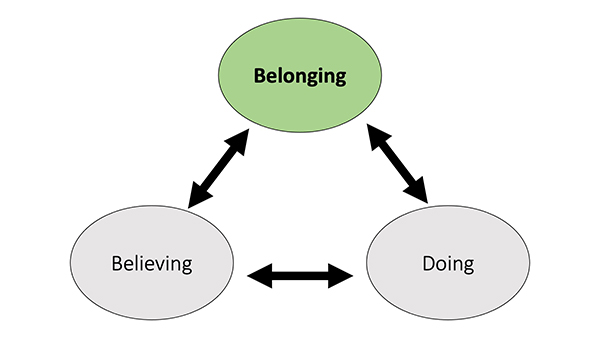
  • Belonging may be the penultimate need of human beings after survival and safety are assured.
Listening Experiments – A Way Forward

Seek first to understand, Then be Understood.
[But] Common Sense is not common practice.
~ Stephen Covey

Empathic Listening – Basic Skill Sets

Thousands of books and training curricula have outlined the following skills for empathic listening. They are foundational for “moral communication” across the political divide.

  • Attending and following: eye contact, a posture of involvement, an invitation to talk, and minimal encouragements, such as “tell me more.”
  • Paraphrasing content: reflecting essential facts and ideas
  • Reflecting feelings: identifying the key emotion expressed by the speaker’s words, body language, and tone. Then reflecting their feelings in your own words.
  • Reflecting meaning: reflecting the speaker’s predominant emotion and your understanding of the reason behind their emotion, which may be their perception of the facts or an inferred meaning not yet expressed.
Use Moral Foundations to Reach your Political Opposite.

If you want to understand someone politically different from you, elicit and consider what is sacred to them. Which of the three moral matrices drive their thoughts and feelings? Next, consider which of the six moral foundations carry the most weight in a particular controversy.

Listening to Hear the Sacred Value

Do you hear mostly a concern for the victims of oppression, for those in need? Concern for victims is a sacred value for liberals. Or, do you hear a concern for protecting institutions, traditions, national pride, and the family? Those are sacred values for conservatives. You might also hear the sacred value of liberty and freedom from government. Liberty is a sacred value to many in our nation. Knowing what is sacred is the first step in reaching across the divide.

Build It and They Might Come

A “field of empathy” between “red and blue” can only emerge on the emotional and instinctual level. We might bridge the divide if we connect with the gut feelings of the other side, if we engage with the other tribe long enough to “feel” what it is like to be them. We must walk in their shoes and know their unique lived experience. Creating this field “beyond right-doing and wrong-doing” will not be easy. But build it, and they might come.

Listen to Hear the Emotion

Imagine if your only goal in a conversation was to know what emotions are being expressed by the speaker. In this experiment, you do not care about their “facts” – only their feelings. Are they mostly angry, afraid, or sad? What do their eyes, mouth, torso, and arms communicate? Their nonverbal language will be congruent with their feelings in most cases. Perhaps their emotions shift, moment to moment. In conversations with conflict, there will also be glimmers of curiosity, enthusiasm, joy, and hope. In Nonviolent Communication – A Language of Life (2005), author Marshall Rosenberg names over one hundred feelings that result when our needs are not met. Nonviolent Communication should also be read to understand the distinction between “I feel” vs. “I think” and how the latter is often used to avoid or mask the emotional content.

Emotion is the Conduit

To reach across the political divide and make a human connection, we must be on a shared emotional channel, not the channel of ideas; we must express what we are angry about, afraid of, or sad about, given our sacred values.

By expressing our feelings, we can shape other people’s emotional states and make it more likely that other people will take our point of view. Emotions are incredibly contagious. MRI studies prove that our brains will synchronize when there are emotional words and content. According to Finish neuroscientist Lauri Nummenmaa, brain synchronization allocates attention in the same direction and generates a similar psychological state. Synchronized brains prompt people to act and view the world in a similar way. If persuasion is eventually your goal, get your listener to feel what you feel.

Emotional Bottomline

Don’t trade facts; trade stories. Don’t try to persuade (with exceptions ahead), just listen. Just listen to their story and their pain, and perhaps share some of your own emotional story. Just hear their anger, fear, and sadness. Just be with it.

Reframing Using Moral Foundations

Researchers Robb Willer and Mathew Feinberg did a series of studies to test how to nudge a political opponent to consider ideas they would normally reject. The idea is to appeal to the other’s moral foundations. Willer and Feinberg found that when conservative policies were framed around liberal values, like equality and fairness, liberals became more accepting of them. And when liberal policies were recast in terms of respect for authority, conservatives became more receptive. This reframing technique is far from a panacea – it is tough to convert a political opponent to your side. But research shows reframing can make a small difference to soften a stance and get the other side to listen a bit more.

Example – Military Spending

If a conservative wanted to convince a liberal to support higher military spending, he should not appeal to his patriotism. He should appeal to his Care/harm foundation with something like, “Through the military, the disadvantaged can achieve equal standing and overcome the challenges of poverty and inequality” (liberal foundations of equality, fairness, and protection of the vulnerable).

Example – Kneeling for the Anthem

If you are trying to convince a conservative of the merits of kneeling for the national anthem in protest, emphasize the traditional values around religious and political freedom. Argue that the founding fathers were deeply concerned about protecting our rights to social protest.

Example – Trump and Loyalty

Feinberg found that an argument against Trump in terms of loyalty (loyalty foundation) led conservatives to report less support for him. This message argued that Trump behaved disloyally towards our country to serve his own interests and that during the Vietnam War, he dodged the draft to follow his father into the development business.

Deep Canvassing – Listening to Gently Persuade

A 2016 article in the journal Science described a way to sway prejudicial opinions in a mode of conversation that political organizer, Dave Fleisher, calls “deep canvassing.” This technique is intuitively quite obvious. Let the “voter” do most of the talking. Ask open-ended questions and let them share their own experiences — delve into their personal story about when they felt (as an example) discriminated against. Near the end of the conversation, nudge the person to consider how their story might relate to the pertinent issue. The idea is that people learn lessons more durably when they come to conclusions themselves, not when someone “bitch-slaps them with a statistic,” says Fleischer. The technique boils down to this: listen to people, get them to think about their own experience, and then highlight your common humanity.

Listening Like a Braver Angel

Building on Abraham Lincoln’s appeal to the “better angels of our nature,” Braver Angel red/blue workshops across the country have structured conversations where deep listening might occur. Braver Angel participants seek to understand the experiences of those across the political divide and find possible areas of common ground. The focus is on listening and reflecting, rather than debating and persuading. These workshops do not seek to change minds nor develop a centrist political philosophy. Participants are asked, with earnest curiosity, how they believe their values and policies are good for the country. This kind of listening to the experience of “the other” may allow for understanding and reveal the operation of their moral matrix.

Personality Differences with Deep Listening

A cautionary note is in order. As discovered in an earlier iteration of this bipartisan effort called “Better Angels,” there may be a problem as described by investigative journalist David Graham: “People who are willing to spend a morning or a day on such an exercise are the kind of people who are already convinced that dialogue is important, and are more willing to hear the other side out.” Remember, there are personality differences (noted in Part 1 and Part 2 and reviewed in Part 3) between liberals and conservatives. Liberals are more comfortable with openness, and that includes experiential workshops.

Listening to Hear the Need

A critical contribution from Nonviolent Communication (NVC) is identifying the needs of the speaker behind their feelings. Recognizing the need is extremely important in reaching across the political divide. Rosenberg identifies needs for autonomy, integrity, celebration, interdependence, play, spiritual communion, and physical nurturance. Maslow’s hierarchy remains the benchmark for understanding human needs. The needs of belonging (as emphasized in prior posts) and esteem (respect) are perhaps the most essential needs to acknowledge in our political opposites. Here is a probe suggested by William Issacs (Dialogue – The Art of Listening Together) that may help find the sacred value, the feeling, or the unmet need. Ask: What else must be true (in your world) in order for you to have that position or belief?

Reflecting Meaning Using NVC

Here is a NVC sentence sequence for the reflection of meaning back to the speaker:

“You feel ….angry
when ….people don’t kneel for the flag (action of a person, institution, or an event)
because you want or need to be respected as our nation is respected.
Is that right?” (check for accuracy)

Of course, there is an “I-statement” version of this sentence sequence.
“I feel afraid and angry
when ….police shoot Black people
because I need to feel safe and want the respect given by equal protection and rights.”

Other versions of reflection of meaning include an explanation of the impact and consequences of the behavior (after “because”), sharing and checking assumptions about the other person, and a request for some new action. But it is the NVC version that has the most focus on hearing the feeling and the need, without necessarily including any request or expectation for the person to think or behave differently. (The complete NVC sequence includes a request.)

Listening Without Judgment – A Worthy Aspiration

Indian philosopher J. Krishnamurti once remarked that observing without evaluating is the highest form of human intelligence. The first component of NVC entails the separation of observation from evaluation. It is an aspirational goal. Humans are judgment machines. (Remember, our cautious discernments protected us from cheaters and free-riders for thousands of years.) But with practice (and mostly keeping your mouth shut), it is possible to learn how to listen “without resistance” and the need to critique. It takes a fair amount of internal monitoring and returning to the state of non-judgment – like returning to a mantra or the breath in meditation.

Listening for Collective, Shared Meaning

Each conversation we have across the political divide is like an act in a play. When we listen for collective meaning, we reveal the plot we are enacting. To reach across the political divide, we need to identify common motivations. Listening for the collective, shared meaning informs us about who we are together and who are becoming together. William Isaacs in Dialogue: The Art of Thinking Together, (1999) suggests this thought experiment: “listen for the already existing wholeness.” Linda Ellinor and Glenna Gerard (Dialogue — Rediscover the Transforming Power of Conversation) pose this question: If there were one voice speaking here, what would that voice be saying?

Challenges of Human Reasoning
 
It is not Rational

We have learned that most political discourse is not about policies or rational thinking. We are in a post-objectivity era of information (see Appendix). We do not share facts. Science has a muffled or even muzzled voice, even in this time of the pandemic. “When gut feelings are present, dispassionate reasoning is rare. Feelings come first and tilt the mental playing field on which reasons and arguments compete. If people want to reach a conclusion, they can usually find a way to do so” (Jonathan Haidt).

Social Media Contact Does Not Bridge the Divide

Researchers at Duke, NYU, and Princeton paid a large sample of Democratic and Republican Twitter users to read more opinions from the other side. The researchers found no evidence that inter-group contact on social media reduced political polarization. Whenever we engage in political debates, we all tend to overrate the power of arguments we find personally convincing – and wrongly think the other side will be swayed.

Messages Do Not Transfer to Another Tribe

Willer and Feinberg underscored what moral foundation theory tells us: messages that excite like-minded voters by appealing to their sacred values do not translate from one moral tribe to another. “You’re essentially trying to convince somebody who speaks French of some position while speaking German to them,” Willer said.

Example – Gun Control

On gun control, for instance, liberals are persuaded by stats like “no other developed country in the world has nearly the same rate of gun violence as does America.” And they think other people will find this compelling. Conservatives, meanwhile, often go to this formulation: “The only way to stop a bad guy with a gun is a good guy with a gun.” Both sides fail to understand that they are arguing a point that their opponents have not only already dismissed but may be inherently deaf to.

Confirmation Bias

We sometimes process information in a manner less like an impartial judge and more like a lawyer working for the mob.
~Douglas Kenrick, et al., Scientific American, Fall 2020

Confirmation bias is the tendency to look for information that confirms our pre-existing beliefs and to interpret information in ways that confirm our preconceptions. We show a natural tendency to pay attention to some findings over others and to reinterpret mixed evidence to fit with what we already believe.

Expecting Malicious Intent

Also, the more we dislike someone or something, the more likely we are to attribute their actions to malice. Whenever someone we dislike makes a mistake, reacting with empathy and understanding tends to be the last response. If we expect malicious intent, we are likely to attribute it wherever possible. Modern media treats outrage as a profitable commodity. These outlets are skilled at generating assumptions of malicious intent. (See post-objectivity era in Appendix.)

Anger is often held in place by a belief that the person has “the intent to do us harm.” If this belief can be dispelled through empathic conversation, anger and hardened positions often subside.

Hanlon’s Razor – Low Level of Intent

Often we are unable to identify when mistakes are the result of incompetence or an accident.

Robert J. Hanlon teaches us not to assume the worst intention in the actions of others. “Hanlon’s razor” says “never attribute to malice that which can be adequately explained by neglect, laziness, or stupidity.” Use with caution inside your own head.

Motivated Reasoning

Along with confirmation bias, humans often use their reasoning to concoct a justification in favor of some belief they hold or to counter an assertion or argument presented against that belief. Researchers Mercier and Sperber (2011) report that human reasoning, deployed in social contexts, evolved not so much as a means of ascertaining truthful propositions, but rather as a way of winning arguments – as a way of persuading others.

Tali Sharot in The Influential Mind debunks the idea that motivated reasoning is a trait of less intelligent people. Indeed, studies show that the greater your cognitive capacity, the greater your ability to rationalize and interpret information at will, to creatively twist data to fit your opinions.

Boomerang Effect

Presenting people with information that contradicts their opinion can cause them to come up with altogether new counterarguments that further strengthen their original view, says Sharot. A burst of counterarguments is known as the “boomerang effect.”

Belief Perseverance

Belief perseverance refers to our quest to maintain what we know as true even after the information has been refuted. Evidence to the contrary will be dismissed, and we are likely to seek and believe information that supports our belief while rejecting any data to the contrary. The “Einstellung Effect” is the brain’s tendency to stick with the most familiar solution to a problem and stubbornly ignore alternatives. (Scientific American, “Why Good Thoughts Block Better Ones”, Fall 2020) Preestablished opinions are difficult to change, even when they are wrong.

Evidence is Rejected

The problem with information and logic is that it ignores the core of what makes you and me human: our motives, our fears, our hopes and desires.
~ Tali Sharot, The Influential Mind

In a 2017 study, Anthony Washburn and Linda Skitka of the University of Chicago tested the hypothesis that conservatives are more distrustful of scientific evidence than liberals. The authors gave 1,347 study participants scientific evidence on six hot button issues – climate change, gun control, health care reform, immigration, nuclear power, and same-sex marriage. Washburn and Skitka found that both conservatives and liberals reject findings that do not align with their political ideologies.

Carrot and Stick

If persuasion is the goal, Sharot’s research makes it clear that we should use a “carrot” (positive rewards) to encourage action and use a stick (punishment) to stop an action or cause inaction. For instance, wearing a protective mask could be increased by counting its use and giving positive feedback instead of delivering messages about preventing sickness and decreasing risk. The human brain is built to associate “forward” action with a reward, not avoiding harm.

Beware of the “Halo Effect”

The “halo effect” is when one trait of a person or thing is used to make an overall judgment of that person or thing. It supports rapid decisions, even if they are biased; it allows us to make snap judgments. Early humans who could make fast decisions were more likely to survive to become our ancestors. We have inherited a tendency to make (overly) quick judgments based on generalizing from a small amount of data.

Don’t Generalize from Their Politics

For example, (as I have reported elsewhere on this site) a tall or good-looking person will be perceived as smart and trustworthy, even though there is no logical reason to believe that height or looks correlate with intelligence or honesty. If you are trying to bridge understanding with a person who is a Trump supporter or a Black Lives Matter protestor (someone opposite of you in affiliation), don’t transfer the fact of their political affiliation (or any easily observed characteristic) to a judgment of that person’s overall character.

Nurture Belonging and the Social Fabric

Cultivate Belonging in a Divided Culture

In my last post (Political Divide Part 5), I noted that belonging is fundamental to human beings; it drives our religious experience and political affiliations. Belonging is more important than beliefs. Belonging is a central need that must be acknowledged in reaching across the political divide.

Brene’ Brown has some wisdom about belonging from her book, Braving the Wilderness.

“The world feels…heartbroken to me right now,” Brown writes. “We’ve sorted ourselves into factions based on our politics and ideology. We’ve turned away from one another and toward blame and rage. We’re lonely and untethered. And scared. So damn scared.” Brown wrote that in 2017. The political divide and social angst have magnified significantly since then.

Brown suggests interventions for this malaise that are congruent with deep listening. Here are her four keys to “true belonging” –an antidote to the crisis of disconnection and loneliness in America.

Four Keys to True Belonging
  1. Make contact with people you disagree with. Rather than judging them from afar, get to know members of the “other” group. “People are hard to hate close-up,” she says. It is harder to dislike someone after you have heard their story.
  2. Share collective joy and pain. “The more we’re willing to seek out moments of collective joy and show up for experiences of collective pain – in person (not online), the more difficult it becomes to deny our human connection, even with the people we disagree with,” she writes. According to a 2017 study reported in Psychological Assessment, “collective assemblies” (like games, concerts, plays, or sharing art) contribute to greater meaning, decreased loneliness, positive emotions, and social connection. (See Emile Durkheim’s “collective effervescence” in Part 5.)
  3. Speak up nicely when you disagree. Brown’s research suggests that sometimes people assert something just because their tribe believes it or because they think it will help their argument. People who feel a sense of belonging do not stay silent in these situations, but they don’t attack either.
  4. Embrace the paradox. Brown says people with a sense of belonging exhibit a paradoxical mix of traits — what Zen Buddhist teacher Joan Halifax calls “a strong back and a soft front.” They have principles and boundaries. But they are also compassionate and vulnerable. The biggest paradox of all, says Brown, is that true belonging involves the courage to stand alone. If we are too afraid to disagree or rock the boat, we won’t feel like we genuinely belong anyway.
Be A Weaver

There are those in America who practice an ethos that puts “relationship over self.” David Brooks calls them the “weavers.” Brooks says they have the trait of “radical mutuality” – everyone is considered equal, regardless of where society ranks them. (Brooks is a conservative but is clearly evoking the liberal moral matrix.) Brooks says we are living with the excesses of sixty years of hyper-individualism – with an emphasis on personal freedom, self-interest, self-expression, and the idea that life is an individual journey toward personal self-fulfillment. But weavers, says Brooks, are not motivated by those things.

Don’t Rip the Social Fabric

Brooks says we don’t just have a sociological problem, we have a moral problem. He underscores the nature of our moral problem: when we stereotype, abuse, impugn motives, and lie to one another, we have ripped the social fabric and encouraged more ugliness.

Weave With Moral Communication

Brooks asks us to decide to be a weaver instead of a ripper. “This is partly about communication,” he says. “When we love across boundaries, listen patiently, see deeply, and make someone feel known, we’ve woven the social fabric and reinforced generosity.”

Weavers want to live in right-relation with others and serve the community good. Learn what it means to be a relationalist and not an individualist, Brooks implores. Culture changes when a small group of people, often on the margins of society, find a better way to live and other people begin to copy them.

Out beyond ideas of rightdoing and wrongdoing
there is a field
I’ll meet you there.
When the soul lies down
In that grass
The world is too full to talk about.
~ Rumi

Appendix: Related Psychological and Cultural Insights

Why Do We Love a Conspiracy Theory?

More than 25% of Americans believe there are conspiracies behind many things in the world, according to a 2017 analysis of survey data by the University of Oxford and the University of Liverpool.

Noam Shpancer, professor at Otterbein University, says that conspiracy theories are byproducts of how the brain thinks. As reported in Psychology Today November/December 2020, Shpancer says there are four central mechanisms underlying our “penchant for preposterous plots.”

  1. Fundamental attribution error is the tendency to prefer “dispositional” explanations to situational ones. Dispositional means someone planned an event for a purpose, rather than it happened randomly or because of circumstances.
  2. Confirmation bias and belief perseverance. (as described above)
  3. Being uniquely knowledgeable. Conspiracy theories supply a seductive ego boost. Believers often consider themselves part of a select in-group that has figured out what’s really going on. Conspiracists possess knowledge that others don’t.
  4. Pattern recognition. The brain evolved in a dangerous environment where the ability to fill in the blanks conferred significant survival advantages. If you can make out the hidden predator in the bushes, you might survive. The brain came to specialize in meaning-making and pattern-finding. In the absence of a pattern, the brain will invent one and impose it on the world. The brain seeks order, cause and effect, and intention. But with the chaos of modern life, humans reduce stress by finding stories that fit the demands of our brain rather than the true facts.
Anxious People are Vulnerable to Conspiracies

Experiments show that anxious people are especially drawn to conspiratorial thinking triggered by a loss of control. When feelings of personal alienation or anxiety are combined with a sense that society is in jeopardy, people experience a kind of conspiratorial double whammy, according to a study conducted near the start of the US great recession. A 2017 study by Princeton psychologists found that feeling alienated or unwanted seemed to make conspiratorial thinking more attractive.

Argument Culture and Truth Decay

Linguist Deborah Tannen broke new ground in gender studies with her book about male-female communication, You Just Don’t Understand Me, published in 1990. Controversy about the book led to media coverage that promoted a battle of the sexes. After many articles were published that misrepresented her work, Tannen finally asked one such writer, “why do you need to make others wrong for you to be right?” The writers’ response: “It’s about the argument!” This tendency to stage a fight on television or in print seemed to be based on the tenuous proposition that opposition leads to truth. (Actually, it was about entertainment and profit.) Tannen turned her focus on this phenomenon and published The Argument Culture in 1998. This book was prescient about the drastic increase of oppositional “journalism” and predicted the coming “post-objectivity era.”

A Short Primer on The Post-Objectivity Era

(From Matt Taibbi’s Hate Inc: Why Today’s Media Market Makes Us Despise One Another)

In 1987 under Ronald Reagan (just before You Just Don’t Understand Me), the federal government stopped enforcing the Fairness Doctrine, which required balance on public airwaves. With the demise of the Fairness Doctrine, companies embraced the idea of selling slanted media. Big media companies like Fox realized that rather than try to corral an increasingly splintered whole audience, it would be better to pick one demographic and try to dominate it. Under Roger Ailes, Fox News hunted an older, white conservative demographic by feeding it stories that reinforced the idea that immigrants, minorities, and criminals were overrunning America. They made villains out of characters. (Hillary Clinton was the perfect TV villain for conservatives!) In the post-objectivity era, media companies learned there was a consistent, dependable way to make money. First, identify an audience. Then, relentlessly feed it streams of stories that validate the audience’s belief systems.

Audiences Are Siloed

Now audiences are completely siloed. A Pew study published in September showed that of the people who say Fox is the primary news source, 93% describe themselves as Republicans. For MSNBC, the number is 95% Democrats. The New York Times is 91% Democrats. NPR is now 87% Democrats.

In this media environment, stories are chosen that adhere to an established editorial approach and political tone with the knowledge that departing from that audience will cost the media outlet millions of dollars. The news today is primarily not a public service. First and foremost, it is a consumer product.

The Media’s Ten Rules of Hate (by Matt Taibbi)
  1. There are only two sides.
  2. The two sides are in permanent conflict.
  3. Hate people, not institutions.
  4. Everything is someone else’s fault.
  5. Nothing is everyone’s fault.
  6. Root, don’t think.
  7. No switching teams.
  8. The other side is literally Hitler.
  9. In the fight against Hitler, everything is permitted.
  10. Feel superior.


References and Recommended Reading


Bolton, R. People Skills – How to Assert Yourself, Listen to Others, and Resolve Conflicts, 1979.
Brown, B. Braving the Wilderness – The Quest for True Belonging and the Courage to Stand Alone, 2017.
Ellinor, L. & Gerard, G. Dialogue – Rediscover the Transforming Power of Conversation, 1998.
Isaacs, W. Dialogue: The Art of Thinking Together, 1999.
Patterson, K. et al. Crucial Conversations – Tools for Talking When Stakes are High, 2002.
Rosenberg, M. Nonviolent Communication – A Language of Life, 2005.
Scientific American, Truth vs. Lies, Fall 2020.
Sharot, T. The Influential Mind – What the Brain Reveals About Our Power to Change Others, 2017.
Tannen, D. The Argument Culture – Stopping America’s War of Words, 1998.

Please Note: Your comment may take up to 12 seconds to register and the confirmation message will appear above the “Submit a Comment” text. 
Political Divide Part 5: The Challenge of E Pluribus Unum – “Out of Many, One”

Political Divide Part 5: The Challenge of E Pluribus Unum – “Out of Many, One”

A wise skepticism is the first attribute of a good critic.

~ James Russell Lowell (1819-1891)

In This Post (Strands of Rope)
  • Jonathan Haidt’s constructive criticism of Democrats
  • Challenges and miracle of e pluribus unum – “out of many, one”
  • Problems with “defund the police” messaging
  • Disagreements with Haidt’s portrayal of the moral matrices
  • Dangers of “moral capital” and potential failures of the Conservative moral matrix
  • “Yin and yang” interdependency of our political affiliations
  • Guiding philosophies of John Stuart Mill and Emile Durkheim
  • Human’s dual nature, “hive switch,” and “collective effervescence”
  • Football games and religious rituals
  • Belonging is more important than beliefs; belonging is essential to humans
Introduction

In my last post, Our Political Divide –  Part 4: Moral Foundations  – A Path To Understanding, I described six moral foundations that undergird and inform the political affiliations of liberals, conservatives, and libertarians.  Based on the work of Jonathan Haidt, I also outlined the moral matrices of liberals, conservatives, and libertarians, using bar graphs to demonstrate the relative strength of each foundation – a unique profile for each political affiliation.   Part 4 explained what liberals and conservatives really care about.   This post will assume that the reader has some familiarity with the six foundations and perhaps the “Ten Insights from Jonathan Haidt” presented in Political Divide – Part 3: Review and Introduction to the Moral Foundations.*

Why is this Information Important?

Understanding what liberals, conservatives, libertarians, and activated authoritarians care about gives a framework for empathic communication – an opening for conflict de-escalation, problem-solving, reconciliation, and unification of communities in the United States. Stay tuned for my final post in this series, Political Divide, Part 6: Moral Communication — the Way Forward.

Biggest Partisan Difference

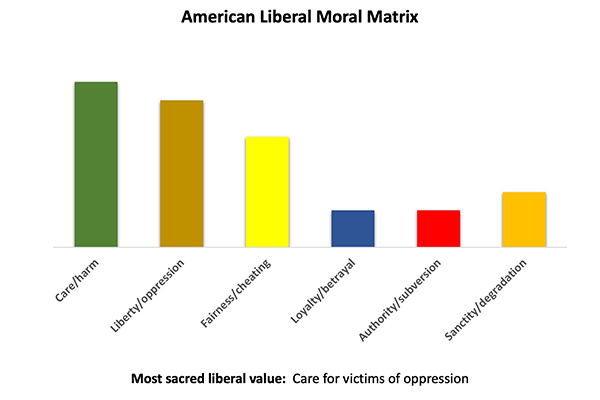
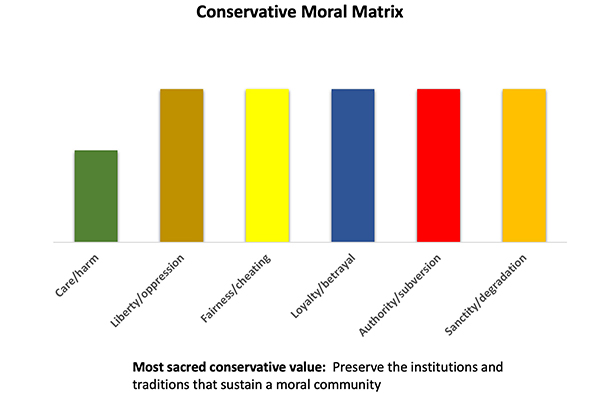
Haidt claims that liberals primarily use three foundations – Care/harm, Fairness/cheating, and Liberty/oppression, whereas conservatives utilize all six.  According to Haidt, the foundations of Loyalty/betrayal, Authority/subversion, and Sanctity/degradation are equally salient in conservative morality.   Haidt contends that liberals are ambivalent about Authority, Loyalty, and Sanctity.  He says this is the most significant partisan difference between liberals and conservatives.

Democrats – Listen Up

Twelve years ago, Haidt warned Democrats about “deficiencies” in their moral framing to the American electorate.  It bears repeating and considering.

Close the Sacredness Gap

Democrats, he said, must find a way “to close the sacredness gap” between themselves and Republicans.  Haidt references sociologist Emile Durkheim in recognizing that sacredness is about society and its collective concerns.  These concerns are embedded in the Loyalty, Authority, and Sanctity foundations.  Democrats could close much of the sacredness gap, Haidt says, if they saw society not as a collection of individuals but as an entity in itself.

Why Do Working Class and Rural Americans Vote Republican?

Voters do not vote for their self-interests; they vote for their values. Working-class and rural Americans don’t want their nation to devote itself primarily to the care of victims and the pursuit of social justice, asserts Haidt. Until Democrats understand the difference between a six-foundation and three-foundation morality, they will not understand what makes people vote Republican.

“Out of Many, One” – It’s Complicated

Our national motto is e pluribus unum – “Out of many, one.”  But political scientist Robert Putnum (Bowling Alone) found that ethnic diversity (in the short run), increased alienation and social isolation by decreasing people’s sense of belonging to a shared community.  People tend to “hunker down,” he says.  Trust (even of one’s own race) is lower, altruism and community cooperation decline.

Difficulty Binding the Many – the Problem with E Pluribus Unum

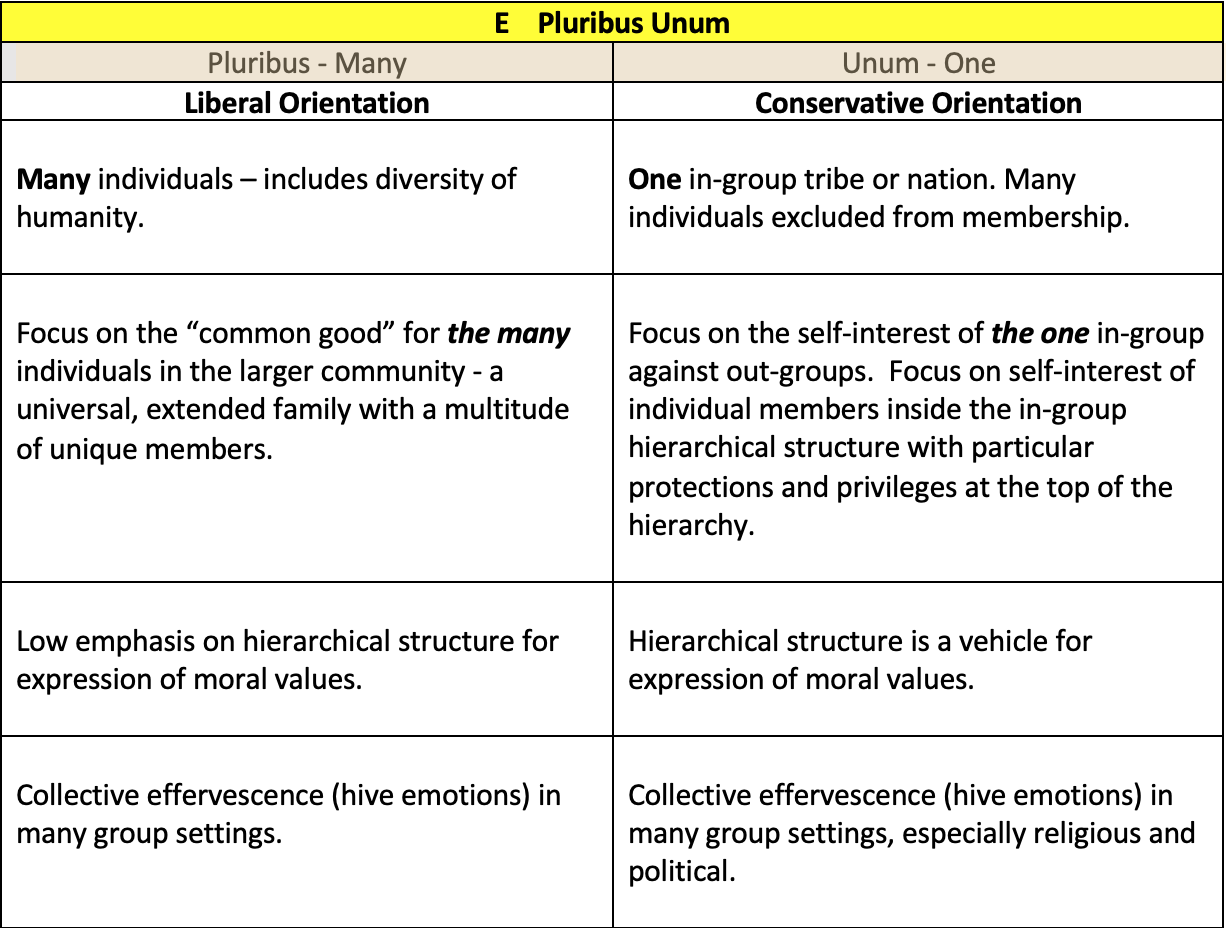
Haidt says liberals have difficulty binding pluribus (the many individuals) into unum (the one, collective, in-group.)  He says Democrats pursue policies for the many at the expense of the one.

Don’t Weaken the Collective

In 2008, Haidt suggested that diversity programs to fight racism and discrimination might be better served by encouraging assimilation and a sense of shared identity.  He asserted that progressive policies of multiculturalism, bilingualism, and immigration demonstrate that Democrats care more about pluribus than unum.  They weaken the integrity of the collective; they widen the sacredness gap. These ideas of Putnam and Haidt might be hard to take in the current era of liberal “wokeness.”  And Haidt might revise this advice in 2021.  But, perhaps Democrats should revisit and reflect on this critique.

The “Many” In-group

Conservatives are more concerned than liberals about group cohesion as sustained by their most prized morality foundations:  Loyalty/betrayal, Authority/subversion, and Sanctity/degradation.  Conservatives are worried about the many (individuals) as long as it is their in-group and not an out-group, whereas liberals are concerned about everyone, inside the group and outside the group.

Moderate Doses of the Loyalty Foundation

The Loyalty foundation supports a kind of patriotism and self-sacrifice that can lead to dangerous nationalism.  But in moderate doses, it can lead to a sense that “we are all one” —  a recipe for high social capital and civic well-being, according to Haidt.

More from Haidt:  Liberal Messaging of Sanctity

The Christian Right uses the Sanctity/degradation foundation to condemn hedonism and sexual “deviance.”   Haidt acknowledges (however meekly) that the Sanctity foundation can, and should, be harnessed for progressive causes.  Sanctity does not have to come from God.  Liberals could do a better job of reframing the ugliness of un-restrained free markets as a moral issue.  Environmental and animal welfare could be “messaged” as issues of Sanctity, not just appeals to the Care foundation.

“Soft On Crime” is a Disqualification

Democrats will have the most difficulty using the Authority foundation, according to Haidt.  This foundation is about maintaining social order, so any candidate seen as “soft on crime” will disqualify himself or herself for many Americans.  Haidt says Democrats should consider the quasi-religious importance of the criminal justice system.  A party perceived to tolerate cheaters and slackers will be committing a kind of blasphemy.

“Defund Police” Violates Conservative Sacred Value

Politicians and pundits are debating the influence of the slogan “defund the police” on the down-ballot races in the November 2020 election.  (“Defund the police” was first used in May 2020 during the George Floyd, Black Lives Matter protests.)  Many prominent Democrats (e.g., Barack Obama, Jim Clyburn, Cory Booker, and Joe Biden) opposed using the term and articulated policies for police reform and reallocation of police resources.  Most observers suspect that “defund the police” turned-off moderate voters and hurt the electoral chances of Democrats.

A Stupid Campaign Slogan

Ibram Kendi recently claimed in the Atlantic (December 3, “Stop Scapegoating Progressives”) that we don’t know if “defund the police” hurt Democrats, while also sharing polling data that sixty-four percent of Americans were opposed to it.  Political scientist, Bernard Grofman, wrote that “defund the police is the second stupidest campaign slogan any Democrat has uttered in the twenty-first century” (second only to Hillary Clinton’s 2016 comment that half of Trump’s supporters belong in a “basket of deplorables,” which was not used as a campaign slogan).

Unity vs. Justice – The Moral Foundation Divide

An interviewer recently asked Abigail Spanberger (newly re-elected moderate Democrat in Virginia) and Ayanna Pressley (re-elected progressive Democrat in Massachusetts) the advisability of promoting “defund the police.”  Both did a pivot and would not address the inaccuracy and political toxicity of that message.  But Pressley framed the Democratic allegiance to Care/harm and Fairness/cheating foundations as distinct from the conservative Loyalty foundation.  She told the interviewer, “it [the issue of Black Lives Matter and defund the police] is not about unity; it is about justice.”  It could not have been more clearly illustrated: unity is a conservative sacred value, justice is a liberal sacred value.

Messaging Lessons Learned

There are six insights related to “defund-the-police” messaging:

  1. Repeating a message dramatically influences perception and cognition.
  2. The Black Lives Matter movement has used messages that are politically inadvisable and not descriptive of policies.
  3. Democrat representatives will avoid talking about this slogan directly; it is an undiscussable.
  4. Republicans will coopt whatever message increases the political divide and will vilify and lie about the reality of Democrat positions.
  5. “Defunding the police” violates the sacred value of the Authority foundation held by conservatives and many other Americans.
  6. Unity vs. justice is an unavoidable interdependent polarity that illustrates our political divide and the complexity of e pluribus unum.**
Guard the Coherent Whole of a Young Nation

Haidt recognizes that “democrats would lose their souls if they ever abandoned their commitment to social justice, but the divisive struggle among the parts must be balanced by a clear and often repeated commitment to guarding the coherence of the whole.”  Haidt reminds us that America lacks the long history, small size, and ethnic homogeneity that holds many other nations together.  So our flag, founding fathers, military, and common language take on a moral importance that many liberals have difficulty comprehending.  (That said, disputing a legitimate election is a dramatic threat to the “coherent whole” of America and its relatively young democracy.)

Structure Restrains In the Service of Liberation

Conservatives believe that people need external structures or constraints to behave well, cooperate, and thrive.  These external constraints include laws, institutions, customs, traditions, nations, and religions. Given twenty years of experience in group process design, facilitation, and agenda development, I concur entirely.  The structure of an agenda (co-developed with the group leader or entire group) frames the order and effectiveness of problem-solving and helps people stay on-task and on-topic.  Without a cogent, planned agenda and strong facilitation, groups flounder and spin their wheels in time-wasting chaos. Organizational development consultants and artists of all types understand that restraints and boundaries “at the edges” promote creativity instead of impeding it.

Blind Spots Around Freedom

Peter Ditto is a research colleague of Haidt’s who studies “hot cognition” – the interface between passion and reason.  He says both conservatives and liberals have a blind spot around freedom.  As mentioned in my last post, conservatives push for economic freedom but not freedom for things they think are morally wrong, like gay marriage or abortions.  Liberals show precisely the opposite: they are comfortable with freedom regarding sexual behavior, and less so in economic behavior.

My Disagreements with Haidt:
  • Haidt underestimates liberals’ connection to Sanctity/degradation foundation (e.g., food and environment).
  • Haidt overestimates the conservative expression of the Care/harm foundation and does not fully acknowledge that conservatives do not prioritize it. We see the Republican deficit in Care/harm clearly expressed in their recent Covid-19 relief proposals:  no direct cash given to vulnerable Americans but liability protections given to corporations. (This changed in the final bill.)
  • Haidt underplays the force of money as a self-interest for conservatives. Conservatives’ in-group loyalty is most vital with those of higher socio-economic status —  conservative/Republicans at the top of the hierarchy.  Haidt appears to underestimate, or not clearly articulate, the power of monied interests in the conservative/Republican tribe.
  • Haidt seems to claim that when Republicans vote for their economic interests, it is from a Fairness-proportionality foundation and not from trying to protect their privileged (self-interested) hierarchical position. It is undoubtedly both.  Conservatives are worried about the perceived lack of proportionality related to programs and taxes that serve the lower class, but not the absence of proportionality of the middle and lower classes compared to the upper socio-economic class.  The salary disparities between CEOs and line workers are ignored or rationalized as necessary.  There seems to be a blind spot for conservatives within the Fairness foundation.  According to recent federal data, the top 1% of Americans hold 30.4% of all household wealth in the US, while the bottom 50% hold just 1.9% of all wealth.  Is it proportionate for the 50 most affluent American families to own as much wealth as the poorest 165 million? (Bloomberg Wealth, October 8, 2020).
  • Haidt asserts that “everyone goes blind with sacred objects.” While this point has merit for understanding human cognitive processing, Haidt’s exposition on this point succumbs to a bit of false equivalency (which he could not have foreseen at the time of the book’s release.)  Democrats are not as blind to science, reason, and common sense as QAnon right-wing extremists and a significant portion of the Republican base.  Donald Trump lied to the American people approximately 30,000 times and broke many American norms of civility and stewardship for an American President.
  • Haidt made an immense contribution with Moral Foundation Theory but overcorrected in his politically correct message to liberals, who, he knows, will actually listen to reasoning. This (rational) appeal to liberals illustrates a perceived difference between a liberal and a conservative, disproving the very argument of equivalency (“everyone is blind”) Haidt seems to be making.
What is Moral Capital?

Haidt defines moral capital as “the resources that sustain a moral community — values, norms, practices, identities, institutions, and technologies that mesh well with evolved psychological mechanisms and thereby enable the community to suppress or regulate selfishness and make cooperation possible.”

“Moral Capital” Can Be Good or Destructive

Moral capital, says Haidt, is “not always an unalloyed good.”  It leads to the suppression of free riders, but it does not lead automatically to other forms of fairness, such as equal opportunity.   And while high moral capital helps a community to function efficiently, the community can use that efficiency to inflict harm on other communities.  High moral capital can be obtained within a cult or a fascist nation, as long as people accept the prevailing moral matrix.

Conservative Failures

Conservatives, says Haidt, do a better job of preserving moral capital but often fail to notice certain classes of victims, fail to limit the predation of powerful interests, and fail to see the need to change or upgrade institutions.  Conservativism may be used to maintain cultural cohesion, but the conservative moral matrix potentially includes violence, subjugation, and inequity in the development of social hierarchies and nation-states.

Liberals Change Things Too quickly

Haidt’s “tough-love letter” to liberals reminds them that if they do not consider the effects of changes on moral capital, they are asking for trouble.  Haidt believes this is the fundamental blind spot of the Left.  It explains, he says, why liberal reforms backfire and why communist revolutions end up in despotism.  Haidt acknowledges that liberalism has done a lot to bring about freedom and equal opportunity but asserts that liberalism is not a sufficient governing philosophy.  It tends to overreach, change too many things too quickly, and “reduce the stock of moral capital inadvertently.”

But Liberals Should Restrain Corporations and Regulate

Haidt says that liberals make two points that are profoundly important for the health of a society: 1) governments can and should restrain corporate superorganisms, and 2) some big problems really can be solved by regulation.

Yin and Yang of Our Political Landscape

A party of order or stability and a party of progress or reform are both necessary elements of a healthy state of political life.”

~John Stuart Mill

Our democracy and psycho-social well-being need both a liberal and conservative framework. Like yin and yang, both are necessary elements of a healthy state of political life. Liberals are better able to see the victims of existing social arrangements as they push to update those arrangements and invent new ones. Conservatives sustain the institutions that bind and preserve a community.    “I see liberalism and conservatism as opposing principles that work well when in balance,” says Haidt.  “Authority needs be to both upheld and challenged.  It’s a basic design principle.  You get better responsiveness if you have two systems pushing against each other.”

Two Approaches for Living in Peace

There are two approaches to having unrelated people create a society where they live together in peace – two philosophies that undergird liberals and conservatives, respectively: prevent harm to others and be loyal to the group.

1. Prevent Harm To Others

Renowned British philosopher, John Stuart Mill, wrote (in On Liberty), “the only purpose for which power can be exercised over any member of a civilized community against his will is to prevent harm to others.”  Mill’s ideas about governing a society of autonomous individuals essentially describe the liberal Care/harm foundation and the libertarian Liberty/oppression foundation.

2. Preserve the Family – Be Loyal To the Group

Emile Durkheim had a different vision from Mill.  The basic social unit is not the individual, it is the hierarchically structured family, which serves as a model for other institutions.  (See George Lakoff’s Strict Father Family Model in Part 2.)  Individuals are born into strong constraining relationships that profoundly limit their autonomy.  A Durkheimian society values self-control over self-expression, duty over rights, and loyalty to one’s group over concerns for out-groups.  A Durkheim world, says Haidt, can be unusually hierarchical, punitive, and religious.

In-group versus Out-group, Again

Mill’s liberal vision would allow care for out-groups. Durkheim’s conservative vision would not;  loyalty and authority are given only to the in-group.  The modern-day conservative vision is focused heavily on in-group hierarchy, which allows the expression of economic self-interest, perhaps sometimes masquerading as Mill’s individualism.  Folks at the top of the hierarchy often revere the individualism of economic self-interest.**

Self-interest vs. the Common Good

Modern-day liberals see the community, the common good, as an extension of the family, whereas modern-day conservatives in America promote individual rights and self-interest over community rights.  Conservatives advocate for individual liberty in economic and social policy in opposition to the “common good” for the larger community of diverse groups.**

The Miracle of E Pluribus Unum

Haidt says that if your moral matrix rests entirely on the Care and Fairness foundations, then it is hard to hear the sacred overtones in America’s unofficial motto: E pluribus unum (“out of  many, one”).  Haidt says that the process of converting pluribus (diverse people) into unum (a nation) is a miracle that occurs in every country on earth.  Nations decline or divide when they stop performing that miracle.

Human Nature, Belief, and Belonging

We are 90% Chimp and 10% Bee

Humans have a dual nature  — we are selfish primates who also long to be part of something larger and nobler than ourselves. We are 90% chimp and 10% bee.  We have the ability under special conditions to transcend self-interest and lose ourselves, temporarily and ecstatically, in something larger than ourselves.  This ability is the “hive switch” — an adaptation for making groups more cohesive and therefore more successful in competition with other groups.

Collective Effervescence

Durkheim calls this inter-social sentiment “collective effervescence” — the passion and ecstasy generated by group rituals.  These collective emotions pull humans fully, but temporarily, into the realm of the sacred where the self disappears and collective interests predominate.  “The very act of congregating is a potent stimulant.   Once individuals gather together, a sort of electricity is generated from their closeness and quickly launches them to an extraordinary height of exaltation.”   (I have witnessed this in a Christian mega-church and a Christian evangelical black church.  In both, the music was a powerful trigger.)

Football and Religion

Durkheim saw the function of religious rituals as the creation of community.  The college  (or pro) football game is a superb analogy for religion.  Football games flip the hive switch and make people feel, for a few hours, that they are simply part of a whole.  The ball movement and the plays are like the content or beliefs of religion – they are important details, but not the emotional reason for the game.

New Atheists

The New Atheist model of religious psychology came as a response to the attacks on 9/11 and was led by Sam Harris’ End of Faith, Richard Dawkin’s The God Delusion, and Daniel Dennett’s Breaking the Spell: Religion as a Natural Phenomenon.  For these authors, beliefs were crucial for understanding the psychology of religion.  Believing a falsehood, they said, makes religious people do harmful  things — “believing” causes “doing.”

Belief is Not the Social Facts

The focus on belief is not unique to the New Atheists.  It is familiar to psychologists, biologists, and other natural scientists.  Sociologists, anthropologists, and scholars in religious studies have a different view.  They are more skilled at thinking about what Durkheim called “social facts.”

Trying to understand the persistence and passion of religion by studying beliefs about God is like trying to understand the persistence and passion of college football by studying the movement of the ball.

Bottom line:  Belonging is More Important than Beliefs

Durkheim sees “belonging,” “believing,” and “doing” as three complementary yet distinct aspects of religiosity.  But belonging is the key; belonging informs belief and action. The function of beliefs and practices is ultimately to create a community. Belonging was palpable in my experience of the Christian churches and even more so in a Jewish congregation with my then-girlfriend, Maureen.

belonging, believing, and doing graphic
Belonging Is the Opposite of “Hunkering Down”

Belonging is an antidote to the alienation described by Robert Putnam.  No one wants to bowl alone.  Belonging is the opposite of “hunkering down.”  Belonging (paradoxically) drives liberal identity politics.  All colors of the rainbow look for their own rainbow coalition.  Individual “snowflakes” actually want to feel connected to similar snowflakes more than they want to be so different that they are alone.  Belonging drives our social media obsessions and increases the psychological risk of “fitting in” during early adolescence, especially for girls.

Belonging is Fundamental to Homo Sapiens

Belonging drives our religious experience and our political affiliations.   The white race is now shrinking in proportion to the entire US population.  Some want to belong to it more stridently than ever.   Belonging to a group and family is fundamental for human beings.  Belonging is part of our evolutionary DNA.  If a hunter got banished from the tribe, he died alone on the savannah.  Individual strands of rope will shred and break.  But the collective strands of rope can get into a nasty knot.  Yes, “out of many, one” is complicated.

Notes

*Ten Insights of Jonathan Haidt from Part 3

1. Intuitions come first, reasoning second.

2. There is more to morality than harm and fairness.

3. Pluralism is not relativism.

4. Morality binds and blinds.

5. We have a “hive switch.”

6. We are not as divided in politics as the moral dualists would have you believe (pre-Trump).

7. We are deeply intuitive creatures.

8. It is hard to connect with those who live in different moral matrices.

9. Look for commonalities.

10. Some things are sacred to others as some things are sacred to you.

**Self-interest vs. The Common Good: E Pluribus Unum is Complicated

e pluribus unum table

In my last post, I explained the apparent paradox of the human predilection for both hierarchy and egalitarianism.   I presented evidence that we are primarily structured for hierarchy but have been egalitarian in our evolutionary past.  In a parallel way, we see that humans are mostly driven by self-interest and in-group interests.  But if triggered, humans can be more inclusive and share an experience of “the hive” —  an experience of the larger collective.  Moral Foundation Theory research has found that liberals are more prone to include the entire hive in their moral calculations.  But clarity about individualism or self-interest vs. the interest of the “common good” of the larger community can be tricky within Haidt’s Moral Foundation Theory.

Venn Diagram of Liberals

If we were to imagine a two-circle Venn diagram of the liberal consideration of in-group and out-group, we would see a large overlap of the two circles.  The in-group would reach further into the circle of “others” (out-group) and the intersection in the middle would be a large area of cooperation and experience of the collective “hive”.

Liberals are often associated (the “me-generation,” et. al) with the idea of individualism.  As presented in modern-day identity politics, there are “snowflakes” of every type. This is “the many” (pluribus) individuals that include the rainbow of human diversity, the “people of difference” who are more outside the mainstream.  The liberal Venn diagram displays more xenophilia and less xenophobia.  In this framing, “the many” is the common good — the community that includes a multitude of unique individual self-interests.

Venn Diagram of Conservatives

The Venn diagram circles for conservatives look much different.  The in-group and the out-group circles do not overlap at all.  There is a xenophobic space between them.  Here’s the tricky part:  Conservatives have allegiance for the in-group as expressed by their Loyalty and Authority foundations.  Their sacred value is “the one” (unum) nation that overrides the individual interests of “the many.”  But the conservative in-group is structured by hierarchy.  And the hierarchy promotes the self-interest of those holding rank and status at the top.  It is also clear that their in-group is above the out-group – a further expression of hierarchy predicted by evolutionary history.  Within the conservative in-group, there can be moments of dissolution of self-interest that produce cooperation for the “hive” through religion and political cultism.

Structured for Hierarchy Wins the Day

In practice, conservatives promote the interests of the one, sacred in-group, and liberals promote cultural individualism and individual justice for the many.  The human predisposition to be “structured for hierarchy” wins the day in contemporary American democracy.  Conservatives promote the self-interest of those with social-economic power and status and liberals promote the “common good” – human rights and justice of those lower on the socio-economic hierarchy.

Paradox of Power

As a final wrinkle, UC Berkeley psychologist Dacher Keltner argues (The Power Paradox: How We Gain and Lose Influence) that we rise in a social hierarchy and gain power and reputation by positively influencing the lives of others (unless you were born rich).  But once humans gain power, they become much less relational and empathic.  “We rise in power and make a difference in the world due to what is best about human nature, but we fall from power due to what is worst,” says Keltner.   His research ultimately supports John Dalberg-Acton’s oft quoted insight that “power tends to corrupt, and absolute power corrupts absolutely.”

Please Note: Your comment may take up to 12 seconds to register and the confirmation message will appear above the “Submit a Comment” text. 

Our Political Divide – Part 4: Moral Foundations – A Path to Understanding

Our Political Divide – Part 4: Moral Foundations – A Path to Understanding

Liberals want dogs that are gentle and relate to owners as equals; conservatives want dogs that are loyal and obedient.  ~ Jonathan Haidt and Jesse Graham (study)

In previous posts, I identified differences between liberals and conservatives on several psychological dimensions, including social domination orientation and male-female evolutionary “affinity” (aggregate tendencies).  I also profiled a significant group of Americans with authoritarian tendencies attached to the Republican party who have some conservative characteristics in the extreme.  Most importantly, I introduced the Moral Foundation Theory of Jonathan Haidt in preparation for an in-depth analysis of the six moral foundations in this post. 

What do Liberals and Conservatives Really Care About?

Moral Foundation Theory adds remarkable insight to our evolutionary and psychological understanding of political affiliation and answers the central question in this series:  What do liberals and conservatives really care about?   Furthermore, how can either side understand the other and bridge this blue-red divide?  I will save that discussion for an upcoming post, Moral Communication – The Way Forward.

Listen for the Sacred

Another framing of the central question is this: what does each side of the political divide hold as sacred?  What are their beliefs that are not subject to persuasion or argument at all?  There is an evolutionary basis for most, if not, all moral positions.  Each moral stance signals a human adaptation that had utility for thousands of years and retains resonance in modern times.  When we listen for what is sacred, we might find a possible “field of empathy” in which to acknowledge and inquire: “I see what is important to you, will you please tell me more?” (More on “listening for the sacred” in Moral Communication – The Way Forward).

The Righteous Mind – Where the Sacred is Found

Developed by acclaimed author and psychologist Jonathan Haidt (The Righteous Mind), Moral Foundation Theory endorses the concept from evolutionary psychology that the human mind is constructed of “modules.”  This cognitive architecture is malleable in response to various cultural and social factors, yet is systematically organized as crafted by natural selection.   Haidt demonstrates that human moralizing is driven more by intuitive processing than conscious deliberations and rational faculties.

The Six Moral Foundations

Haidt’s research has named six moral foundations that are “innate” (inextricably shaped) in the human experience: Care/harm, Fairness/cheating, Loyalty/betrayal, Authority/subversion, Sanctity/degradation, and Liberty/oppression.   Haidt claims that liberals primarily use three foundations – Care/harm, Fairness/cheating, and Liberty/oppression, whereas conservatives utilize all six.    Haidt tells us that moral psychology is not just about how we treat one another but also about binding groups together, supporting essential institutions, and living in a sanctified and noble way.

1. Care/harm Foundation

We are a species that thrives when it keeps its young around for a long time and protects them. The Care/harm foundation evolved in response to the adaptive challenge of caring for vulnerable children.  It is related to our long evolution as mammals with attachment systems and the ability to feel (and dislike) the pain of others.  It makes us sensitive to signs of suffering and need; it makes us despise cruelty and want to care for those who are hurting.   It underlies virtues of kindness, gentleness, and nurturance.

Liberals in America rest heavily on the Care foundation in their feelings about people, animals, and victims they do not know directly. For conservatives, care is more often for those who have sacrificed for the group; it is not universalist.  It is more local and blended with loyalty.

2. Fairness/cheating Foundation

Cooperation — Not Exploitation

Altruism toward non-kin presented one of the longest-running puzzles in the history of evolutionary thinking.   Then Robert Trivers gave us the theory of reciprocal altruism in 1971 and explained the benefit of cooperation and social exchange among non-kin.  The Fairness/cheating foundation evolved in response to the adaptive challenge of reaping the rewards of cooperation without getting exploited by free riders.   It makes us sensitive to indications that another person is likely to be a good (or bad) partner for collaboration and exchange.  The Fairness/cheating foundation makes us want to shun and punish cheaters. It generates ideas of justice, rights, and autonomy.

Tit for Tat

We are a species that evolved to form beneficial alliances – to know what is “fair” for various members of a group trying to stick together.  Hunters worked together to bring down prey they could not catch alone.  Humans evolved a set of moral emotions that make us play “tit for tat” — emotions that can foster fairness: guilt, shame, revenge, responsibility, generosity, and gratitude.   A strategy of “tit for tat” reaped more benefits than a strategy of  “help anyone who needs it” (inviting exploitation) or a strategy of “take, but do not give” (which can work only once).

Two Kinds of Fairness

Everyone cares about fairness, but there are two kinds.  For liberals, fairness often implies equality and social justice; liberals accuse the wealthy of exploiting people at the bottom and not paying their fair share of taxes.

For conservatives, fairness means proportionality – people should be rewarded in proportion to what they contribute, even if that guarantees unequal outcomes.  Conservatives see Democrats as socialists who take money from hardworking Americans and give it to lazy people and illegal immigrants.  Years ago, a Tea Party bumper sticker captured one version of proportionality with these words: “Spread my work ethic, not my wealth.”

Reciprocal Altruism is Not the Entire Story

Reciprocal altruism fails to explain why people cooperate in group activities. Reciprocity works great for pairs of people who play tit for tat, but in groups, it is usually not in a person’s self-interest to be the enforcer—to be the one who punishes slackers.  But punishment, says Haidt, turns out to be one of the keys to large-scale cooperation.  Egalitarianism seems to be more rooted in the hatred of domination and concern for victims than in the love of equality and desire for reciprocity (see Liberty foundation below).

Moral Communities

Cultures developed systems of justice to formalize what each group member is due to keep the group together.  “Moral” communities are maintained (in this framework) by gossip and punishment – driven by the desire to protect communities from cheaters, slackers, and free riders who might cause society to unravel.

3. Loyalty/betrayal Foundation

For millions of years, our ancestors faced the adaptive challenge of forming and maintaining coalitions that could fend off attacks from rival groups.  The Loyalty/betrayal foundation is related to our long history as tribal creatures.  We survived as a species due to loyalty.  We are the descendants of successful tribalists.  This foundation underlies the virtues of patriotism and self-sacrifice for the group.

We Are Groupish

When Haidt says that human nature is also groupish, he means that our minds contain various mental mechanisms that make us adept at promoting our group’s interest in competition with other groups.  We have developed emotions and thinking patterns that help us defend an in-group (people of a similar race, political affiliation, religion, etc.) and reject the out-group.

Origins of Prejudice

The most remarkable of these thinking patterns is prejudice.  Our brains quickly size up others as “like me” or “not-like-me.”   We take shortcuts to categorize others and assess them as friends or foes.

Heroism or Betrayal

Protecting the in-group takes a particular personality structure,  perhaps one with courage and aggression.  Predictably, we have developed cultural notions like loyalty and heroism on one side and betrayal or treason on the other.

The Sex/Gender Dynamic

“The male mind appears to be innately tribal,” says Haidt,  “that is, structured in advance of experience, so that boys and men enjoy doing the sort of things that lead to group cohesion and success in conflicts between groups, including warfare.”  Haidt and Hector Garcia ( Sex, Power and Partisanship) are of one mind on this. “The virtue of loyalty,” Haidt continues, “matters a great deal to both sexes, though the objects of loyalty tend to be teams and coalitions for boys and two-person relationships for girls.”

Matters of Faith

The Koran is full of warnings about the duplicity of out-group members, particularly Jews.  But far worse than a Jew is an apostate – a Muslim who has betrayed or simply abandoned his faith.  In the Inferno, Dante reserves the innermost circle of hell and the most excruciating suffering for the crime of treason.   Far worse than lust, gluttony, violence, or even heresy, is the betrayal of one’s family, team, or nation.

Political Affiliation and Hyperbole

Haidt observes that the Left tends toward universalism and away from nationalism and has trouble connecting to voters who rely on the Loyalty foundation.  Ann Coulter’s goal was to highlight that in her book, Treason: Liberal Treachery from the Cold War to the War on Terrorism (2003).

4. Authority/subversion Foundation

The Authority/subversion foundation evolved from our primate history of hierarchical social interactions in response to the adaptive challenge of forging relationships that benefit us within those hierarchies.

Sensitivity to Rank

This foundation makes us sensitive to signs of rank or status and evidence that other people are (or are not) behaving properly, given their position.  It underlies virtues of leadership and followership, including deference to legitimate authority and respect for traditions. When exaggerated and combined with the Loyalty/betrayal foundation, this foundation can display in an authoritarian personality.

Looking In Two Directions

Authority-ranking relationships are more complex than relationships in the other foundations because they must look in two directions – up toward superiors and down toward subordinates.  We are descendants of individuals who were able to rise in status while cultivating the protection of those in charge.

Survival in Social Hierarchy

While it is true that hunter-gather societies had an egalitarian impulse (see Liberty/oppression foundation below), humans primarily survived because of a developed sense of social hierarchy.  Monkeys, bees, and other species show similar organizational patterns.  These species coordinate thinking and action through a leader like an alpha male, a queen bee, or a Napoleon.  In support of our “fluid functioning hierarchies” (Haidt), we have developed emotions like pride in leadership, awe for power, and respect for others.

Authorities as Parent

Drawing on his fieldwork in Africa, anthropologist Alan Fisk identified the Authority/subversion foundation.  Fisk discovered that authority-ranking relationships “are based on perceptions of legitimate asymmetries, not coercive power; they are not inherently exploitative.”   Authorities take on responsibility for maintaining order and justice.  Fiske showed that people inside these social relationships have expectations more like those of a parent and child than those of a dictator and fearful underlings.  This parent-child dynamic is reminiscent of George Lakoff’s (Moral Politics) “strict father family” model described in Root of Our Political Divide – Part 2.

Triggers for Conservatives

If authority is (in part) about protecting order and fending off chaos, then everyone has a stake in supporting the existing order and in holding people accountable for fulfilling the obligations of their station. Triggers for conservatives include any act of disobedience, disrespect, or rebellion against authorities perceived as legitimate.  Conservatives will generally oppose actions perceived to subvert the traditions, institutions, or values that provide stability.  As with the Loyalty foundation, it is much easier for the political Right to build on the authority foundation than it is for the Left, which often defines itself by its opposition to hierarchy, inequality, and power.

5. Sanctity/degradation Foundation

You Are What You Don’t Eat

Most animals are born knowing what to eat.  However, humans had to learn what to eat as omnivores – seeking out new foods while remaining wary of them until they were proven safe.  Humans learned to sort from inedible dead things about the same time we developed a large frontal cortex.   Evolutionary psychologists and anthropologists say those two developments coincided with the evolution of the human emotion of disgust.

Disgusting Emotion

The psychology of disgust and contamination shaped the Sanctity/degradation foundation.  It evolved initially in response to the adaptive challenge of the “omnivore’s dilemma” and then to the broader challenge of living in a world of pathogens and parasites.

Disgust helped shape cultures.  We developed the incest taboo, a dislike for the sight and smell of feces and vomit, and a distaste for deformity and disease.  Cultures established systems that extended disgust to other body issues, often embracing racial and sexual purity while rejecting non-normative lifestyles, unusual eating patterns, and atypical sexual activity.

Religious Notions

The Sanctity/degradation foundation includes the “behavioral” immune system, which can make us wary of a diverse array of symbolic objects and threats.  It causes people to invest in objects with irrational and extreme values (both positive and negative) that are important for binding groups together.  The Sanctity foundation underlies religious notions of striving to live in an elevated, less carnal, and more noble way.  It underlies the widespread idea that the body is a temple which can be desecrated by immoral activities and contaminants spread by physical touch or proximity.

Triggers for Liberals and Conservatives

Triggers of this foundation are extremely variable and expandable across cultures and eras.  For example, present-day American conservatives are more blasé about Covid-19; their allegiance (Loyalty and Authority foundations) to a political tribe overrides their fear of pathogens.

Liberals score higher on “neophilia” (an attraction to new things and openness to experience)  and conservatives score higher on neophobia (a fear of new things), preferring to stick to what’s tried and true, guarding borders, boundaries, and traditions.  These preferences have their origin in this foundation.

Follow the Sacred

The Sanctity/degradation foundation links to whatever is considered sacred.  The psychology of “sacredness” helps bind individuals into moral communities.  American conservatives are more likely to talk about the “sanctity of life” and the “sanctity of marriage.”  Liberals express Sanctity (purity) by their interest in natural foods, the environmental movement, and concern for the degradation of nature by industrialism and capitalism.

6. Liberty/oppression Foundation

The Liberty/oppression foundation evolved in response to the adaptive challenge of living in small groups and generates feelings of resentment and reaction against people who dominate and restrict others’ liberty.   Its intuitions are often in tension with those of the Authority foundation.  The hatred of bullies and dominators motivates people to come together in solidarity to take down the oppressor.

Egalitarian Hunter-Gatherers

The archeological evidence supports the view that our ancestors lived for hundreds of thousands of years in tribes of nomadic hunter-gatherers who were egalitarian – they had norms of sharing resources.   Therefore, Haidt asks an essential question: are our minds “structured in advance of experience” for hierarchy or equality?

Structured for Hierarchy

Anthropologist Christopher Boehm studied tribal cultures and chimpanzees (Hierarchy in the Forest, 1999) and gave us an answer.  Boehm says we were structured for hierarchy —  humans and chimps are similar in displays of dominance and submission.  Alpha male chimps were not really leaders of their groups.  They are better described as bullies.

The Morality of Gossip

During the thousands of years of hunter-gathering, the Liberty/oppression foundation’s moral sensibilities were etched in the human brain as a module of adaptation.  Once early humans (pre-agriculture) developed spears, anyone could kill a bullying alpha male. Boehm says our ancestors created the first moral communities about 500,000 years ago, after the advent of language.  With language, humans could gossip and unite to shame, ostracize, or kill anyone whose behavior threatened or simply annoyed the rest of the group.

Fragile State

The result is a fragile state of political egalitarianism achieved by creatures innately predisposed to hierarchical arrangements.  Boehm called this “self-domestication.”  Our ancestors began to “breed” for the ability to construct shared moral matrices and live cooperatively within them.   With the development of agriculture, domestication of animals, and staying in place, humans began to create hierarchical social structures — status, rank, and ownership unleashed latent hierarchical tendencies with a vengeance.*

Freedom Fighters Everywhere

The Liberty foundation supports the moral matrix of revolutionaries and freedom fighters everywhere.  We find hatred of oppression on both sides of the political spectrum.  This foundation supports egalitarianism and anti-authoritarianism of the Left as well as the “don’t-tread-on-me and give-me-liberty anti-government anger of libertarians and some conservatives.

The Three Moral Matrices

Hundreds of people completed the Moral Foundations Questionnaire developed by Jonathan Haidt and Jesse Graham available on YourMorals.org.  Those results produced scores on five moral foundations for liberals and conservatives. After additional research on the sixth foundation, Liberty/oppression, Haidt described the moral matrices of liberals, conservatives, and libertarians and depicted them in three separate illustrations in The Righteous Mind.  Below is my adaptation of Haidt’s moral matrix summaries and a new rendering (bar graphs) of the foundations for each political orientation.  Bar graphs demonstrate default settings of each foundation like dials on a stereo tuner; slight adjustments of strength are activated depending upon the interpersonal context and triggering event.

1. Liberal Moral Matrix

Haidt says liberals have a three-foundation morality: Care/harm, Liberty/oppression, and Fairness/cheating. Liberals apply all three foundations in the service of underdogs, victims, and vulnerable groups everywhere. Much research shows that liberals are more disturbed by signs of violence and suffering compared to conservatives and especially compared to libertarians.

Equality Supersedes Proportionality

All three foundations of the liberal moral matrix support the ideals of social justice.  Liberals sacralize care for victims of oppression and equality (fairness).  Liberals are often willing to trade away the concept of fairness as proportionality when it conflicts with compassion or their desire to fight oppression.  Liberals are suspicious of appeals to loyalty, authority, and some conservative concepts of sanctity.  Liberals “sanctify life” by caring for the vulnerable, addressing climate change, preserving animal species, and advocating for the purity of food.

2. Conservative Moral Matrix

Conservatives use all six moral foundations equally, according to Haidt.**   He asserts that conservatives’ broader moral matrix allows them to detect threats to “moral capital” (resources that sustain a moral community) that liberals do not perceive. Haidt admits that conservatives are more willing than liberals to sacrifice Care and let some people get hurt to achieve their moral objectives.  The most sacred conservative value is to preserve the institutions and traditions that sustain a moral community.

Libertarian Lite

American conservatives also sacralize the word liberty (the right to be left alone), but not to the degree espoused by libertarians.  Conservatives do not sacralize equality; they rely on the Fairness foundation once fairness is restricted to what is deemed proportional.   The Liberty/oppression foundation and the hatred of tyranny support the tenets of economic conservatism. 

Virtues of the In-group

Conservatives are more parochial; they are more concerned about their groups rather than all of humanity.  Again, Haidt calls this the groupish adaptation of human nature.   Conservatives believe (although rarely stated) that we need groups to develop our virtues even though those groups will necessarily exclude nonmembers. 

3. Libertarian Moral Matrix

Libertarians are basically liberals who love markets and lack bleeding hearts. ~ Will Wilkinson, Cato Institute

Libertarian Personality

I contend that if you lack a bleeding heart, you are not like a liberal.  But research from YourMorals.org found that libertarians look more like liberals than conservatives on most measures of personality.  They score higher than conservatives on “openness to experience” and lower than conservatives on disgust sensitivity and conscientiousness. 

Not Like Liberals or Conservatives

Libertarians joined liberals in scoring low on the Loyalty, Authority, and Sanctity foundations. They diverge from liberals sharply (as noted above) on the measures of the Care foundation, where they score very low – even lower than conservatives.  

Republican Liberty

Libertarians also diverge from liberals with extremely high scores on measures of economic liberty.  People with libertarian ideals have generally supported the Republican party since the 1930s because libertarians and Republicans have a common enemy: the liberal welfare society they believe is destroying America’s liberty (for libertarians) and moral fiber (for social conservatives).  Libertarians care about liberty almost to the exclusion of all other concerns – that is their sacred value.  

Conclusion and Preview of Next Posts

This post deepened our understanding of the six moral foundations and how they undergird and inform the political affiliations of liberals, conservatives, and libertarians.  In my next post (December 22), I will share Haidt’s message (constructive criticism) to Democrats and a few of my disagreements with Haidt’s portrayal of the liberal and conservative moral matrices.  I will cite the potential dangers of “moral capital” and briefly outline two philosophical approaches to a healthy society.  That will be a prelude to a crucial idea: our democracy (and perhaps our psycho-social well-being) needs both a liberal and conservative framework — a recognition of the “yin and yang” interdependency of our political affiliations.  On January 5, I will conclude this series on our political divide with Moral Communication – The Way Forward.


Notes

*It may be confusing to unpack the human predilection for both hierarchy and egalitarianism. If we consider an evolutionary sequence of time, we start with being “structured for hierarchy” as primates and hominids;  then egalitarian norms were practiced when humans were hunter-gatherers.  These “moral communities” understood that cheaters and dominators must be stopped. Lastly, we see the expansion of non-nomadic human populations with agriculture, food storage, ownership, and the power of status and rank.  Then, being “structured for hierarchy” was unveiled for full expression and utility.  Our modern-day mate-selection psychology (intersexual competition and intrasexual selection) is drawn primarily from this period beginning 10,000 years ago.

**Conservatives scored 3.1-3.3 on a 5-point scale for all foundations; liberals scored 3.7 on Care/harm and Fairness/cheating.  I confess to some skepticism about conservatives’ equal application (and prioritization) of the Care/harm foundation based upon Haidt’s supporting narrative and my own bias.  I reflect my bias in the reduced height of Care/harm on the bar graph.

Please Note: Your comment may take up to 12 seconds to register and the confirmation message will appear above the “Submit a Comment” text.