
Once the Flirting Is Over – Humor in Ongoing Relationships

Once the Flirting Is Over – Humor in Ongoing Relationships

   It was the way you laughed….I knew I wanted that in my life. ~ R.M. Drake

Humor is valued for mates worldwide.  There is abundant cross-cultural evidence that being funny makes you more desirable as a mate, especially if you are a man.  Humor production by men signals creativity, playfulness, mental health, potential generosity, intelligence, and genetic fitness.  During courtship, men produce humor to attract women. 

For courtship and mate selection, women prefer men who make them laugh and men like women who laugh at their jokes.  Women want a humor “generator.”  Men want a humor “appreciator.”  But once the initial flirting and choosing are over and you are in an ongoing romantic relationship, how large a role does humor play?

Laughter as Medicine in Human Relating

Humor in ongoing relationships rests on a foundation of general benefits to human beings. In addition to being a  “signal device” for mate selection,  humor and laughter have a two-fold purpose:

1. Physical benefits: laughter releases endorphins (“feel-good” neurotransmitters), boosts immunity, relaxes muscles, aids circulation, increases oxygen to the brain, lowers anxiety, and protects against heart disease.  (After his heart attack, Norman Cousins purportedly extended his life ten years by watching the antics of the Marx Brothers.)

2. Emotional benefits: laughter bonds people through prosocial behavior and is remarkably contagious as a distinguishing feature among human beings.  Robert Provine, Ph.D., University of Maryland, says laughter is more about relationships than humor.

Humor in Established Relationships 

When it comes to long-term relationships and marriage, both men and women may be equally motivated to be funny.  Humor on the part of both partners affects the quality of their relationship.  

Soothing Each Other vs. Winning a Mate

There is a difference between winning a mate and keeping a mate.  As a relationship develops, humor becomes more about soothing each other and less about winning each other.  The typical sex roles in humor tend to reverse. 

Humor Styles in Relationships

Humor researcher Rod Martin developed the widely-used Humor Styles Questionnaire to assess how people use humor in their daily life.  This assessment identifies four humor styles:

1. Affiliative humor: the tendency to share humor with others, tell jokes and funny stories, make others laugh, and use humor to facilitate relationships and put others at ease.

2. Self-enhancing humor: the tendency to maintain a humorous outlook on life even when alone and use humor to cope with stress and “cheer-up” oneself.

3. Aggressive humor: the tendency to use humor to disparage, put down, or manipulate others; use ridicule, offensive humor; potentially use sexist or racist jokes.

4. Self-defeating humor:  the tendency to amuse others at one’s own expense, self-disparaging humor; laughing along with others when being ridiculed or teased; using humor to hide one’s true feelings from self and others.

Affiliative Humor is Satisfying

Martin and research colleagues recorded couples having live conversations and found that affiliative humor was associated with relationship satisfaction, whereas aggressive humor was related to relationship dissatisfaction.

Humor Diffuses Conflict in Married Couples

Relationship expert John Gottman found that when humor plays a role in diffusing tension and conflict, marriages tend to last longer. Additional studies show that people who joke with their spouses in everyday situations tend to be happier in their marriage than couples who don’t.

A playful and humorous frame of mind (“self-enhancing” style) is protective, even when spouses disagree about what they find funny.

Male Humor During Stress May Be Harmful

Psychologists Thomas Bradbury of the University of California, Los Angeles and Catherine Cohan of Pennsylvania State University analyzed the marriages of 60 couples over 18 months.  They found the use of humor by men during the time of significant life stressors, such as job loss or a death in the family, was associated with adverse relationship outcomes. According to Bradbury and Cohan, when the man used humor during times of stress, couples experienced a greater incidence of divorce and separation than couples in which the woman reverted to humor under such circumstances.  They speculated that the more aggressive humor of males might be inappropriate in stressful situations. 

Humor to Calm the Husband

In a similar study with 130 married couples, a wife’s use of humor predicted greater marital stability over six years, but only if the humor led to a decrease in the husband’s heart rate.   If humor calms husbands, then it might be beneficial to marriages.   Perhaps the more soothing style of female humor serves to better bond partners during these times.   

Sex Difference in Use of Humor

These two studies show the disparate function of humor for men and women. For men, humor might serve as a way to distract from dealing with problems in the relationship, perhaps in an attempt to reduce their anxiety. On the other hand, women may use humor to create a more relaxed atmosphere that can facilitate reconciliation.

It appears male humor is better designed to win attention and affection, while female humor is better designed to maintain affection.

Humorous Partner Remains More Important to Women

In a study conducted with 3,000 married couples from five countries (United States, United Kingdom, China, Turkey, and Russia), both husbands and wives were happier with a humorous partner.  Still, this trait was reported to be more important for the marital satisfaction of the wives than the husbands.  (Thus, male humor remains important to women after courtship and mate selection.)   Interestingly, both husbands and wives thought that the husband was humorous more often.  Married couples overwhelmingly say that humor has a positive impact on their marriages.  This study also found that couples with fewer children laugh more than couples with a larger number of children.  

Men Who Enjoy Women’s Humor May Be More Secure

To say that men don’t seek a funny mate is “painting with a broad brush,” says Don Nilsen, a linguistics professor at Arizona State University and humor expert.  Nilsen argues that men who appreciate their female partner’s humor are usually more secure, mature, and educated than the average guy. They hold their mates in high esteem and aren’t intimidated.  A woman would do well to find a man who enjoys her humor, says Nilsen, because that’s an indication of his own self-esteem and willingness to be supportive.

Fear, Joy, and the Pleasure of Ridiculing Others

Researchers Kay Brauer and René T. Proyer studied 154 heterosexual couples and identified three traits around humor that predict both positive and negative outcomes for relationship satisfaction:

1. Fear of being laughed at (gelotophobia)

2. Joy of being laughed at (gelotophilia

3. Pleasure derived from laughing or ridiculing others (katagelasticism).

Joy of Being Laughed At Can Be Positive

As reported in the Journal of Research in Personality (2018), Brauer and Proyer found that women who liked being teased (gelotophilia) showed greater fascination, appreciation, and sense of togetherness with their male partners.  Brauer and Proyer argue that women enjoy playfulness from men if it is not ridiculing; it is seen as an indicator of lower aggression. 

But Teasing is Not Good for Gelotophobes

People who don’t enjoy being teased don’t thrive among those who are “funny” by nature. They (gelotophobes) tend to distrust “lightness or silliness,” says Proyer, making them prone to disagreements with their partners based on misunderstandings and misinterpretations.  Proyer advises gelotophobes to date people with similar personalities while also trying to build up “more positive experiences with laughter.” 

Sexual Satisfaction and Humor Traits

Bauer and Proyer also reported that male partners were less satisfied with their sex life if their partner was afraid of being laughed at.  Apparently their partner’s insecurities make them less appealing. In contrast, women who loved being laughed at were more attracted to and enjoyed higher sexual satisfaction with their partner.

Pair Up With a Similar Comedic Sensibility

Fundamentally, Proyer suggests it may be best if people pair up with those who have a similar comedic sensibility. If they are aligned, no matter how funny or somber they are, they’re more likely to have a workable relationship.

What Does Sense of Humor Mean?

When people say that they want to be with someone who has a sense of humor, they don’t necessarily mean someone who laughs at the same things. They mean someone who has a positive attitude and can see good where others might tend to see the negative, complain or feel overwhelmed.  They want someone with a “self-enhancing” style.

Being Attracted to the Same Type of Humor is a Bonus

Although not a deal-breaker, relationships may be enhanced if partners are attracted to the same kinds of humor.

We found that married couples who shared a similar style of humor tended to have happier and more successful relationships in their first few years of marriage.  ~ Study by eharmony 

Types of Humor – Which Ones Do You Share With Your Partner?

According to research by the dating site eharmony and a comedy training offered online (Udemy) by Phillipe Schaffer, there are approximately 12 types of humor.  They are not mutually exclusive; they often present in combination.  What do you and your partner find funny?  

The Not-So-Dirty Funny Dozen

1. Physical humor:
Also referred to as slapstick, this type of humor involves physicality – from clowns to mimes to funny facial expressions to someone falling over.

2. Self-deprecating humor:
This type is a favorite among stand-up comedians; making yourself the butt of a joke.

3. Surreal humor:

This humor is weird, with illogical events, absurd situations, or nonsensical themes. Or just plain silly.  It may include a non-sequitur (inference that does follow logically).

 4. Improvisational humor:

This is comedy without a plan — jokes made up on the spot. 

 5. Wit-Wordplay humor:

This type of humor uses a play on words — twisting language around with humorous results.  Puns are a typical example of wordplay.

 6. Satire:

Satire uses irony, sarcasm, and caricature to highlight real-life vices and flaws.    (Irony is saying something and meaning the opposite; or an outcome that is the opposite of what is expected.)

5. Parody:

Parody humor mocks something through imitation and may use elements of satire (such as sarcasm and irony). 

6. Topical humor:
Topical humor is based on current events or trends (Saturday Night Live, especially Weekend Update).  Most sketch comedy shows or late-night talk shows are topical. 

7. Observational humor:
This humor pokes fun at everyday life.   Jokes about sex and relationships are often observational and highlight uncomfortable or embarrassing truths.

10. Bodily humor:
This humor has everything to do with bodily functions. It tends to be popular with men and teenagers.

11. Dark humor: 
Also called black comedy or gallows humor, this type involves serious, morbid, or depressing themes and often uses deadpan, self-deprecation, or satire to mock a terrible situation or possibility.

“Cremation: my last hope for a smoking hot body.”

12.   Deadpan humor:
Dry humor, defined more by its delivery – with no change in emotion.  The incongruence of the delivery to the content is what is funny.

Sense of Humor Mismatch

Not sharing a sense of humor isn’t always a problem for couples, but it can be. If you and your partner don’t usually find the same things funny, watch for the signs (below) of serious incompatibility.

If your partner doesn’t get your jokes, that is one thing.  But if you feel like your partner doesn’t get “you,” that is another, much more serious, issue. Your partner doesn’t have to sit on the couch and laugh at Saturday Night Live with you, but if they sigh and roll their eyes every time they see you watching Saturday Night Live, you could have a problem.

Aggressive Humor Against Partner is a Bad Sign

You definitely have a problem if your partner’s sense of humor frequently makes you feel:

  • insecure
  • put down, judged, or devalued
  • patronized
  • excluded
  • offended

If you often feel this way when your partner is trying to be funny (or, incidentally, at other times), you should question how compatible you truly are and whether this relationship is healthy for you. 

What’s the bottom line about love and laughing?

Whether your relationship works well probably has less to do with whether you always laugh at the same things than whether you:

  • communicate well
  • respect and affirm each other
  • find each other attractive
  • enjoy spending time together
  • resolve your differences effectively

If you don’t share a sense of humor, but you love being with your partner, take heart!  Your relationship is probably on solid ground. Over time, you may even find yourself laughing at more of the same things. Humor compatibility and shared jokes often develop organically over time.

Humor Created Together

Humor created by a couple together may be more important than appreciating humor overall.

Jeffrey Hall at the University of Kansas looked at the results of 39 studies on humor that included over 15 thousand people and couples worldwide. 

Hall found that what matters is the humor that couples create together: sharing funny stories about your day, remembering things you think your partner would find funny, or having a storehouse of inside jokes.  It’s not about being a great comedian, but finding what’s funny in every day and enjoying it together.

The bottom line is it is good to have humor.  It’s better to see it in your partner. And it’s best to share it.

 Humor for Mate Selection and Relationship Maintenance – Overview
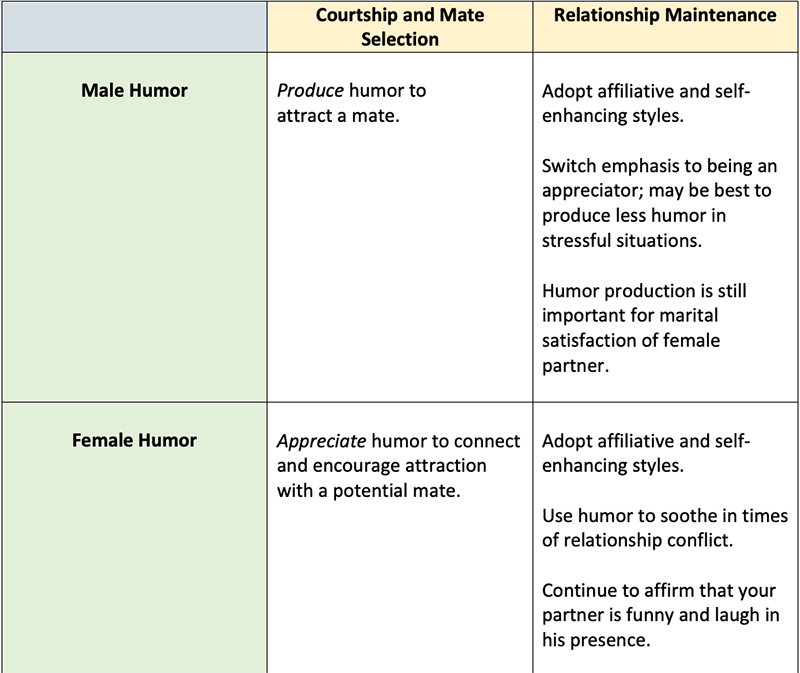
chart describing humor in human mating
References

Cohan, C.L., & Bradbury, T. N. (1997)  “Negative life events, marital interaction, and the longitudinal course of newlywed marriage.”  Journal of Personality and Social Psychology, 73(1), 144-128.

Li, N. et al. (2009). “An evolutionary perspective on humor: Sexual selection or interest indication?”  Personality and Social Psychology Bulletin, 35, 923-936.

 Martin, R.A. (2006). The Psychology of Humor: An Integrative Approach.

Campbell, L., Martin, R.A., & Ward, J.A. (2008).  “An observational study of humor used during a conflict discussion.  Personal Relationships, 15, 41-55.

Appendix
Summary of Prior Post – Humor and Sexual Selection
  • Humor is valued for mates worldwide.
  • Men produce humor to attract women. Men are motivated to be funny.
  • Humor production by men signals creativity, playfulness, mental health, potential generosity, intelligence, and genetic fitness.
  • Women want a humor “generator.” Men want a humor “appreciator.”
  • Men find women more attractive when they laugh.
  • Females are more discriminating (more “choosey”) than men about humor.
  • Female laughter is a signal of sexual interest.
  • Judgments of humor are affected by the person’s initial attraction and interest.
  • Humor is most effective if a person (she) is already attracted to the person (man).
  • Synchronized laughter predicted mutual attraction, but the amount of female laughter predicted the level of interest in dating.
  • Women do not have a preference for humorous female friends.
  • When ovulating, women may prefer funny “poor” men for short-term liaisons over non-funny (richer) men.
  • Women laugh more generally, and both sexes laugh more at men.
  • In mixed company, women tease more generally and direct more teasing toward men.
  • Aggressive humor by women may be a threat to men.
  • Women and men are equally funny and appreciate humor equally.
  • Women use more stories, narratives, puns, and self-deprecating humor.
  • Men use more one-liners and physical/active humor.
  • Men tease other men to gain the upper hand; men use humor to derogate rivals.
  • Men who cause other men to laugh in mixed company have increased status.
  • Self-deprecating humor is considered most attractive, especially for a high-status man.
  • Sarcasm or ridicule of others is considered the least attractive humor.
  • Humor increases the attraction of a less physically attractive man or a man of low status.
  • Verbal intelligence and humor predicted an increase in lifetime sexual partners for men.
  • Women initiate sex more with funny men and have more sex with funny men.
  • Sex with humorous men increased the likelihood of female orgasm.

Please Note: Your comment may take up to 12 seconds to register and the confirmation message will appear above the “Submit a Comment” text. 

Humor and Sexual Selection

Humor and Sexual Selection

“Women tend to prefer men who make them laugh, whereas men prefer women who laugh at their jokes.” *

In my last post about Tiger Woods, I examined the role of storytelling, art, music, dance, athleticism, and humor in sexual selection. Women select for those traits in men. These expressions of creativity signal genetic fitness because they are relatively rare in the human population.

Today’s post will put the microscope on humor. I will examine the influential role that humor plays in sexual selection – why humor production is a mating trait preference. In my next post (March 2), I will address how humor affects ongoing relationships; humor for established couples is different from the role of humor in selecting a mate (courtship). In other future posts, we will laugh together at displays of humor about the dynamics of sex, dating and relationships. For now, see my earlier post, Sex Can Be Funny: https://www.matingstraighttalk.com/sex-can-be-funny-50-humorous-quotes-volume-1/.

Here are a few random quips to warm you up before I go all nerdy:
  • “Bigamy is having one wife too many. Monogamy is the same.” ~ Oscar Wilde
  • “It’s been so long since I have had sex, I’ve forgotten who ties up whom.” ~ Joan Rivers
  • “I was nauseous and tingly all over. I was either in love or I had smallpox.” ~ Woody Allen
  • “A man who correctly guesses a woman’s age may be smart, but he is not very bright.” ~ Lucille Ball
  • “You’d be surprised how much it costs to look this cheap.” ~ Dolly Parton
  • “Good girls go to heaven, and bad girls go everywhere.” ~ Helen Gurley Brown
Laughter is Universal in Our Species

Laughter is universal within our species; it manifests in distinct facial and vocal expressions. Laughter emerges spontaneously during childhood and is intensely pleasurable. It shows all the hallmarks of a psychological adaptation – a fundamental building block of our evolutionary past.

Humor is Valued for Mates Worldwide

Humor is an integral part of mate choice. A robust finding in evolutionary psychology research is the value that people worldwide place on a good sense of humor. Females demonstrate more appreciation of humor than men; these differences begin in early childhood and appear to reflect differences in sexual choosiness.

Sexual Selection Is No Joke

Evolutionary psychologist, Geoffrey Miller (The Mating Mind), argues that the “humor divide” is best understood as a result of sexual selection. Women are the choosier sex, and because they prefer funny men—a signal of cognitive fitness—men learned to deploy humor and wit to attract a mate and to outsmart other men.

Humor and creativity researcher Scott Barry Kaufman of New York University believes sexual selection explains why the use of humor is important in the initial stages of a relationship: “When you have little else to go on, a witty person who uses humor in a clever, original way is signaling quite a lot of information, including intelligence, creativity, and even aspects of their personality such as playfulness and openness to experience.”

Comedy Reveals Capacity for Creativity

A capacity for comedy reveals a capacity for creativity. It plays upon our intense love of novelty (neophilia), says Miller. “Creativity is a reliable indicator of intelligence, energy, youth, and proteanism (ability to change shape). Humor is attractive, and that is why it evolved.”

Class Clowns Are Male

Have you ever wondered why class clowns are virtually always male? Documented differences in the ways the sexes use and respond to humor explain this and other humor-related phenomena. Humor plays a role in relationships from the initial flirtation through long-term commitment. Knowing the differences in how men and women process and use humor serves one well in all situations involving the opposite sex.

Male Courtship Humor

Males produce humor in courtship much more than females, according to researcher Jennifer Hay and are more likely than females to produce verbal humor in informal social settings, according to Helga Kotthoff. This research suggests that females, on average, are more discriminating than men when it comes to humor and that men, on average, are more motivated to be funny.

Men produce humor to be chosen by women. As explained in my prior post, men produce humor (and everything else) “to get laid.”

Humor Attracts Women

Studies from the David Buss’ Evolutionary Psychology Lab revealed that displaying a good sense of humor is the single more effective tactic men can use to attract women. Women are attracted to men who produce humor because (at the most surface level) laughing elicits a positive mood. Humor is very agreeable and is linked to the traits of generosity and willingness.

Humor for Potential Genetic Benefit

Evolutionary psychologists have also theorized that a sense of humor is a sign of intellect and healthy genes. Women are the more selective sex due to the burdens associated with pregnancy and thus are attracted to funny men because of the genetic benefit that could be bestowed upon potential offspring.

Woman Want a Humor Generator

According to Eric Bressler, a psychologist at McMaster University in Canada, men and women don’t mean the same thing when they say they value humor in a long-term partner. His research manipulated how funny both men and women appeared on paper. Subjects were asked to choose a potential date of the opposite sex. Bressler found that women want a man who is a humor “generator,” while men seek a humor “appreciator.”

Female Laughter is a Signal of Sexual Interest

The allure of male humor is so strong that female laughter may have evolved as a signal of sexual interest—picture a woman’s girlish giggles as she flirts with a man at a bar. Indeed, a German study found that when male and female strangers engaged in natural conversation, the degree to which a woman laughed while talking to a man was indicative of her interest in dating him. How much the woman laughed also predicted the man’s desire to date her.

Someone Who Makes Me Laugh — Someone Who Laughs at My Jokes

In Bressler’s study, men expressed no preference for funny women, but women tended to choose more humorous men as partners. Rod Martin of the University of Western Ontario elaborated on this discrepancy between the preferences of the sexes when he said, “Although both sexes say they want a sense of humor, in our research, women interpreted this as ‘someone who makes me laugh,’ and men wanted ‘someone who laughs at my jokes.’”

Bressler says his study indicates that humor likely developed through sexual selection because it is most desirable in romantic relationships. Women don’t seem to care about a friend’s sense of humor, whether male or female. He and fellow researcher Sigal Balshine found that although women rated funny men as better potential partners and more friendly, fun, and popular, they didn’t have the same preference for humorous women as potential friends.

Women Seek Funny Men in Personal Ads

Humor is a human trait important enough to have its abbreviation (GSOH) in personal ads. Psychology professor Robert Provine at the University of Maryland analyzed more than 3,000 singles ads and found that women were more likely to tout their humor appreciation ability whereas men were more likely to describe their ample humor-production ability. Women who posted personal ads sought a partner who could make them laugh twice as frequently as they offered to be the source of humor. However, men offered to be the provider of humor a third more than they sought it in a partner.

Fertile Women Choose Creative Men for Short-term Liaisons

An interesting study examined the desirability of funny men to ovulating women. Conducted in 2006 by Geoffrey Miller and Martie Haselton, female subjects read descriptions of poor but creative men and wealthy but uncreative men and rated each man’s desirability. Miller and Haselton found that women chose poor creative men twice as often as wealthy uncreative men for short-term relationships during times of high fertility. In low fertility days of their menstrual cycle, women shifted their preferences to males who offered resources.

This supports the idea that displays of creativity, at least in the short-term, act as good gene indicators.

Women Laugh More and Both Sexes Laugh More at Men

In another study, Provine observed social interaction in various public urban spaces while studying spontaneous conversation, ultimately recording 1,200 “laugh episodes” (comments that elicit a laugh from the speaker or listener). In examining the episodes, he found that women laugh significantly more than men, and that both men and women laugh more at men than at women.

Men Find Women More Attractive When They Laugh

In addition to the attraction women feel toward funny men, men find women more attractive when they laugh. Laughter signifies enjoyment and interest, or connection and understanding — all desirable qualities in a potential mate.

But Men and Women Are Equally Funny

Although men consistently garner the most laughs, research has repeatedly shown men and women to be equally funny when it comes to humor production. Researchers conclude that men are not funnier than women but are just more motivated to showcase their humor.

Ph.D. student Kim Edwards of the University of Western Ontario arrived at this conclusion following a 2009 study in which men and women were rated on the funniness of captions they created (produced) for single-frame cartoons. Edwards found that men and women created a similar number of highly rated captions. (Edwards also concluded that the greater laughter garnered by men was more a consequence of social factors than a sign of a superior capacity for humor.)

Women and Men Also Appreciate Humor Equally

Women and men also score very similarly on tests of humor appreciation. Psychiatrist Alan Reiss of Stanford University scanned male and female subjects’ brains while they rated 30 cartoons for humor. Women and men rated the cartoons in the same order of funniness, indicating equal amounts of humor appreciation.

Men and Women Are Funny In Different Ways

Men and women are both funny, but in different ways that the opposite sex sometimes finds unfunny. While women tend to share humorous stories and take a narrative approach, men more commonly use one-liners and engage in slapstick. While women tend to use puns, self-deprecating humor, and wordplay, men are more inclined to use physical and active humor.

Men Tease to “One-up” Other Men

Psychologist Jennifer Hay taped group conversations and found that men were more likely to tease and try to “one-up” other men in their use of humor. But according to research conducted by Martin Lampert of Holy Names University and Susan Ervin-Tripp of the University of California, men teased significantly less when in the presence of women.

Women Tease Men More in Mixed Company

After analyzing 59 conversations, Lampert and Ervin-Tripp found that in mixed company, women actually teased more than men and directed their teasing toward the men. Women became less self-deprecating while the men laughed at themselves more — a kind of reversal of the typical sex-specific humor tendencies. Lambert and Ervin-Tripp concluded that men reduce teasing with women present out of a concern that it might repel them, while women become more assertive around men to counter feelings of vulnerability and gain equal footing with them.

Self-deprecation vs. Ridicule of Others

Anthropologist Gil Greengross studies the role humor plays in flirtation and seduction. Of all the humor styles, self-deprecating humor was perceived as the most attractive. Self-deprecating humor reduces tension and indicates a nonthreatening stance that puts others at ease. The opposite of self-deprecating humor, and therefore the most unattractive kind, is sarcasm or ridicule directed at others. Humor that comes at the expense of someone else’s feelings divides rather than bonds. Although it might elicit a laugh or two, the research indicates those laughs will not be there for long.

Female Laughter Determines Level of Attraction

Psychologists Karl Grammer and Irenaus Eibl-Eibesfeldt of the Ludwig Boltzmann Institute for Urban Ethology demonstrated that laughter can be a very accurate source for determining the level of attraction between people. After studying mixed group conversations and the subjects’ level-of-attractiveness ratings, the researchers found that the amount of female laughter accurately predicted the level of attraction between both partners. A woman who laughs at a man’s jokes indicates an interest in him, and this indication of interest can spur even further interest on the part of the man.

Synchronized Laughter Means Mutual Attraction

According to Grammer and Eibl-Eibesfeldt, the amount of synchronized laughter during spontaneous male/female conversations predicted initial mutual attraction, but the amount of laughter the woman produced was most predictive of mutual interest in actually dating. Woman’s laughter is a useful index of humor appreciation and has an impact in a mating context.

Are We Sure That Humor and Intelligence Are Correlated?

Humor and intelligence appear to be significantly correlated according to long-standing theories and studies within evolutionary psychology. Humor is seen as an honest signal of intelligence, and humor ability is thought to have evolved due to sexual selection through mate choice.

However, Jeffrey Hall, a professor in Communication Studies at the University of Kansas, concluded from his studies that “the evidence isn’t there that humor used by men is perceived as intelligent by women, nor is the link between intelligence and humor strong.” Hall asserted that women like humor because of “good timing, self-deprecation, playfulness, flintiness, and being inviting.” None of that is intellectual, he says. Perhaps that last point is debatable.

Humor is a Signal of Mental Health

Building on Hall’s insights, humor may also signal a person’s openness to experience, extraversion, and sociability (as explained by Scott Kaufman above). Tucker Max and Geoffrey Miller (Mate) say the ability to be funny or having a sense of humor is a signal of mental health, which is quite important to women. “Making fun of yourself shows a resilient self-confidence that narcissists, psychopaths, and depressed people don’t have,” they explain.

Humor Is Most Effective If Already Attracted

Humor is most effective if the potential mate is already attracted to the person attempting the humor. Norman Li found that both males and females reported initiating humor and laughter at someone’s jokes when they were already attracted to the individual but not when they were not already attracted to the person.

Humorous Halo Effect

Indeed, judgments of humor are affected by a person’s initial attraction and interest. Researchers have found that initial attraction to a person led to greater perceptions of interpersonal warmth from that person’s humor. This perception of warmheartedness could be a “halo effect” – when one trait is used to make an overall judgment of that person or thing. Evolutionary psychologist David Buss shared an amusing aside during a talk about the trait of physical attractiveness and humor: “It is very interesting that women find Brad Pitt ‘just hilarious’.”

Humor and Status

Li says that humor is a powerful tool in mating intelligence for the relatively unattractive or men who are lower in social status. On the flip side, if you are high in social status, then self-deprecating humor may be your most valuable tool in the mating marketplace.

Humor Production Predicts Number of Sexual Partners

There is evidence that humor is related to mating outcomes. In a sample of 400 university students, Gil Greengross and Geoffrey Miller found that general intelligence and verbal intelligence both predicted humor-production ability, which in turn predicted the number of lifetime sexual partners.

Humor and Social Proofing

In a study by Nicolas Gueguen, men who produced humor were three times more likely to get a phone number from women than men who just observed the humor. In addition to the attraction to humor production, researchers believed this demonstrated the power of social proofing — the status of the humor-producer compared to the male confederate receivers of the humor.

Men Use Humor to Derogate Sexual Rivals

“Men taunt other men with clever nicknames and insults,” says John Morreal, a professor of religion at William and Mary College in Williamsburg, Virginia, who has studied humor for 25 years. “That isn’t something that women do. They don’t tend to play practical jokes or engage in humor that humiliates or puts somebody down.”

The primary difference is that males tend to use humor to compete with other men, while women tend to use humor to bond with others. Studies show that men more often use humor to jockey for position with other males when they are in the company of women.

Aggressive Humor by Women is a Threat

A woman who deploys a typically male sense of humor—one that’s aggressive or competitive—is a turnoff to men, says Don Nilsen, a linguistics professor at Arizona State University in Tempe and an expert on humor. Many men feel threatened, perceiving a funny woman as a rival or worrying that they’ll become a target of her sharp tongue. “I think every man in the world loves the humor, even the sexual put-down humor, of Judy Tenuta or Joan Rivers,” he says. “But very few men want to marry them.”

Funny Men Give More Orgasms

Orgasm is a female mate selection preference (psychological adaptation), and humor adds to the likelihood of female orgasm.

A study reported in Evolutionary Psychology looked at whether women whose partners have a great sense of humor also have more orgasms. (Previous studies have demonstrated how women with partners who have more symmetrical faces, are more attractive, richer, or who are more muscular experience more orgasms.)

Researchers found that a sense of humor was a good predictor of sexual pleasure. Women initiated more sex with men who have a great sense of humor and had more sex with them in general. Women with partners who had a great sense of humor enjoyed more orgasms and stronger ones as well.

Conclusion

Humor production by men is an effective courtship strategy, and women have a preference for humorous men in their mate selection. Humor appears to be a domain of behavior that evolved to demonstrate traits of male genetic fitness and increase sexual access. Funny how that works.

Note

*Bressler, E. R., Martin, R.A., & Balshine, W. (2006).  ‘Production and appreciation of humor as sexually selected traits.”  Evolution and Human Behavior, 27, 121-130.

References

Bressler, E. R., Martin, R.A., & Balshine, W. (2006).  “Production and appreciation of humor as sexually selected traits.”  Evolution and Human Behavior, 27, 121-130.

Gallup et al. “Do Orgasms Give Women Feedback About Mate Choice?” Evolutionary Psychology, December, 2014.

Geher, G. & Kaufman, S.K. (2013).  Mating Intelligence Unleashed.

Grammer, K., Eibl-Eibesfeldt, I. (1990). The Ritualisation of Laughter.

Gueguen, N. (2010). “Men’s sense of humor and women’s responses to courtship solicitations: An experimental field study.”  Psychological Reports, 107, 145-156.

 Hay, J. (2000). “Functions of humor in the conversations of men and women.”  Journal of Pragmatics, 32, 709-742.

Kaufman, S.B., Kozbelt, A., Bromley, M.L., & Miller, G.F. (2008).  “The role creativity and humor in human mate selection.”  In G. Geher & G. Miller (Eds.) Mating intelligence: sex, relationships, and the mind’s reproductive system.

Kotthoff, H. (2000). “Gender and joking: On the complexities of women’s image politics in humorous narratives.”  Journal of Pragmatics, 32, 55-80.

 Li, N. et al. (2009). “An evolutionary perspective on humor: Sexual selection or interest indication?”  Personality and Social Psychology Bulletin, 35, 923-936.

Max, T., & Miller, G., (2015). Mate: Become the Man Women Want.

Miller, G.  (2001). The Mating Mind: How Sexual Choice Shaped the Evolution of Human Nature.

Provine, R.R. (2000). Laughter: A Scientific Investigation.

Please Note: Your comment may take up to 12 seconds to register and the confirmation message will appear above the “Submit a Comment” text. 

“Men Do Everything To Get Laid” — Tiger Woods and Sexual Selection

“Men Do Everything To Get Laid” — Tiger Woods and Sexual Selection

Male status aspirations and power displays are a result of their adaptive success in attracting women.

I recently watched the HBO documentary on Tiger Woods. I found it captivating. The return and redemption of Tiger Woods is a modern-day hero’s journey with unique ingredients: freakish, savant-like talent, a psychologically absent father, personal injury, drug addiction, estrangement from childhood, compartmentalization of feelings, a repressed inner world, public idolatry, public humiliation, and endless sexual temptation. (Concerning sexual dalliances, Woods was more in search of a “new self” than a new partner, but I will save that discussion for a post on infidelity from the view of author and psychotherapist, Esther Perel.)

Winning Takes Care of Everything – Fallen Hero Returns

As a hero, Tiger Woods fell hard. But he did return. Woods had five more victories in 2013, regained his number one ranking in the world, and spawned a controversial “Winning Takes Care of Everything,” Nike ad. Then, Woods suffered a back injury in 2014 and his game collapsed. But the “phoenix” rose again. Woods came back to win the Masters in 2019. He achieved some healing with his former wife, Elin, and demonstrated a rededication to his kids. In the language of the hero’s journey, that is a lot of positive “elixir.” Now in 2021, he faces the challenge of recovery from a fifth back surgery. The journey continues.

Tiger Woods – Infidelity and Sexual Selection

There are many psychological dimensions in the Tiger Woods life story. But let’s take a look again at his infidelities through the lens of evolutionary psychology (EP), mate selection, and what was being said in 2009.

Evolutionary psychologist Satoshi Kanazawa wrote a series for Psychology Today in 2008 entitled “Men do everything they do in order to get laid.” A follow-up piece in 2009 was about the infidelities of Tiger Woods. Kanazawa asked, “why are we surprised?” Kanazawa was bold and brash in his statements about human mate selection using Tiger Woods as an example.

Kanazawa asserted that all male behavior is consciously or unconsciously a response to female choice in mate selection. (This is not that controversial in the EP literature.) Men do everything they do with the ultimate goal of getting sexual access to women. The word “ultimate” is essential to Kanazawa’s meaning; I will explain below.

Men Compete and Achieve for Sex

Kanazawa said men compete and achieve to have sex with women and that this behavior is mostly unconscious. Men don’t necessarily know that they do everything they do in order to get laid. They consciously think that they want to attain the highest political office in the state or the country; they want to become a successful businessman and make more money than anyone else; they want to practice and play hard so that they can become the best in their sport; they want to make America laugh so that they become the most successful entertainer. Men want to do these things because they are designed by evolution to compete and achieve, and when they do, women seek them out as sexual partners.

Successful Men Have Affairs

Highly successful men have sexual affairs, not because they want to but because women choose them. (If what men want mattered, all men would have a maximum number of affairs, says Kanazawa). Sex and mating among humans and other mammals is an entirely female choice, not a male choice; it happens whenever and with whomever women want, not whenever and with whomever men want. What men want doesn’t matter because it’s a constant. What matters is what women want. (Evolutionary psychologists, like Kanazawa, are very cognizant of rape and sexual coercion as exceptions to this assertion.)

It’s Not Like They Don’t Want Their Man to Cheat

Here’s where Kanazawa showed his stripes of political incorrectness. He said, “Elin Nordegren* and other ‘wronged wives’ cannot really complain about their husbands’ affairs. It’s not like women want their husbands to cheat on them, but then, it’s not like they don’t want them to cheat on them either.” He goes on, “they have chosen to marry these men precisely because they are the type of men who would cheat on their wives. If they were the kind of men who wouldn’t (and, more importantly, couldn’t), then they would not have been attractive enough for the wives to marry.”

Bill Clinton became the President of the United States, unconsciously, indirectly, and ultimately, so that he could get laid. David Letterman became America’s favorite entertainer, unconsciously, indirectly, and ultimately, so that he could get laid. Tiger Woods became the most successful golfer in history, unconsciously, indirectly, and ultimately, so that he could get laid. It would be a tremendous evolutionary puzzle if these men, after spending their entire lives attaining the status and resources they attained, then didn’t have affairs. And their wives married them because they were the kind of men who could cheat on them.

Ultimate vs. Proximate Causes

Now, to understand that last point I need to remind you (from my page on EP) that evolutionary psychologists examine proximate and ultimate causes of behavior. Proximate causes of behavior often include stimuli in the immediate environment of the organism or physiological mechanisms inside the organism. Ultimate causes of behavior evoke our ancestral past and address behavior or psychological processes that were adaptive for survival-based natural selection or reproduction-based sexual selection. Ultimate causes of a behavior pertain to our evolutionary (phylogenetic) history, addressing these questions:

How did this behavior come to be? How was it adaptive? How did it confer reproductive benefits to individuals with this behavior?

EP seeks to understand both proximate and ultimate causes of species-typical psychological processes in light of basic evolutionary theory. Kanawaza’s argument is about the unconscious, ultimate causes of Tiger Woods’ idolatry from women, Elin’s choice to mate with him, and his pattern of infidelities.

Male Power is not an End in Itself

Male power is rarely (perhaps never) an end in itself. Male power is always a means to sexual access at the foundational level of evolutionary adaptation. Sex is always the ultimate end. “Trophy” wives or girlfriends are sought because of sexual attraction to them first and foremost, and they serve as status displays for sexual access to the next woman (“mate copying effect”). Male status aspiration and power displays are a result of their adaptive success in attracting women. This power can be abused. But here is the complexity: women also desire this power. It is needed for sexual attraction.

Hints of Dark Triad Attraction

As I have reported elsewhere on this site, men who have the dark triad traits of narcissism, Machiavellianism, and psychopathy have earlier sexual experiences and more sexual partners than men of average or typical character. (This is a successful short-term sexual strategy for the “dark triad” man and a failed long-term sexual strategy for his female partner.) Tiger Woods does not fit the dark triad profile exactly, but there are some elements of agreement. On the golf course, at least, Tiger had “dark triad” confidence and exceptional one-pointed focus. More “proximately,” Tiger is rich, talented in a unique way, and very famous. He has resources and status at the highest level. The temptation with interested women was ubiquitous and on-going even before he discovered Las Vegas with Michael Jorden and Charles Barkley.

Creative Talent, Intellectual Genius, and Athletic Prowess

Male competition for mates and female choice is the “first cause” of most male behavior and ultimately the first cause of all human affairs. Nearly all male behavior can be linked to female choice in mate selection. Competition between men for sexual access to women undergirds male striving for power, status, and expressions of creativity, genius, and athletic prowess.

 Evolutionary psychologist Geoffrey Miller (The Mating Mind) argues that sexual selection may have played a more significant role than natural selection in shaping our species’ talents for storytelling, art, music, dance, humor, and leadership. The idea that music may have been shaped by sexual selection can be traced back to Darwin. There is plenty of sexual hysteria relating to rock stars, writers, artists — and athletes. Researchers Daniel Nettle and Helen Clegg found that professional male artists and poets had about twice as many sexual partners as other people. The effect was not true for female artists.

 Male Crime and Risk-taking

Young men engage in more criminal activity and risk-taking than older men. (See note below on “young male syndrome.”**) Tiger Woods’ escapades in Las Vegas and affair with Mindy Lawton in a church parking lot were hallmarks of risk-taking. And his car crash was a young male cliché.

 Male Creativity Peaks in Early Adulthood

Young men tend to produce more than older men and express more creative genius. This is a statistical correlation, not an absolute. The relationship to age and productivity (age-curve) among male jazz musicians, male painters, male writers, and male scientists is called the age-genius curve. Being a creative genius is part of what men do to get laid.

Benefits of Being a “Tiger”

There are no reproductive benefits from competition before puberty because prepubescent males cannot translate their competitive edge into reproductive success. With puberty, however, the benefits of competition rapidly increase. Once men are reproductively capable, every act of competition (be it through strength, skill, athletic prowess, violence, theft, or creative genius) can augment their reproductive success.

Marriage and First Child Depresses Productivity

Male creative productivity peaks in early adulthood and then declines, especially with marriage and the first child. Marriage depresses both crime and genius production. The age-crime curve and the age-genius curve can be explained as the mathematical difference between the benefits and costs of competition. Young men rapidly become more violent, more criminal, and more creative in late adolescence and early adulthood as the benefits of competition rise. Then, their productivity just as rapidly declines in late adulthood as the costs of competition rise and cancel its benefits. As an example, Orson Welles was a mere 26 years old when he wrote, produced, directed, and starred in perhaps one of the greatest movies ever made. He declined after that. (Welles married Rita Hayworth at age 28.)

Tiger Woods peaked as a teenager and was a golf “phenom” before he turned pro. But Tiger Woods is now predictably and naturally more focused on his kids.

Mate Selection for Exceptional Genes

We select mates based upon traits that effectively discriminate good genes from the norm. For many traits in our species, genes are fixed and lead to little variation among people. However, some traits have great variability between people – like Geoffrey Miller’s list of talents. Creative talent or athletic skill signal positive genetic variability. These traits help a man get chosen as a sexual partner.

Male Height is a Common Genetic Preference

There is a lot of variability in the height of adult males in North America — ranging from approximately 5 feet 3 inches to 6 feet six inches. Females who prefer relatively tall males (a widespread preference) demonstrate a preference for specific genes – the genes coding for tallness over shortness. Thus, sexual choice for an observable feature of a potential mate selects certain genes to be more likely than others to propagate in the future. (Tiger Woods is 6 feet, one inch.)

Golf Talent is Rare

Tiger Woods’ talent hitting a golf ball is a rare and exceptional genetic expression. Almost no one can hit and direct a golf ball like Tiger Woods. Tiger’s father (Earl Woods) was obsessed with golf and orchestrated Tiger’s direct exposure to golf as a toddler. Earl Woods legitimately thought Tiger innately predestined to be the best golfer in the world — a perfect integration of nature (genetics) and nurture.

Tiger’s Ultimate Goal

Tiger Woods’ ultimate goal is to be the best golfer that every lived — he wants to beat Jack Nicolas’ record of 18 major championships. No other trophies or total wins will do. Tiger is learning the toughest lesson of the hero. Yes, “winning (pretty much) takes care of everything” for attracting sexual partners and selling products. Tiger’s competitive drive is natural, instinctive, hard-wired. But does that heal the soul of a hero? We shall see.

Notes

*Make no mistake, Elin Nordegren was (is) a gorgeous, genetic “celebrity” (former model) with the very highest mate value. She could essentially have any man she wanted and could successfully choose a man of high status, stature (athletic prowess), and financial resources. That is what she did. By all accounts – fame did not need to be part of her partner’s profile. Erin was mistreated and was emotionally traumatized by Tiger Woods. (Kanazawa examined her unconscious choices.) With a divorce from Woods, she was made inordinately rich ($100 million). She had a baby in October 2019 with her boyfriend, former NFL football player, Jordan Cameron, who is 6 foot, 5 inches tall and worth approximately 20 million.

**Young men enter mate competition with fewer resources to offer women. When young men face the peril of being shut out of the mating game, violent risk-taking has been an evolutionarily sensible strategy. Today, risk-taking and antisocial behavior are strongly associated with being young and male across societies worldwide, and men at their reproductive peak tend to be the most inclined to violence, a phenomenon known as young-male syndrome.

Please Note: Your comment may take up to 12 seconds to register and the confirmation message will appear above the “Submit a Comment” text. 

Long-term and Short-term Mating Strategies: Domain #2 of Male-Female Difference

Long-term and Short-term Mating Strategies: Domain #2 of Male-Female Difference

“…to an extraordinary degree, the predilections of the investing sex —females, determine the direction in which the species will evolve. For it is the female who is the ultimate arbiter of when she mates and how often and with whom.” ~Sarah Blaffer Hrdy, The Women That Never Evolved, 1981

Would You Go to Bed With Me?

In a study on a college campus, confederate men walked up to women, and confederate women walked up to men and said:

“Hi, I’ve been noticing you around town lately and I find you very attractive.”

Then they (eventually) asked:

“Would you go to bed with me tonight?”

All the women said “no,” and were offended, insulted, and just puzzled by the request to go to bed.

Seventy-five percent of the men said “yes.” Many of the men who declined the offer were apologetic, citing previous commitments.

This is an often-cited series of experiments in social and evolutionary psychology conducted by Russell Clark & Elaine Hatfield. These experiments were replicated in France with the same results.

How Receptive are Men versus Women to Sexual Invitations?

In a study by Buss and Schmitt (1993), college men and women rated how likely they were to consent to sex with someone they viewed as desirable if they had known them for only an hour, a day, a week, a month, six months, a year, two years, or five years. Both men and women said they would probably have sex after knowing a desirable potential mate for five years. At every shorter interval, men exceeded women in the reported likelihood of having sex. After knowing someone for only one week, men were positive about consenting to sex.

Women Unlikely to Consent to Sex

Women, in sharp contrast, were highly unlikely to consent to sex. Men were only slightly disinclined to having sex with someone they had known for only one hour; for women, sex after one hour was a virtual impossibility.

Long and Short-term Mating Strategies — Differences Between Men and Women

The predominant theory in evolutionary psychology suggests humans have both long-term and short-term mating strategies. These studies unmask the differences between men and women in their mating strategies.

Second Domain of Differences in Sexual Psychology and Response

This is the second in a series of posts that explain the domains (see Appendix) of difference between men and women in their sexual psychology and response. Tendencies related to short and long-term mating strategies apply to the general population of male and female heterosexuals but do not predict the unique sexuality of a particular man or women. (See introduction to the series: Male-Female Differences in Sexual Psychology and Response.)

This post will explore the following differences:

  1. General psychological factors related to mating strategies
  2. Objectives, costs, and benefits of short-term and long-term mating strategies for men and women
  3. Relative importance of trait preferences for each strategy along three dimensions: physical attractiveness, resources, and character, illustrated by Venn diagrams.
At-a-Glance Summary of this Post
  •  A long-term mating strategy is essentially rooted in commitment and monogamy.
  • A short-term mating strategy allows or prefers casual sex with more than one partner.
  • Women’s predominant mating strategy is long-term vs. short-term by a wide margin.
  • Men’s predominant mating strategy is short-term but their long-term strategy is almost equal for reasons also tied to evolutionary benefits.
  • The human mating economy is primarily fueled (implicitly) by the intersection of men’s short-term mating strategy and women’s long-term mating strategy.
  • Men’s short-term mating strategy is emboldened by their perceived mate value.
  • Women’s short-term strategy is correlated with low self-esteem.
  • Lower mate value men benefit most from a long-term strategy.
  • High mate value women (commonly with high self-esteem) choose a long-term strategy and benefit most from that strategy.
  • Men have lower standards for short-term mates, requiring almost no traits other than physical attractiveness.
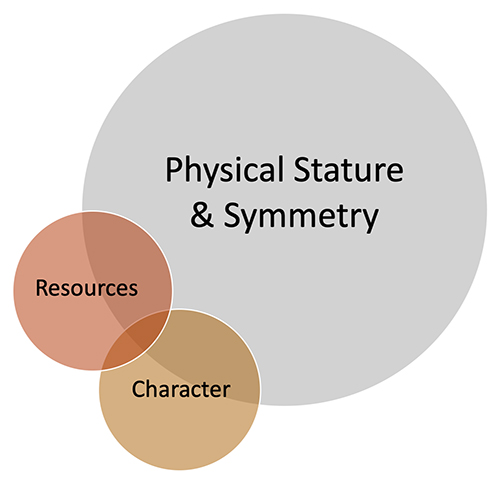
  • Women’s short-term strategy emphasizes physical stature of the man, with some concern for resources and character.
  • Women’s short-term strategy, while secondary, reveals complex motivations and is used to secure resources, access better genes, switch mates, and sometimes secure a long-term partner.
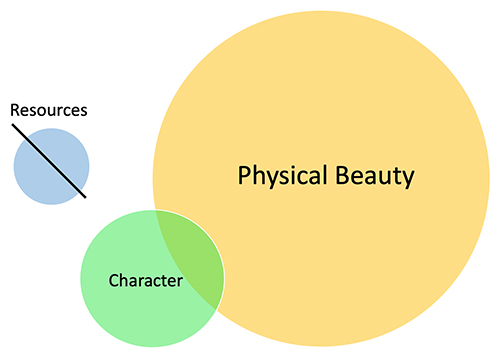
  • Men’s short-term strategy gives great emphasis to physical attractiveness, has a small concern for character, and no concern for resources.
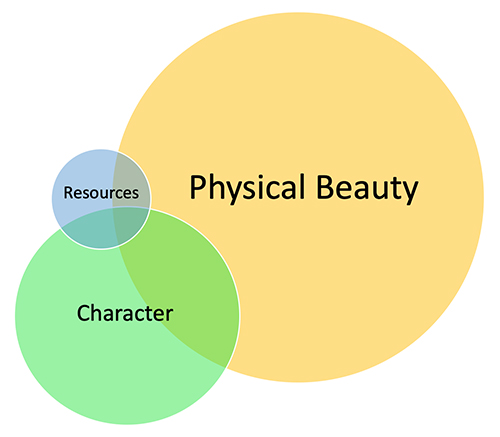
  • Men’s long-term mating strategy has character requirements, some resource considerations, and an emphasis on physical attractiveness.
  • Women’s long-term strategy has a great need for resources and character, with physical attractiveness prioritized in a third position. Resources and character are often subject to trade-offs in mate selection.
  • Long-term and short-term mating strategies operate as concurrent functions (like dual processing switches) sensitive to context and environmental conditions.
  • Female choice in mate selection is the most powerful force on the planet – determining the mating strategies of both sexes.
General Sex Differences in Long-term and Short-term Mating Strategies

The above studies underscore several differences in male-female sexual psychology and response, as noted in: Dynamics in the Mating Economy: Domain #1 of Male-Female Difference.

  • Women have the psychology of choice and an abundance of sexual attention during their reproductive years; men mostly do not have choice or an abundance of mating opportunities.
  • Men (mostly) have the psychology of sexual scarcity.
  • Women have the psychology of caution and fear — sexual inhibition and “brakes” on sexual activity and the experience of risk. Women fear being physically hurt, left to fend on their own with a child, or suffering reputational damage.
  • Women are prone to have regret or guilt about what they did in the sexual and mating realm.
  • Men are prone to have guilt and regret about what they did not do.
  • Men fear being humiliated and rejected.
  • Men are driven by a spontaneous, initiating sexual psychology (spontaneous desire) and women are characterized by a cautionary, “response desire.”

Mating Strategies Introduction

“Today’s dating scene has become a global uncontrolled experiment in competing mating strategies. Men and women are locked in a run-away arms race of male sexual escalation tactics vs. female commitment escalation tactics. Science-minded singles have a new self-consciousness as fitness displayers, mate choosers, gene replicators, and social primates.” ~ Evolutionary Psychologist, Geoffrey Miller (YouTube – 2019)

Long-term Mating Strategies

A long-term mating strategy for men involves attracting and securing a mate who will provide sexual fidelity. A long-term mating strategy for women seeks sexual fidelity and provision of resources and protection of children over time. Women have predominantly a long-term mating strategy (and sex “drive”) that most often seeks a single-sex partner who is committed to her and the potential offspring that might result from their mating. A women’s long-term strategy creates caution and selectivity in accepting male advances. The desired benefits of a woman’s long-term strategy influence male sexual access and thus much of male behavior. (See Mate Selection Science.)

Short-term Mating Strategies

A short-term mating strategy attempts to maximize immediate sexual access and sexual partners. Men have evolved with mostly a short-term-mating strategy (and sex “drive”) but also employ a long-term strategy for several evolutionary advantages. A man’s short-term mating strategy fuels desire for contact with women for any possible chance of a romantic or sexual encounter. Although much less predominant, a woman’s short-term mating strategy may include a complex set of motivations. (See Why Women Have Sex.)

Dual Processing Switches

Long-term and short-term strategies for men and women operate as concurrent functions sensitive to context and environmental conditions. They are not binary operations but more like dual processing switches with a range or “volume” on each at any moment in time. They may function in parallel like a thermostat, modulating the influence of other mode to keep a particular sexual personality in balance or at its “set” point. Sexual strategies by men and women are influenced by age and especially a woman’s fertility window.

Big Cojones — Evidence of Short-term mating

Evidence of short-term mating is seen by the size of human male testes; they are larger than the highly monogamous gorillas and orangutans, but smaller than the more promiscuous baboons, bonobos, and common chimpanzees. Bigger testes mean more sperm competition and more short-term mating.

Sperm Volume

Also, sperm volume increases related to the amount of time a couple has been apart since their last encounter. This increase in sperm insemination is precisely what is expected if humans had an ancestral history of casual sex and marital infidelity. The fact that men carry a physiological mechanism that elevates sperm count when their wives may have had opportunities to be unfaithful points to an evolutionary history in which humans had extramarital affairs at least some of the time.

 
“Collision” of Strategies

The human mating economy is primarily fueled (implicitly) by the intersection of men’s short-term mating strategy and women’s long-term mating strategy (See Human Mating Strategies). This “collision” of a man’s short-term mating strategy and a woman’s long-term mating strategy continues to shape gender-specific sexual behavior in modern times and causes more selectivity, caution, and different sexual responses by women as compared to men. Mating strategy “conflict” is resolved by accommodation and negotiation in a process of mate value sorting within the mating economy. It is highly dependent upon individual context. Desire is mitigated by costs, benefits, and availability for both sexes.

Diagram #1: “Collision” of Mating Strategies

venn diagram: collision_of_mating_strategies
Subset Strategies

Humans also have “subset” mating strategies or mating behaviors that intersect with basic long and short-term strategies, including serial mating and extra-pair copulation (EPC) – i.e. infidelity or consensual non-monogamy. Which mating strategy is adopted very much depends on individual mate value. Those higher in mate value can more easily implement their preferred mating strategy. In general, higher mate value women focus even more on a long-term strategy and higher mate value men may focus even more on a short-term strategy. Mating strategy can also be influenced by the sex ratio in the local mating pool and operation of social/cultural norms in the local environment.

Humans Employ Strategic Pluralism

Ultimately, what people want in a long-term mate can be quite different from what they want in a short-term mate. Humans employ “strategic pluralism” — a variety of strategies and tactics when it comes to mating. There are multiple routes to mating success.

Women’s Long-term Strategy

Women’s long-term mating is driven by genetic characteristics and interests of our species: internal fertilization, an extended period of gestation, prolonged infant dependence on mother’s milk, and the need for relatively “high” male parental investment compared to other primates. In addition to protection and a provision of resources, a woman’s long-term strategy seeks character traits that ensure stability and loyalty to her and her children over the long-term.

Trade-offs Between Resources and Character

What is often more salient in female mate selection and relationship satisfaction is the tension between the two preferences inside the female long-term strategy: resources and character. A woman’s long-term mating strategy often involves ambivalence and internal confusion related to her desire for a mate with resources and status, and her preference for loyalty, kindness, intelligence, and character traits for parenting. (See “trade-off boundary” on diagram below.) In America, resources usually win this game of mate selection preference, often with rationalization and denial about the lack of optimal character.

Diagram #2: Women’s Long-term Mating Strategy

Venn diagram: women's long-term mating strategy

Benefits of Women’s Long-term Mating Strategy

  • Significant resources from mate
  • Parental investment
Costs of Women’s Long-term Mating Strategy
  • Restricted sexual opportunity
  • Sexual obligation to mate

The benefits far outweigh the costs and have pre-eminent value in female mate selection — and thus overall power to influence sexual access and all domains of male behavior.

Women’s Short-term Strategy

Women are found to prefer features related to muscularity, strength, fitness, and masculinity – traits associated with symmetry, in their short-term mates. They also look for stable character traits (minimal levels of generosity and kindness) and a fair amount of resources. While the following gives considerable attention to the complexities of a woman’s short-term strategy, it bears repeating that this strategy is not dominant in female mate selection; it is secondary and selective.

Diagram #3: Women’s Short-term Mating Strategy

venn diagram: women's short-term mating strategy
Benefits of a Woman’s Short-term Strategy

Women have a short-term mating strategy that brings several benefits. According to David Buss (Evolutionary Psychology, The New Science of the Mind, 1999), there are three classes of benefits (among a few other hypotheses) that are supported by research:

  1. Resource acquisition. Women could engage in short-term mating for the immediate exchange of meat, goods, or services. Ancestral women may have also engaged in short-term mating in order to obscure the paternity of her offspring (“paternity confusion”) and elicit resources from more than one man. In addition, short-term mating may have brought protection (a resource) from other males when the primary mate was not present.
  2. Genetic benefits. Short-term mating potentially brings enhanced fertility. It may also bring superior or diverse genes from a high-status male, thus giving offspring a better chance of survival against environmental change. Also, the “sexy son” hypothesis suggests that male progeny of such men are very attractive to women in the next generation, thus securing a positive genetic legacy.
    • Physical Stature Equals Genetic Fitness. Women’s prioritization of physical features in short-term partners is consistent with strategic pluralism theory that says women may seek genetic fitness in short-term partners. (Gangestad and Simpson, 2000). According to this “good genes” theory (Thornhill and Gangestad, 1993), women are attracted to men who effectively advertise having genes that are resistant to local pathogens.
    • Ovulation and Short-term Mating Success. Research has found that women value such characteristics (including the scent of symmetrical men) even more around the time of ovulation. As a result, symmetrical and muscular men have greater short-term mating success compared to their relatively asymmetrical and non-muscular peers. They have more sexual partners and are more desirable as affair partner.
  3. Mate Switching Hypotheses. While preferences for traits associated with high-testosterone (muscularity, strength and facial symmetry) tend to support the hypothesis that women seek genetic benefits in short-term mating, recent research and DNA evidence has cast some doubt on this as a motivation and has drawn more attention to the “mate switching hypothesis.” (See Mate Switching Hypothesis).

David Buss (Evolutionary Psychology, The New Science of the Mind, 1999) identifies three reasons for a woman’s short-term mating strategy (infidelity or extra-pair copulations) that confirm a mate switching hypothesis.

Hit the Road Jack

One study found that extra-pair mating made it easier for a women to break up with their current partner — what Buss calls “mate expulsion.” David Buss and Cindy Meston report (Why Women Have Sex, 2009) that women have affairs to test the waters to see if there is someone better out there for them, in an attempt to “trade-up” for a better partner. Women have affairs if they think their relationship may be dissolving. And women cultivate “back-up mates.” As Buss likes to joke in quoting a female research participant, “men are like soup; you always want to have some on the back burner.”

From a Short “Flight” to a Long “Flight”

According to “sexual strategies theory” (Buss and Schmitt, 1993), by being open to short-term relationships, women can increase their options for long-term ones. They can solicit the interest of many men and use this wider net to evaluate long-term mates, or they may be able to turn short-term relationships into long-term ones. If women use short-term mating to assess or attain long-term relationships, they may prioritize the same traits in short-term partners that they prioritize in long-term partners.

More Clues to Mate Switching and Sex Differences

There are other clues to explain the infidelity (short-term mating strategy) of women as reported by Buss –clues that fortify a mate switching objective.

  1. Women who are sexually or emotionally unhappy have affairs. This is not true for men. Men do not often report marital unhappiness as a reason for an affair. According to Buss, men can be relatively happy in their marriage and still have affairs. The issue of emotional dissatisfaction appears to be specific to women.
  2. 70% of women become emotionally involved with or fall in love with their affair partner. In contrast, only about 30% of men do.
  3. As stated above, qualities desired by women in an affair partner are often similar to the qualities desired in a long-term mate. Women want character traits (e.g. kindness) and resources in an affair partner, just not as much as in a long-term mate. This is not true for men. For example, women usually want intelligence in an affair partner. For men, intelligence in an affair partner is mostly irrelevant. Desiring the same qualities in an affair partner further supports a view that the female long-term mating strategy is significantly more adaptive in evolution than the short-term mating strategy.
Self-esteem in Women

Studies have shown that a woman’s self-esteem is a significant predictor of short-term-mating. Women scoring low on self-esteem tended to have a greater number of sex partners, one-night stands, and a preference for short-term sexual relationships.

Costs of Women’s Short-term Strategy
  • Risk of a sexually transmitted disease
  • Risk of pregnancy
  • Reduced value as long-term mate
  • Greater risk of physical and sexual abuse
  • Risk of withdrawal of resources from husband

While the benefits noted above seem compelling, the costs of a woman’s short-term mating strategy far outweigh the benefits and produce a “response desire” and “braking” pattern of female sexual response. These costs directly influence female sexual response and sexual psychology. (See Spontaneous and Response Desire – the Underbelly of Heterosexual Mating.)

Men’s Short-term Strategy

“There seems to be no question but that the human male would be promiscuous in his choice of sexual partners throughout the whole of his life if there were no social restrictions. The human female is much less interested in a variety of partners.” ~ Alfred Kinsey

Evolutionary adaptation has dictated a preference by men for a short-term mating strategy. Trivers’s (1972) theory of parental investment and sexual selection provides a powerful reproductive basis for expecting sex differences. Men, more than women, are predicted to have evolved a greater desire for casual sex and a variety of partners. The same act of sex that causes a woman to invest nine months of internal gestation obligates the man to practically no investment.

Premium On Female Beauty

Men’s short-term strategy puts an immense premium on physical beauty and fertility. Character traits required of a woman are minimal (i.e. “don’t be dangerously crazy”) and resources are not required at all. Men’s short-term strategy is more predominant than their long-term strategy, but the difference is less pronounced behaviorally in modern times.

Diagram #4: Men’s Short-term Mating Strategy

venn diagram: men's short-term mating strategy
Restraints on Men’s Short-term Mating Strategy

Although men could potentially conceive more offspring if they were promiscuous instead of monogamous, there may have been at least two restraining factors of evolution against male promiscuity. Reproductive success depends on the survival of one’s offspring. Children have a better chance of survival if two parents contribute. Men who were highly promiscuous may not have been able to support all their offspring, and thus may not have been as genetically successful as more monogamous men.

Women Have to Consent

As suggested by Roy Baumeister and Dianne Tice (The Social Dimension of Sex, 2001), a second possible restraining factor on male promiscuity is an obvious one: the question of whether a male can get a lot of potential mates if females won’t consent to mate with him.

Promiscuous Male At Possible Disadvantage

Men not predisposed to mate in long-term relationships might not have left enough offspring for a totally promiscuous genetic tendency to proliferate. According to Baumeister and Tice, males thus evolved to mate in long-term relationships to raise their children to adulthood, and also evolved a tendency to be more open than females to a wider variety of mating opportunities. Perhaps this greater need for compromise between monogamy and promiscuity can also explain why men have a greater variety of sexual practices and interests than women.

Put A Ring On It

David Buss suggests (Evolutionary Psychology, The New Science of the Mind, 1999), that men, even in ancestral times, who failed to commit might not have attracted any women at all. Women’s requirement for consenting to sex could have made it costly for men to pursue a short-term strategy exclusively. In the economics of reproductive effort, the costs of not pursuing a permanent mate may have been prohibitively high for most men.

High Mate Value Men Like Short-term Mating

High mate value men (on the “Self-perceived Mating Success Scale”) tended to have sex at an earlier age, a greater number of sex partners, and more sex relative to their lower mate-value counterparts. And high mate value men scored higher on the “Sapiosexuality Inventory” suggesting that they are pursuing a short-term mating strategy. These are measures of the holy grail of sexual turn-on for women: self-confidence. This is what “cocky” really means. (BTW, penis size does indeed contribute to this self-confidence — to being “cocky.” (See Undiscussables.)

Men Lower Their Standards

Buss and Schmitt (1993) found that men desire more partners and lower their standards for short-term mating. Men in this study expressed lower standards than women on forty-one of the forty-seven characteristics named as potentially desirable in a casual mate. For brief encounters, men required a lower level of charm, athleticism, education, generosity, honesty, independence, kindness, intelligence, loyalty, sense of humor, sociability, wealth, responsibility, spontaneity, cooperation, and emotional stability.

Closing Time Phenomenon

Relatedly, men shift perceptions of attractiveness near closing time in a singles bar regardless of how much alcohol they have consumed. With this “closing time phenomenon,” women just look better and better as the night wears on. In contrast to men, most women can obtain a desirable temporary mate without having to relax their standards at closing time.

Sex Ratio Effect on Short-term Mating for Both Sexes

Men shift to brief encounters when more women are sexually available (positive sex ratio), satisfying their desire for variety. Correlated to that, women on college campuses today will shift toward more short-term mating because the surplus of women causes more intra-sexual competition. When there is a surplus of men, in contrast, both sexes shift toward a long-term mating strategy marked by stable marriages and fewer divorces.

Benefits of Men’s Short-term Strategy
  • Potential to reproduce; more sex partners
  • No parental investment
Costs of Men’s Short-term Strategy
  • Risk of sexually transmitted diseases
  • Some resource investment
  • Less protection for genetic children
  • Acquiring a reputation as a womanizer
  • Suffering violence from husbands, brothers or fathers
  • Retaliatory affairs by wives or a costly divorce

The benefits of the male short-term mating strategy have shaped the evolution of male neurology and physiology and influenced male behavior, especially sexual initiation and intra-sexual competition. But costs do mitigate this strategy, especially in modern times.

Men’s Long-term Strategy

For long-term mates, men still put a premium on physical beauty and markers of health and fertility for initial attraction. Buss and Schmitt (1993) studied 37 cultures and confirmed the universal desire for physical attractiveness in a long-term mate. But men also want a woman who is faithful and kind. Resources are considered but are usually a distant third in importance. As stated above, men who are willing to commit to a long-term relationship have a wider range of women from which to choose.

Marriage in the U.S. Favors Men With Resources

As discussed in Dynamics in the Mating Economy: Domain #1 of Male-Female Difference, marriage patterns in modern America confirm the fact that men with resources are most able to actualize their preferences.

Diagram #5: Men’s Long-term Mating Strategy

venn diagram: men's long-term mating strategy
Benefits of Men’s Long-term Strategy
  • Increased paternity certainty
  • Improved social competitiveness of children
  • Sexual and social companionship, especially for “beta” males
Costs of Men’s Long-term Strategy
  • Restricted sexual opportunities
  •  Heavy parental investment
  • Heavy relationship investment

The benefits of men’s long-term mating strategy tend to outweigh the costs in most cultures in modern times. Pair-bonding and relative monogamy is the norm in most modern societies.

References

Buss, D. M., (1999). Evolutionary Psychology, The New Science of the Mind.

Buss, D. M. & Schmitt, D.P. (1993) “Sexual strategies theory: An evolutionary perspective on human mating.” Psychological Review, 100, 204-232.

Clark, R. D. & Hatfield, E. (1989). “Gender differences in receptivity to sexual offers.” Journal of Psychology and Human Sexuality, 2, 39-55.

Dibble, et al (2015, June 11). “Simmering on the back burner: communication with and disclosure of relationship alternatives.” Communication Quarterly, 63(3), 329-344.

Gangestad, S.W. & Simpson, J.A. (2000). “The evolution of human mating: Tradeoffs and strategic pluralism.” Behavioral and Brain Sciences, 23, 573-587.

Li, P. (2008). “Intelligent Priorities: Adaptive Long- and Short-term Mate Preferences,” in Mating Intelligence, eds., Geher, G., & Miller, G.

Thornhill, R., & Gangestad, S..W. (1993). “Human facial beauty: Averageness, symmetry and parasite resistance.” Human Nature, 4, 237-269.

Trivers, R. L. (1972). “Parental investment ad sexual selection.” In B. Campbell (Ed.), Sexual Selection and the Descent of Man, (pp.136-179).

Appendix

 
Domains of Male-Female Differences in Sexual Psychology

1. Behavioral dynamics in the mating economy

2. Long-term vs. short-term mating strategies

3. Trait preferences and priorities for mate selection

4. Physical attraction and perceptions of beauty

5. Concordance between physiological response and psychological desire

6. Spontaneous desire vs. response desire

7. Sex and love-making that fuels desire

8. Accelerator vs. brake: sexual excitation and inhibition systems

9. Brain structures: sexual pursuit and visual stimuli

10. Hormonal differences

11. Variety and novelty

12. Sexual mentation and “sex drive”

13. Influence of context

14. Female competing intentions and imposed double bind 

15. Sexual orientation (and preference) fluidity and response variability

16. Orgasm – purpose and characteristics

17. Meta emotions

18. Romance and desire, together and apart

19. Psychology of monogamy

20. Infidelity – reasons and response

21. Jealousy – triggers, tactics, and consequences

22. Sexual fantasies


*Assumptions of Mating Straight Talk
  • Men and Women have similarities as human beings, and aggregate differences from each other, that are primarily a function of biology and evolutionary adaptation. Our similarities do not often cause conflict. But our differences, and the denial of those differences, often cause “trouble”.
  • Men and Women have differences that we must acknowledge and understand in order to have satisfying heterosexual (romantic and sexual) relationships.
  • Men and Women have differences that we must acknowledge and understand in order to bring clarity to the “politics” of sex and gender.
  • Men and Women need “straight talk” (radical honesty) in order to uncover and accept our differences.
  • Men and Women need straight talk about our differences in order to empower one another for co-creative relationships.

Please Note: Your comment may take up to 12 seconds to register and the confirmation message will appear above the “Submit a Comment” text. 
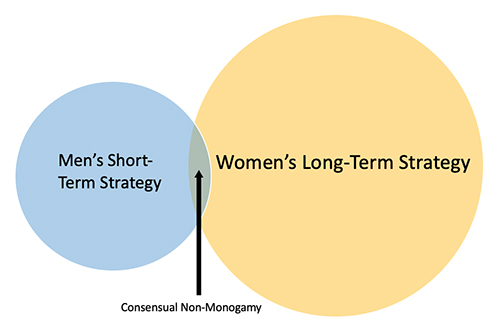
Dynamics in the Mating Economy: Domain #1 of Male-Female Difference

Dynamics in the Mating Economy: Domain #1 of Male-Female Difference

“There are a number of mechanical devices which increase sexual arousal, particularly in women. Chief among them is the Mercedes-Benz SL500.” ~ Lynn Lavner

Twenty-two Domains of Difference (See list in Appendix)

This is first in a series of posts that will explain the twenty-two domains of difference between men and women in their sexual psychology and response. (See introduction to the series: Male-Female Differences in Sexual Psychology and Response.) Differences are based on statistical aggregates of all men and women from authoritative research studies. These are tendencies that apply to the general population of male and female heterosexuals but do predict the unique sexuality of a particular man or woman. It may be instructive, however, to understand our foundational “wiring” – the evolutionary adaptations that remain active in modern human mating. Most of these domains of difference can affect the equilibrium of our relationships.

Behavioral Dynamics in the Mating Economy – Domain #1
This post will explore differences related to:

  1. General psychological sex differences in the mating economy (an overview)
  2. The influence of money, status, and resources in the mating economy
  3. The operation of the mating economy as a market place – the haves and have-nots
  4. The nature and influence of the “bargain” of exchange between men and women
  5. The psychological difference between the pursuer and the one pursued

General Sex Differences in the Psychology of the Mating Economy:

  • Women have the psychology of choice and an abundance of sexual attention during their reproductive years (this is mostly good, but sometimes bad); men mostly do not have choice or an abundance of mating opportunities. Beautiful women have immense choice in the mating economy and rich men have the greatest opportunity to be chosen.
  • Men (mostly) have the psychology of sexual scarcity and activation of the sympathetic nervous system as pursuer and competitor with other males.
  • Women have the psychology of caution and fear — sexual inhibition and “brakes” on sexual activity and experience of risk. Women fear being physically hurt, left to fend on their own with a child, or suffering reputational damage.
  • Women are prone to have regret or guilt about what they did in the sexual and mating realm.
  • Men are prone to have guilt and regret about what they did not do. (Lack of courage to initiate toward a woman.)
  • Men have fear of humiliation and being rejected. This fear is “existential” in its impact – it evokes the very essence of manhood and worth because it goes to the core of evolution: male sexuality and the passing on of the genetic code. Men’s fear of humiliation is mostly understood by women but the male psychology of existential threat is not acknowledged, understood, or given an empathic ear.
  • Men have anger that comes from this threat and the lack of sexual access; there are no easy answers to this in the mating economy. The psychology of the haves and have-nots is ubiquitous across many domains of social life in the West.
  • Some women experience their own existential angst related to the need to have a child; this too is encoded into sexual expression. The female sexual “instinct” interfaces with the maternal/care-taking instinct.
  • Women also have fear, anger, and grief about being over-looked or no longer being desired by the men that are acceptable to them as mates. This is a loss of “erotic power.”
  • Women often experience a significant trade-off problem in their mate selection decision-making between choosing a man of status (financially successful) and choosing a man with a loyal and generous character. Both trait profiles are required. Men do not have this particular trade-off dilemma in their mate selection psychology nor any other trade-off problem as significant as that in their long-term mating strategy. (This will be explored in a future post, Domain #3: Trait Preferences and Priorities in Mate Selection.)
  • Men are driven by a spontaneous, initiating sexual psychology (spontaneous desire) and women are characterized by a cautionary, “response desire.” (See Spontaneous and Response Desire – the Underbelly of Heterosexual Mating.) I will explore this in Domain #6: Spontaneous Desire vs. Response Desire.
  • Finally, the psychology of the mating economy is haunted by the undertow of the erotic-economic bargain: the exchange of beauty and fertility for resources and protection. The dynamic of this exchange is anchored in the fundamental objectives of human mating strategy and reproduction. In modern times, it is characterized by motivated reasoning used to deny its existence. This is the psychology of collusion, rationalization, and avoidance. The erotic-economic bargain has political implications.

Supply and Demand Forces in the Mating Marketplace
In the human mating economy, men mostly sell and women mostly buy; this is the predominant evolutionary dynamic. The buyer (female chooser) significantly controls the marketplace.

All behaviors of mate selection (intersexual selection by women and intra-sexual competition primarily by men) are driven by supply and demand forces for sexual access to the best (highest mate value) mates. Fertile (and consensually most “beautiful”) women are in great demand and the supply of men interested in them creates significant differences in behavioral dynamics – leading to a multitude of male initiation strategies, misreading of signals by women (male “over-perception bias”), and a reproductive variance curve in the human population: more women have sex and reproduce in the general population than do men, as shown by genetic studies (see below).

Most Men Want the Same Women

Simply said, roughly 80% of men compete for 20% or less of the same (highest mate value) women in the overall mating economy. Interested men are in great supply in this market (as driven by biological-hormonal imperatives), and receptive women are scarce. Supply and demand forces skew odds in favor of female choice and dramatically work against the odds of a man being chosen.

Pursuer vs. Pursued

The 180% difference between a buyer and a seller in the mating-sexual economy is dramatic in its psychological impact. It affects motivation, origination of desire, perceptions of risk and safety, and ultimately the experience of sexual scarcity or abundance.

The psychology (lived experience) of the sexual initiator and pursuer is vastly different than the psychology of the one pursued and the one who chooses among her pursuers. This general difference between men and women cannot be overstated.

Male intra-sexual competition (men competing against one another) has unique behavioral and psychological dynamics. The psychology of female intersexual selection (preferential mate choice) – the experience of being pursued, is a mixed bag. It can be exhilarating to be adored and desired, until it is not. Women’s intra-sexual competition (women competing against one another) for male attention is a different behavioral phenomenon than male-on-male competition. (I will explore intra-sexual competition in Domain #2: Long-term vs. Short-term Mating Strategies.)

Erotic-Economic Bargain – the Ultimate Exchange in the Mating Economy

The exchange of physical beauty and fertility (erotic power) for economic power (and/or protection) is the perennial bargain of human mating over eons of time. This bargain is rooted in the willingness and capacity for parental (economic) investment from the man and the reproductive (sexual) access allowed by the women in response to that investment.  It is the unconscious infrastructure of heterosexuality.  The ability of a man to protect and provide for children is the key ingredient and evolutionary force driving this mate preference by women; it is the trigger for her sexual availability. Her youth and fertility is her erotic power — a power that controls and influences male aspiration for social dominance, economic power, and competition with other men. Female erotic power fuels the fire of male sexuality. Sexual access to women is the penultimate motivation and prize. The strength of a man’s preference for physically attractive women and a woman’s preference for financially successful men works conjointly in relationship to their mate value. At the upper end of their respective mate value, there is an assortative pairing of the beautiful with the rich.

Renegotiating the Bargain?
In recent decades, the erotic-economic bargain may be undergoing a bit of renegotiation with surface or cosmetic changes that comport with our particular political moment. Female empowerment and independence from men is progressing and evolving in its influence. But most evidence “on the ground” of the modern dating scene (with some nuances related to older or senior Americans) does not show a movement away from our ancient, evolutionary adaptations; there has not been a significant change in the foundational priorities and preferences for a partner by men and women. Content analysis of dating websites reveal that women explicitly ask for “financially secure” or “professional” partners roughly twenty times more often that men do.

 Foundational Collusion
Although the exchange of sex for resources is a shared agreement, it is often implicit and “secretly” held – that is what is meant by “collusion.” Men and women have vastly different parts to play in holding the agreement in place. This foundational collusion of exchange influences all other pieces of the heterosexual “puzzle.” To be clear, even though the erotic-economic bargain is often not explicit or conscious, it fertilizes (sorry for the pun) the soil of human reproduction.  The erotic-economic bargain is largely “undiscussable.”

Mate Value is the “Currency”

Mate value (and assessed mate value trajectory of men) rules the marketplace. Men with resources, status, and larger physical attributes (especially height) have greater mate value than men who do not. Women’s mate value is primarily determined by physical characteristics of beauty, waist-to-hip ratio, and other signals of fertility. Mate value drives the initial mate selection process. Mate value includes elements of character and other preferred traits as courtship continues into the period of relationship maintenance. But human sexuality is primarily designed to choose and access sexual partners, not keep them over time.

“In or Out of Your League”

It is no accident that we commonly rate ourselves and others on a “1-10” point scale. While there is a tendency for both sexes to over-rate vs. under-rate themselves, we generally know if our desired partner is “in or out of our league.” If we are a “7”, we strive to bargain successfully for a “7-9.” Men, especially, who know they are seen as a “5” or below, lust hopelessly after unattainable women who are a “9” or “10.” This understandable tendency is biologically, not rationally inspired. There is painful despondency for both sexes related to the invisibility of low mate value. Narratives in comedy, television, literature, and film often use mate value mismatches as fodder for entertainment.

Assortative Mating is the Visible Part of the Iceberg

Assortative mating is the tendency to be attracted to someone who is similar in age, socio-economic status, educational attainment, geographic location, physical appearance, and facial attractiveness. Someone who is “in our league.” Linked to mate value, assortative mating is the dominant process in the mating market. Assortative mating is the part of the iceberg that is visible above the water; below the surface is the erotic-economic bargain that may influence how things sort out.

Definition of a Good Deal

Assortative mating demonstrates the power of “mate value” attributions about self and others. These value assessments fuel strategic mating behavior toward the people we desire, or at least determine who we actually end up with. People self-sort according to their mate value; traits and priorities are unconsciously or consciously ranked and considered as a whole. The mate value of most people is limited, so one cannot attract a committed partner who is at the maximum of every desired trait. Trade-offs are made. But the definition of a “good” deal in the mating game can be traced to how well the erotic-economic bargain is maximized in the favor of each person, considering their individual mate value and the availability of potential partners in the local mating pool.

Mate Value Sex Differences and Assortative Mating
Assortative mating is a neutral process with regard to sex differences over-all. Men and women seek similarities along many dimensions of background, and the market naturally brings them a partner with an equal mate value. The assortative mating process does match for equivalent mate value, but the mate value of a woman is powerfully defined by her physical beauty, and the mate value of a man is largely based on the size of his financial resources.

Trait Preferences and Perceptions of Attraction

Mate selection research has documented many shared preferences of men and women; they seek love, kindness, intelligence, and good health in their mates (as they uniquely define those traits). When entering a relationship, women place greater emphasis on the immediate access to resources in order to assess a potential mate’s willingness and ability to invest in her; if a man does show immediate investment in a relationship, the woman is typically more likely to have sex with him. (Spreecher, Sullivan, & Hatfield, 1994).

“The two sexes often engage in this exchange of reproductive currencies with men looking to exchange investment for sex and women preferring to exchange sex for investment.” (Kruger, 2008).

Emphasis on Attractiveness and Financial Prospects

Males and females rate the characteristics of physical attractiveness and financial prospects differently. The degree of emphasis that women place on the importance of a man’s financial prospects has been well documented (see references). The different valuation of these two traits is consistent throughout the world, with men placing a higher value on physical attractiveness and women placing a higher value on financial prospects. Men are generally indifferent to the financial prospects of women (Buss, 1989). But a woman’s preference for a mate with financial prospects also influences her perception of a man’s physical attractiveness.

Money and Beauty are Directly Correlated

Psychological researchers Richard Urdy and Bruce Eckland did a study of men and women to predict marital and socio-economic status fifteen years into the future. They used attractiveness ratings based on high school annual pictures. Results showed that a man’s level of resources was directly correlated with the level of physical attractiveness of his partner. Attractiveness allowed females to secure highly educated husbands with a high income. Money and beauty were correlated in a positive and linear relationship. 

The Car Makes the Man

Gregory Shuler & David McCord (Western Carolina University) used subject ratings from the website “Hot or Not” and found a linear and positive relationship between the value of a man’s car and the degree of attractiveness perceived by women. A man was depicted with three different cars: a decrepit Dodge Neon, a Ford Focus, and a Mercedes C Class C300. He was rated most “hot” when pictured with the Mercedes.

As reported in the British Journal of Psychology (April, 2009), researchers Michael Dunn and Robert Searle found that men positioned with a high-status, silver Bentley Continental GT were rated significantly more attractive than when the man was positioned with a red Ford Fiesta ST. When the conditions were reversed by sex, men did not rate women as more attractive in the high status vs. low-status condition; it had no influence. 

“Costly-signaling” by Men

Since women have a preference for men with resources, men have evolved strategies for the purpose of demonstrating this characteristic for women. Strategies include boasting about one’s resources, the derogation of a competitor’s status, ambition or resources, and displaying conspicuous consumption when in potential mating scenarios. Men tend to increase spending on luxury items (like a car) that indicates “costly-signaling” as a display of expendable income that could be potentially be allocated to a mate.

Diamonds Are A Girl’s Best Friend

Other studies have shown a positive and linear correlation between female physical beauty and the monetary values of engagement and wedding rings. The value and expenditures for courtship and nuptial gifts increase with the physical attractiveness of the female. In a study by researchers Jaime Cloud and Madalyn Taylor (“The Effect of Mate Value Discrepancy on Hypothetical Engagement Ring Purchases”), women desired greater resource investment to compensate for a lack of physical attractiveness in their male partners.

Reproductive Variance: the Haves and the Have-nots

“Reproductive variance” refers to the variability of reproductive success for human males and females. For men, the difference between men who did not reproduce (the have-nots) and the men who reproduced prolifically (the haves), is very wide. For women, there is much less variance; most women reproduce and the number of children they have is constrained by their biology.

DNA studies by Jason Wilder and colleagues revealed that approximately 80% of women in human history have reproduced compared to approximately 40% of men. The human population is descended from twice as many women as men. Author and influential social psychologist, Roy Baumeister, (Is There Anything Good About Men), says reproductive variance between men and women was probably even greater through much of human history, and especially human prehistory. “In many animal species, close to 90% of the females but only 20% of the male reproduced. In modern times, human monogamy has spread across the globe. But in past eras, polygamy (one husband, multiple wives) was the norm, the reproductive imbalance would have been more severe” than 80% to 40%.

Most Men are Losers in the Mating Game

Put another way, a woman’s odds of having a line of descendants down to the present is double those of a man. Most women who ever lived to adulthood probably had at least one baby and in fact have a descendant alive today. Most men did not. Baumeister again: “Most men who ever lived, like all the wild horses that did not ascend to the alpha males’ top spot, left behind no genetic traces of themselves. Of all the humans ever born, most women became mothers, but most men did not become fathers.” Baumeister considers this “the single most underappreciated fact about the difference between men and women.”

The Super-Haves – Men at the Top of the “Economic”- Status Hierarchy

One of the greatest conquers in world history (13th century), Genghis Khan, is reported to have sired hundreds and possibly over a thousand children. In 2003, an international team of geneticists published a DNA analysis of central Asians. Researchers found that one in twelve men in Central Asia had the same Y chromosome. Genghis Khan had roughly 16 million descendants in 2003. 

Other Males Who Got More than Their Share

Other male all-stars in the genetic/Y chromosome reproductive hall of fame are: Middle Age king, King Nail. One in 12 in Ireland are genetically linked to King Nail, possibly 2-3 million worldwide. Manchu ruler (17th century), Nurhaci, or perhaps his grandfather Giocangga, has 1.6 million descendants alive today. Moulay Ismail ibn Sharif, a warrior King who ruled Morocco from 1672-1727, had 500 concubines and 888 children. King Solomon had 700 wives and 300 concubines. Idi Amin, Ugandan despot in the 1970s had 4 wives and 30 children. Large harems were the order of the day for the Egyptian Pharaohs, the Aztec kings, the Turkish sultans, the African kings, and the Chinese emperors. (Laura Betzig, Despotism and Differential Reproduction).

Incas Allocated Women According to Status

Inca law allowed male aristocrats 50 women apiece; the leaders of vassal nations (Inca feudal territories) were allotted 30, the heads of 100,000 men were given 20 women, and so on down to leaders of ten men, who were allotted 3. The men at the bottom often went unmarried (Sex and War, Malcom Potts and Thomas Hayden, p. 18-19). 

Erotic and Economic Power – the Age of Celebrity

At the high end of male and female mate value, rich men and beautiful women find each other. The erotic-economic bargain is commonly demonstrated by the preference and ability of older men to partner with significantly younger women – women usually in their fertile years at the time of the union. Take a look at the list below (Appendix) of high status, celebrity, rich men, and their wives. You will see up to 60+ years of age difference. Money can allow men to “mate down” decades to find beautiful women who will choose to partner with them.

Of course, many of these celebrities have attractive intellectual, physical, and emotional qualities (i.e. their talent), but what they have most importantly is high status and great wealth.

 Undeniably we see evidence of:

  • the power of fame and money to attract younger women – with relative doses of charm, talent, and physical attractiveness.
  • how resources, prestige, and status drive the mating system and female choice.
  • how men, given options literally “afforded” them, will naturally pursue the most beautiful women.
  • how the resistance against age difference, proclamations of “he is too old,” are relative to the degree of fame and money the man possesses.

All the men included here are rich and famous. All the women are beautiful. The erotic-economic bargain in stark terms.


Appendix

 
Age Differences of Male Celebrities and their Partners – The “Haves” of Erotic-Economic Exchange
Jay Marshall and Anne Nicole Smith 62 years
Hugh Hefner and Crystal Harris 60 years
Dick Van Dyke and Arlene Silver 46 years
Mick Jagger and Melanie Hamrick 43 years
Robert Duval and Luciana Pedraza 41 years
Patrick Stewart and Sunny Ozell  38 years
Rupert Murdoch and Wendy Deng 38 years
Charlie Chaplin and Oona O’Neill 36 years
Clint Eastwood and Dina Ruiz  35 years
Woody Allen and Soon-Yi Previn 35 years
David Foster and Katharine McPhee 34 years
Doug Hutchinson and Courtney Stodden 34 years
Lee Majors and Faith Noelle Cross 34 years
Gary Grant and Dyan Cannon 33 years
Dennis Quaid and Santa Auzina 33 years
Aristotle Onassis and Jackie Kennedy 33 years
Billy Joel and Alexis Roderick  33 years
Bing Crosby and Kathryn Grant  33 years
David Lynch and Emily Stofle 32 years
Billy Joel and Katie Lee  32 years
John Cleese and Jennifer Wade  31 years
Ronnie Wood and Sally Humphreys 31 years
Jeff Goldblum and Emilie Livingston 30 years
Frank Sinatra and Mia Farrow 30 years
William Shatner and Elizabeth Anderson 30 years
Alan Thicke and Tanya Callau  28 years
Rod Stewart and Penny Lancaster 27 years
Eric Clapton and Melia McEnery  27 years
Nelson Mandela and Graca Machel 27 years
Larry King and Shawn Southwick  26 years
Alec Baldwin and Hilaria Thomas 26 years
Bill Murray and Jenny Lewis 26 years
Steve Martin and Anne Stringfield 26 years
Rupert Murdoch and Jerry Hall  26 years
Dane Cook and Kelsi Taylor  26 years
Humphrey Bogart and Lauren Bacall 25 years
Michael Douglas and Catherine Zeta-Jones 25 years
Rod Stewart and Rachel Hunter 25 years
Kelsey Grammer and Kayte Walsh 25 years
Bruce Willis and Emma Heming 24 years
Rene Angelil and Celine Dion 24 years
Donald Trump and Melania  24 years
Christopher Knight and Adrianne Curry 23 years
Johnny Depp and Amber Heard 22 years
Harrison Ford and Calista Flockhart 22 years
Sylvester Stallone and Jennifer Flavin 22 years
Kevin Costner and Christine Baumgartner  22 years
Carlo Ponti and Sophia Loren 22 years
Glen Campbell and Kim Campbell 21 years
Floyd Mayweather and Raemarni Ball 20 years
Prince Albert of Monaco and Princess Charlene 20 years
Warren Beatty and Annette Bening 19 years
Jason Statham and Rosie Huntington-W. 19 years
Anthony Hopkins and Stella Arroyave  19 years
Eddie Murphy and Paige Butcher  19 years
Jason Statham and Rosie Hunington-W. 19 years
Dominic Purcell and AnnaLynne McCord  18 years
Christian Slater and Brittany Lopez 18 years
Howard Stern and Beth Ostrosky  18 years
Paul McCartney and Nancy Shevell 18 years
Jerry Seinfeld and Jessica Sklar 17 years
Oliver Sarkozy and Mary-Kate Olsen 17 years
George Clooney and Amal Alamuddin  17 years
Bradley Cooper and Suki Waterhouse 17 years
Tom Cruise and Katie Holmes 16 years
Kevin Kline and Phoebe Cates 16 years
References

Buss. D. M. & Schmitt, D.P. (1993) “Sexual strategies theory: An evolutionary perspective on human mating.”  Psychological Review, 100, 204-232.

Buss, Shackleford, Kirkpatrick & Larsen, (2001). “A half century of mate preferences: the cultural evolution of values.”  Journal of Marriage and Family, 63 (2), 491-503.

Dunn, M. &  Searle, R., (2009). “Effect of manipulated prestige-car ownership on both sex attractiveness ratings.”  British Journal of Psychology, 101, (Pt 1) 69-80.

Gangestad, S.W. & Simpson, J.A. (2000). “The evolution of human mating: Tradeoffs and strategic pluralism.”  Behavioral and Brain Sciences, 23, 573-587.

Kruger, D. J. (2008). “Young adults attempt exchanges in reproductively relevant currencies.” Evolutionary Psychology, 6(1), 204-212.

McAndrew, F., “Costly Signaling Theory,” Encyclopedia of Evolutionary Science, 2019.

Shuler, G., & McCord, D. (2010). “Determinants of Male Attractiveness: “Hotness” Ratings as a Function of Perceived Resources,” American Journal of Psychological Research, Vol. 6, No. 1.

Spreecher, S., Sullivan, Q., & Hatfield, E. (1994).  Mate selection preferences: Gender differences examined in national sample.   Journal of Personality and Social Psychology, 66(6), 1074-1080.

Udry, J.R. & Eckland, B.K. (1984).  “The benefits of being attractive: Differential payoffs for men and women.” Psychological Reports, 54, 47-56.

Wilder, J.A. et al, (2004). “Genetic evidence for unequal effective population sizes of human females and males.”  Molecular Biology and Evolution, 21, 2047-2057.

 
Domains of Male-Female Differences in Sexual Psychology

1. Behavioral dynamics in the mating economy

2. Long-term vs. short-term mating strategies

3. Trait preferences and priorities for mate selection

4. Physical attraction and perceptions of beauty

5. Concordance between physiological response and psychological desire

6. Spontaneous desire vs. response desire

7. Sex and love-making that fuels desire

8. Accelerator vs. brake: sexual excitation and inhibition systems

9. Brain structures: sexual pursuit and visual stimuli

10. Hormonal differences

11. Variety and novelty

12. Sexual mentation and “sex drive”

13. Influence of context

14. Female competing intentions and imposed double bind 

15. Sexual orientation (and preference) fluidity and response variability

16. Orgasm – purpose and characteristics

17. Meta emotions

18. Romance and desire, together and apart

19. Psychology of monogamy

20. Infidelity – reasons and response

21. Jealousy – triggers, tactics, and consequences

22. Sexual fantasies


*Assumptions of Mating Straight Talk
  • Men and Women have similarities as human beings, and aggregate differences from each other, that are primarily a function of biology and evolutionary adaptation. Our similarities do not often cause conflict. But our differences, and the denial of those differences, often cause “trouble”.
  • Men and Women have differences that we must acknowledge and understand in order to have satisfying heterosexual (romantic and sexual) relationships.
  • Men and Women have differences that we must acknowledge and understand in order to bring clarity to the “politics” of sex and gender.
  • Men and Women need “straight talk” (radical honesty) in order to uncover and accept our differences.
  • Men and Women need straight talk about our differences in order to empower one another for co-creative relationships.

Please Note: Your comment may take up to 12 seconds to register and the confirmation message will appear above the “Submit a Comment” text. 
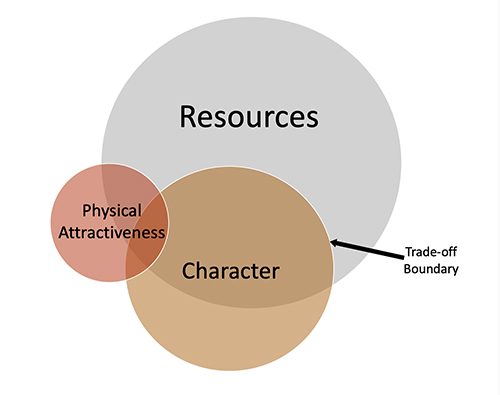
Male-Female Differences in Sexual Psychology and Response

Male-Female Differences in Sexual Psychology and Response

Over the millennia, men and women have evolved with different objectives and strategies of sexual psychology and response – strategies related to choosing a mate, reproduction, and parental investment. For the next several months, this blog space will address twenty-two “domains” of difference in sexual psychology and response between cisgender men and women with an emphasis on a heterosexual orientation.* (See “Assumptions” below.)

Here is a narrative summary of these differences followed by a list of the twenty-two domains. There is overlap and synergy between the domains but the underlying distinctions are clarifying. These differences are based on statistical aggregates of all men and women from authoritative research studies and cannot predict the unique sexuality of a particular man or woman.

General Differences between Men and Women in Sexual Psychology and Response
  • Women have their own unique sexuality, like a fingerprint, and vary more than men in anatomy, sexual response, sexual mechanisms, and the way their bodies respond to the sexual world. Women vary more widely from each other and change more substantially over their lifetime than do men.
  • Women are less likely to have alignment (“concordance”) between their genital response and their subjective arousal; this causes confusion and misunderstanding for women and their male partners. Men have dramatically more concordance between their genital response and subjective arousal.
  • All sex happens in context. Women are more context-sensitive than men and all external circumstances of everyday life influence the context surrounding a woman’s arousal, desire, and orgasm.
  • Women’s sexual functioning is more influenced by their internal brain state — how they think and feel about sex. Judgment, shame, stress, mood, trust, body image, and past trauma are more influential on a woman’s sexual well-being.
  • Men and women have significantly different hormones and some variations in brain structure. Differences caused by the amount of testosterone cannot be overstated.
  • Men and women differ in visual orientation for physical attraction and the traits preferred in a mate.
  • Human sexual response consists of a “dual control” system with an excitation mechanism (“accelerator”) and an inhibition mechanism (“brake”). Men are accelerator-dominant and women are brake-dominant.
  • Related to differences between the sexual “accelerator” and “brake,” men operate primarily from “spontaneous desire” triggers and women operate primarily from “response desire” triggers.
  • Men sell (mostly) and women buy (mostly) in the mating economy; this is the predominant evolutionary dynamic. The psychology of the sexual initiator and pursuer is vastly different than the psychology of the one pursued and the one who chooses among her pursuers.
  • The psychology of male intra-sexual competition is quite different than the psychology of female intersexual selection (preferential mate choice.) Also, women’s intra-sexual competition (women competing against each other) for male attention is a different behavioral phenomenon than male-on-male competition.
Domains of Male-Female Differences in Sexual Psychology

1. Behavioral dynamics in the mating economy
2. Long-term vs. short-term mating strategies
3. Trait preferences and priorities for mate selection
4. Physical attraction and perceptions of beauty
5. Concordance between physiological response and psychological desire
6. Spontaneous desire vs. response desire
7. Sex and love-making that fuels desire
8. Accelerator vs. brake: sexual excitation and inhibition systems
9. Brain structures: sexual pursuit and visual stimuli
10. Hormonal differences
11. Variety and novelty
12. Sexual mentation and “sex drive”
13. Influence of context
14. Female competing intentions and imposed double binds
15. Sexual orientation (and preference) fluidity and response variability
16. Orgasm – purpose, and characteristics
17. Meta emotions
18. Romance and desire, together and apart
19. Psychology of monogamy
20. Infidelity – reasons and response
21. Jealousy – triggers, tactics, and consequences
22. Sexual fantasies

Each domain will be examined as a distinct phenomenon of difference although some will be addressed as correlated or parallel in physiological or psychological response. This blog series will not necessarily run continuously – as other topics (some in a series, some not) will also be posted.

Thanks for reading what is coming to Mating Straight Talk. Comments are encouraged!

*Assumptions of Mating Straight Talk
  • Men and Women have similarities as human beings, and aggregate differences from each other, that are primarily a function of biology and evolutionary adaptation. Our similarities do not often cause conflict. But our differences, and the denial of those differences, often cause “trouble”.
  • Men and Women have differences that we must acknowledge and understand in order to have satisfying heterosexual (romantic and sexual) relationships.
  • Men and Women have differences that we must acknowledge and understand in order to bring clarity to the “politics” of sex and gender.
  • Men and Women need “straight talk” (radical honesty) in order to uncover and accept our differences.
  • Men and Women need straight talk about our differences in order to empower one another for co-creative relationships.

Please Note: Your comment may take up to 12 seconds to register and the confirmation message will appear above the “Submit a Comment” text.